This is the multi-page printable view of this section. Click here to print.
About
- 1: Features
- 2: Roadmap
- 3: History
- 4: News & Events
- 5: Join the Community
- 6: Privacy Policy
- 7: License
- 8: Sponsor Us
- 9: User Cases
- 10: Subscription
- 11: FAQ
- 12: Release Note
- 13: Comparison
- 13.1: Cost Reference
1 - Features
“PostgreSQL In Great STYle”: Postgres, Infras, Graphics, Service, Toolbox, it’s all Yours.
—— Battery-included, local-first PostgreSQL distribution, open-source RDS alternative
Value Propositions
- Extensibility: Powerful extensions out-of-the-box: deep integration of PostGIS, TimescaleDB, Citus, PGVector and 440+ plugins with Oracle / SQL Server compatible kernels.
- Reliability: Quickly create high-availability, self-healing PostgreSQL clusters with auto-configured point-in-time recovery, access control, self-signed CA and SSL, ensuring rock-solid data.
- Observability: Based on Prometheus & Grafana modern observability stack, providing stunning monitoring best practices. Modular design, can be used independently: Gallery & Demo.
- Availability: Deliver stable, reliable, auto-routed, transaction-pooled, read-write separated high-performance database services, with flexible access modes via HAProxy, Pgbouncer, and VIP.
- Maintainability: Easy to use, Infrastructure as Code, Management SOPs, auto-tuning, local software repository, Vagrant sandbox and Terraform templates, zero-downtime migration solutions.
- Composability: Modular architecture design, reusable Infra, various optional modules: Redis, MinIO, ETCD, FerretDB, DuckDB, Docker, Supabase.

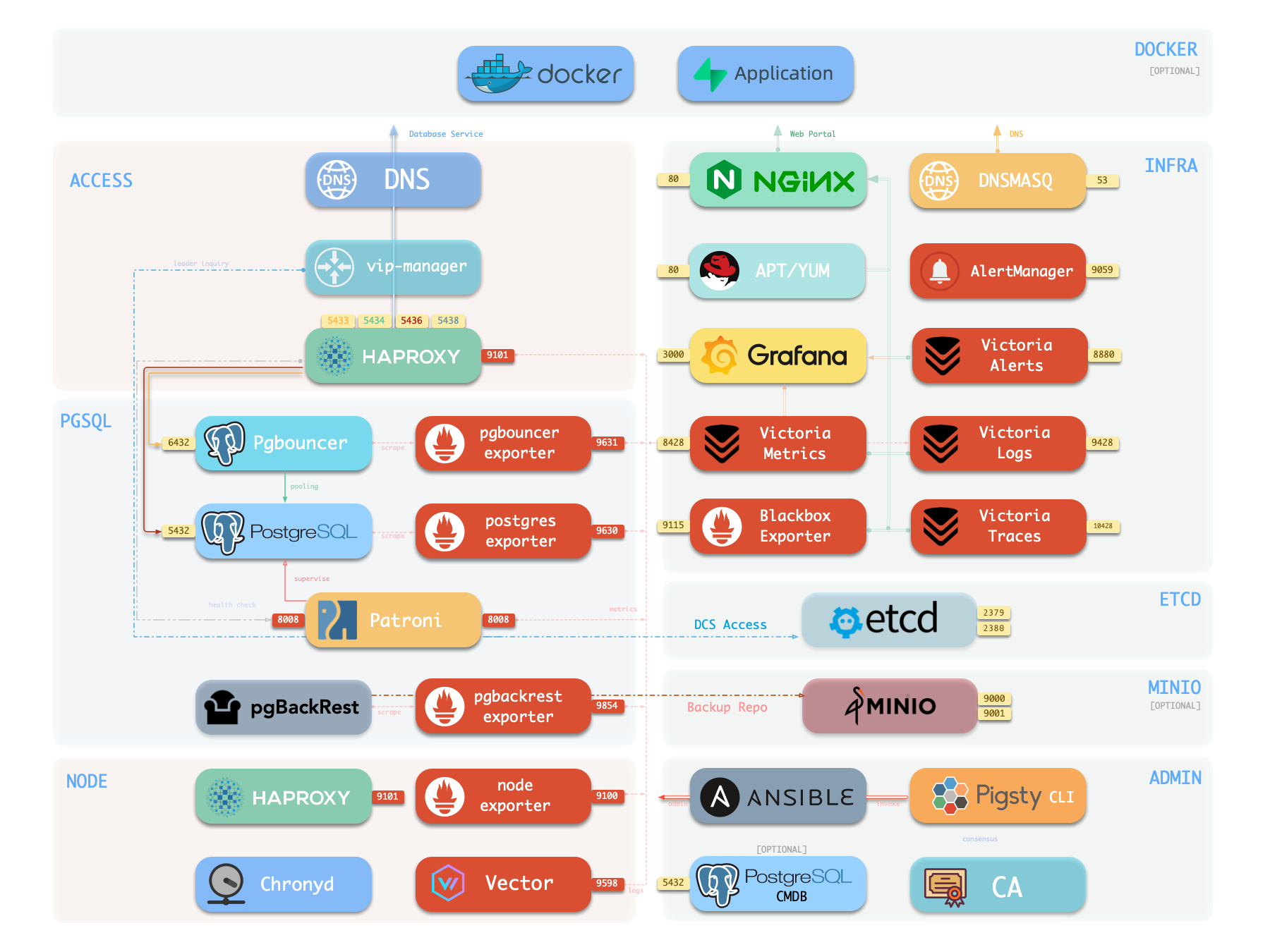
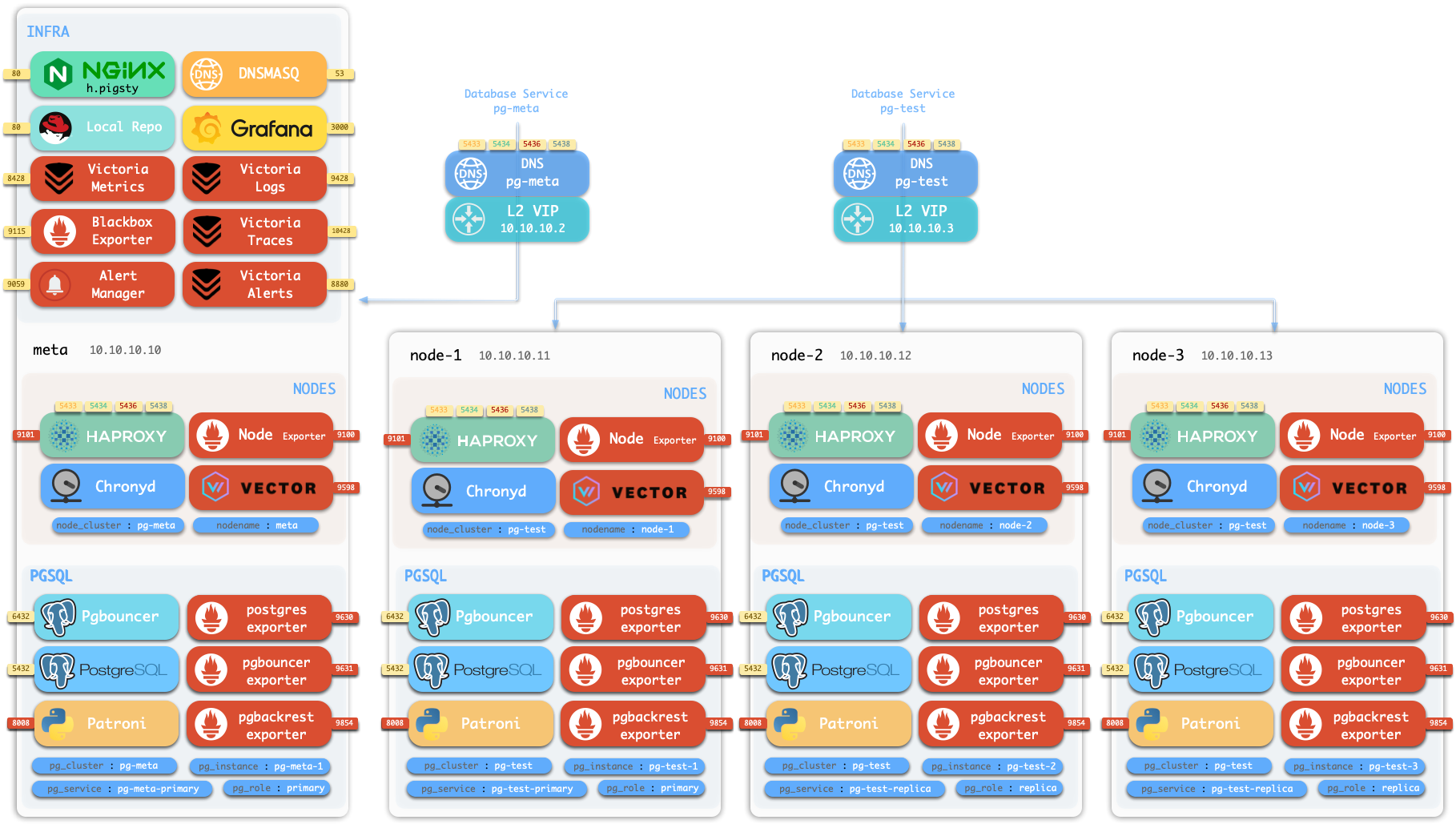
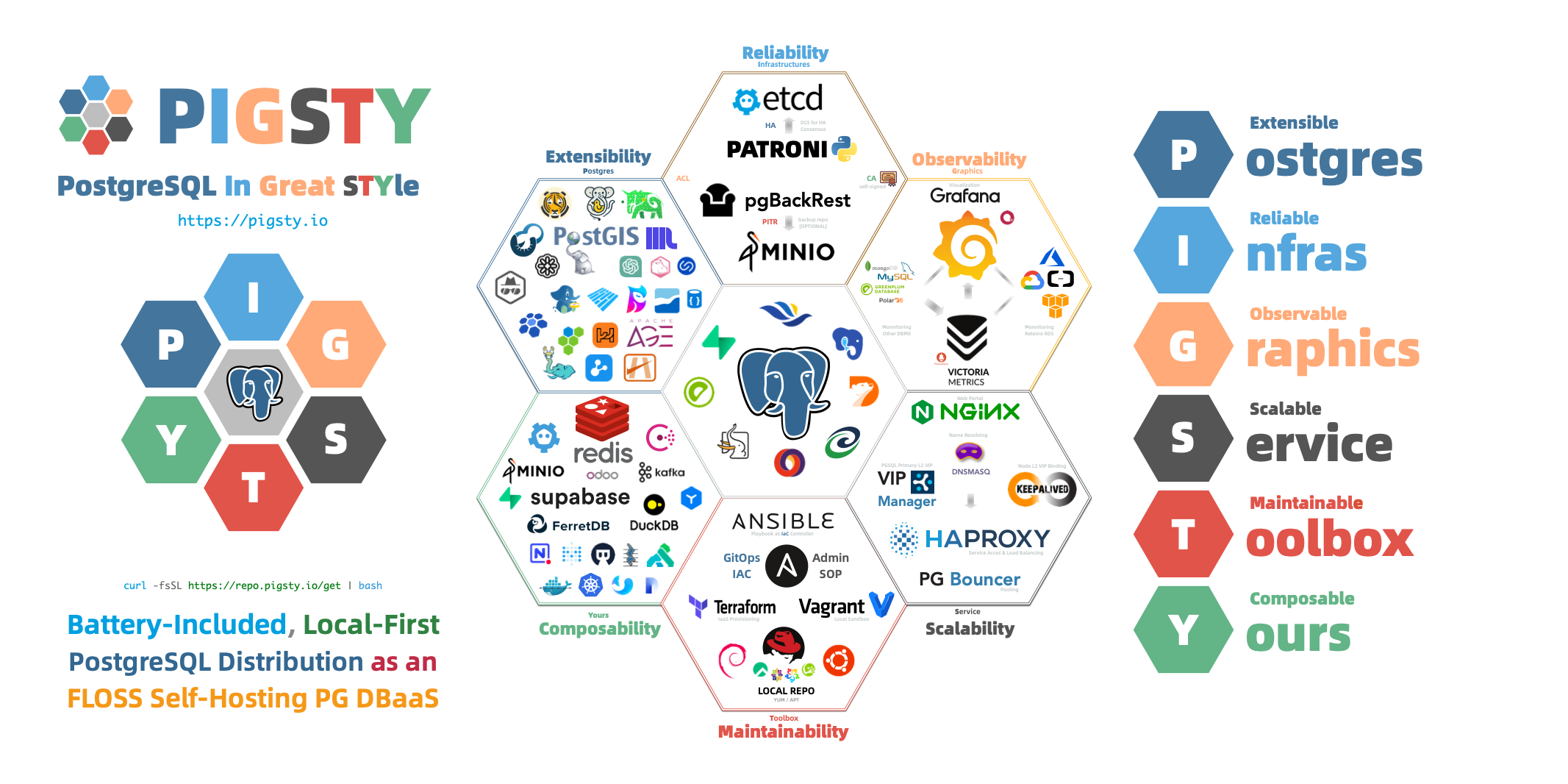
Overview
Pigsty is a better local open-source RDS for PostgreSQL alternative:
- Battery-Included RDS: From kernel to RDS distribution, providing production-grade PG database services for versions 13-18 on EL/Debian/Ubuntu.
- Rich Extensions: Providing unparalleled 440+ extensions with out-of-the-box distributed, time-series, geospatial, graph, vector, multi-modal database capabilities.
- Flexible Modular Architecture: Flexible composition, free extension: Redis/Etcd/MinIO/Mongo; can be used independently to monitor existing RDS/hosts/databases.
- Stunning Observability: Based on modern observability stack Prometheus/Grafana, providing stunning, unparalleled database observability capabilities.
- Battle-Tested Reliability: Self-healing high-availability architecture: automatic failover on hardware failure, seamless traffic switching. With auto-configured PITR as safety net for accidental data deletion!
- Easy to Use and Maintain: Declarative API, GitOps ready, foolproof operation, Database/Infra-as-Code and management SOPs encapsulating management complexity!
- Solid Security Practices: Encryption and backup all included, with built-in basic ACL best practices. As long as hardware and keys are secure, you don’t need to worry about database security!
- Broad Application Scenarios: Low-code data application development, or use preset Docker Compose templates to spin up massive software using PostgreSQL with one click!
- Open-Source Free Software: Own better database services at less than 1/10 the cost of cloud databases! Truly “own” your data and achieve autonomy!
PostgreSQL integrates ecosystem tools and best practices:
- Out-of-the-box PostgreSQL distribution, deeply integrating 440+ extension plugins for geospatial, time-series, distributed, graph, vector, search, and AI!
- Runs on bare operating systems without container support, supporting mainstream operating systems: EL 8/9/10, Ubuntu 22.04/24.04, and Debian 12/13.
- Based on patroni, haproxy, and etcd, creating a self-healing high-availability architecture: automatic failover on hardware failure, seamless traffic switching.
- Based on pgBackRest and optional MinIO clusters providing out-of-the-box PITR point-in-time recovery, serving as a safety net for software defects and accidental data deletion.
- Based on Ansible providing declarative APIs to abstract complexity, greatly simplifying daily operations management in a Database-as-Code manner.
- Pigsty has broad applications, can be used as complete application runtime, develop demo data/visualization applications, and massive software using PG can be spun up with Docker templates.
- Provides Vagrant-based local development and testing sandbox environment, and Terraform-based cloud auto-deployment solutions, keeping development, testing, and production environments consistent.
- Deploy and monitor dedicated Redis (primary-replica, sentinel, cluster), MinIO, Etcd, Haproxy, MongoDB (FerretDB) clusters
Battery-Included RDS
Get production-grade PostgreSQL database services locally immediately!
PostgreSQL is a near-perfect database kernel, but it needs more tools and systems to become a good enough database service (RDS). Pigsty helps PostgreSQL make this leap. Pigsty solves various challenges you’ll encounter when using PostgreSQL: kernel extension installation, connection pooling, load balancing, service access, high availability / automatic failover, log collection, metrics monitoring, alerting, backup recovery, PITR, access control, parameter tuning, security encryption, certificate issuance, NTP, DNS, parameter tuning, configuration management, CMDB, management playbooks… You no longer need to worry about these details!
Pigsty supports PostgreSQL 13 ~ 18 mainline kernels and other compatible forks, running on EL / Debian / Ubuntu and compatible OS distributions, available on x86_64 and ARM64 chip architectures, without container support required. Besides database kernels and many out-of-the-box extension plugins, Pigsty also provides complete infrastructure and runtime required for database services, as well as local sandbox / production environment / cloud IaaS auto-deployment solutions.
Pigsty can bootstrap an entire environment from bare metal with one click, reaching the last mile of software delivery. Ordinary developers and operations engineers can quickly get started and manage databases part-time, building enterprise-grade RDS services without database experts!

Rich Extensions
Hyper-converged multi-modal, use PostgreSQL for everything, one PG to replace all databases!
PostgreSQL’s soul lies in its rich extension ecosystem, and Pigsty uniquely deeply integrates 440+ extensions from the PostgreSQL ecosystem, providing you with an out-of-the-box hyper-converged multi-modal database!
Extensions can create synergistic effects, producing 1+1 far greater than 2 results. You can use PostGIS for geospatial data, TimescaleDB for time-series/event stream data analysis, and Citus to upgrade it in-place to a distributed geospatial-temporal database; You can use PGVector to store and search AI embeddings, ParadeDB for ElasticSearch-level full-text search, and simultaneously use precise SQL, full-text search, and fuzzy vector for hybrid search. You can also achieve dedicated OLAP database/data lakehouse analytical performance through Hydra, duckdb_fdw, pg_analytics, pg_duckdb and other analytical extensions.
Using PostgreSQL as a single component to replace MySQL, Kafka, ElasticSearch, MongoDB, and big data analytics stacks has become a best practice — a single database choice can significantly reduce system complexity, greatly improve development efficiency and agility, achieving remarkable software/hardware and development/operations cost reduction and efficiency improvement.
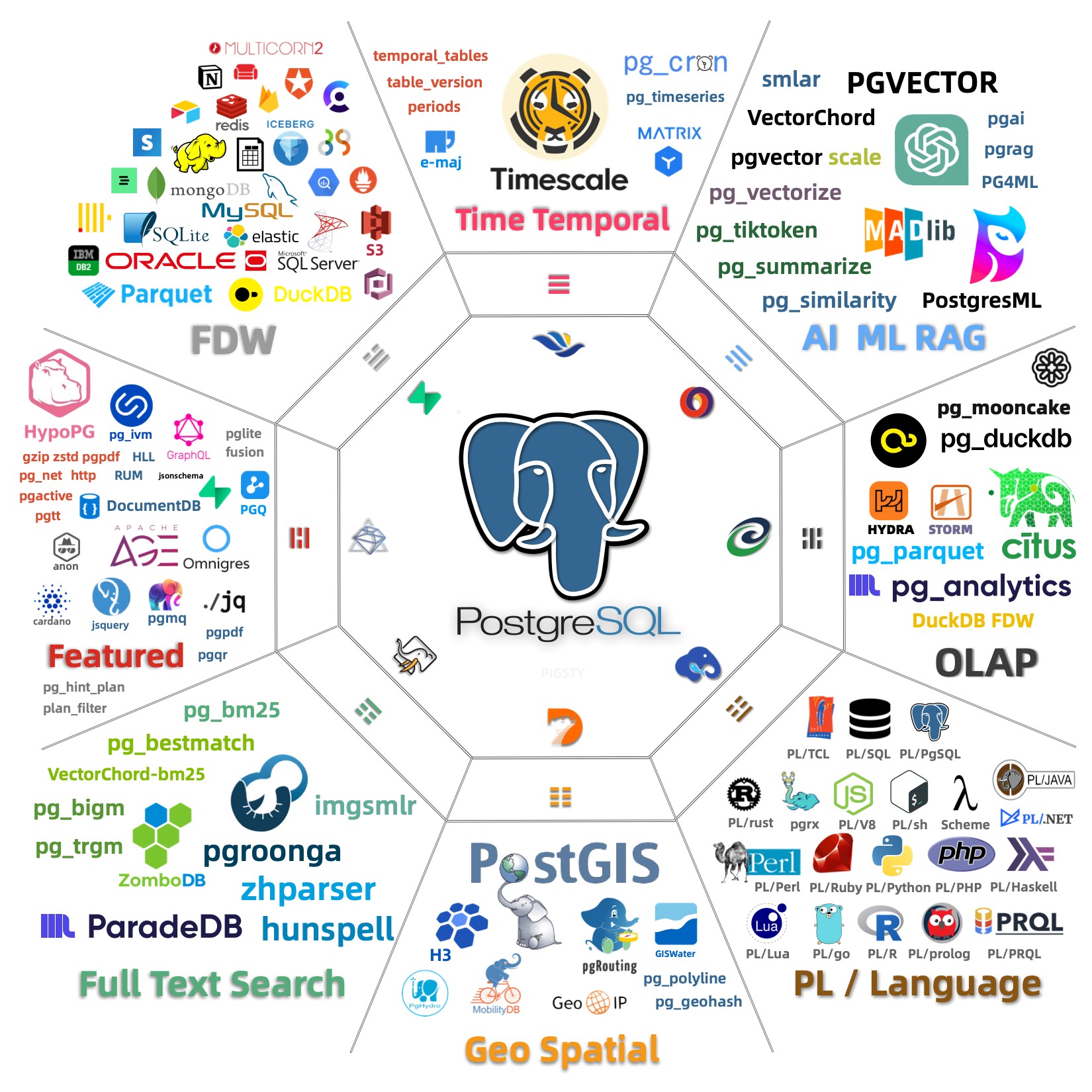
Flexible Modular Architecture
Flexible composition, free extension, multi-database support, monitor existing RDS/hosts/databases
Components in Pigsty are abstracted as independently deployable modules, which can be freely combined to address varying requirements. The INFRA module comes with a complete modern monitoring stack, while the NODE module tunes nodes to desired state and brings them under management.
Installing the PGSQL module on multiple nodes automatically forms a high-availability database cluster based on primary-replica replication, while the ETCD module provides consensus and metadata storage for database high availability.
Beyond these four core modules, Pigsty also provides a series of optional feature modules: The MINIO module can provide local object storage capability and serve as a centralized database backup repository.
The REDIS module can provide auxiliary services for databases in standalone primary-replica, sentinel, or native cluster modes. The DOCKER module can be used to spin up stateless application software.
Additionally, Pigsty provides PG-compatible / derivative kernel support. You can use Babelfish for MS SQL Server compatibility, IvorySQL for Oracle compatibility,
OpenHaloDB for MySQL compatibility, and OrioleDB for ultimate OLTP performance.
Furthermore, you can use FerretDB for MongoDB compatibility, Supabase for Firebase compatibility, and PolarDB to meet domestic compliance requirements.
More professional/pilot modules will be continuously introduced to Pigsty, such as GPSQL, KAFKA, DUCKDB, VICTORIA, TIGERBEETLE, KUBERNETES, CONSUL, JUPYTER, GREENPLUM, CLOUDBERRY, MYSQL, …

Stunning Observability
Using modern open-source observability stack, providing unparalleled monitoring best practices!
Pigsty provides best practices for monitoring based on the open-source Grafana / Prometheus modern observability stack: Grafana for visualization, VictoriaMetrics for metrics collection, VictoriaLogs for log collection and querying, Alertmanager for alert notifications. Blackbox Exporter for checking service availability. The entire system is also designed for one-click deployment as the out-of-the-box INFRA module.
Any component managed by Pigsty is automatically brought under monitoring, including host nodes, load balancer HAProxy, database Postgres, connection pool Pgbouncer, metadata store ETCD, KV cache Redis, object storage MinIO, …, and the entire monitoring infrastructure itself. Numerous Grafana monitoring dashboards and preset alert rules will qualitatively improve your system observability capabilities. Of course, this system can also be reused for your application monitoring infrastructure, or for monitoring existing database instances or RDS.
Whether for failure analysis or slow query optimization, capacity assessment or resource planning, Pigsty provides comprehensive data support, truly achieving data-driven operations. In Pigsty, over three thousand types of monitoring metrics are used to describe all aspects of the entire system, and are further processed, aggregated, analyzed, refined, and presented in intuitive visualization modes. From global overview dashboards to CRUD details of individual objects (tables, indexes, functions) in a database instance, everything is visible at a glance. You can drill down, roll up, or jump horizontally freely, browsing current system status and historical trends, and predicting future evolution.
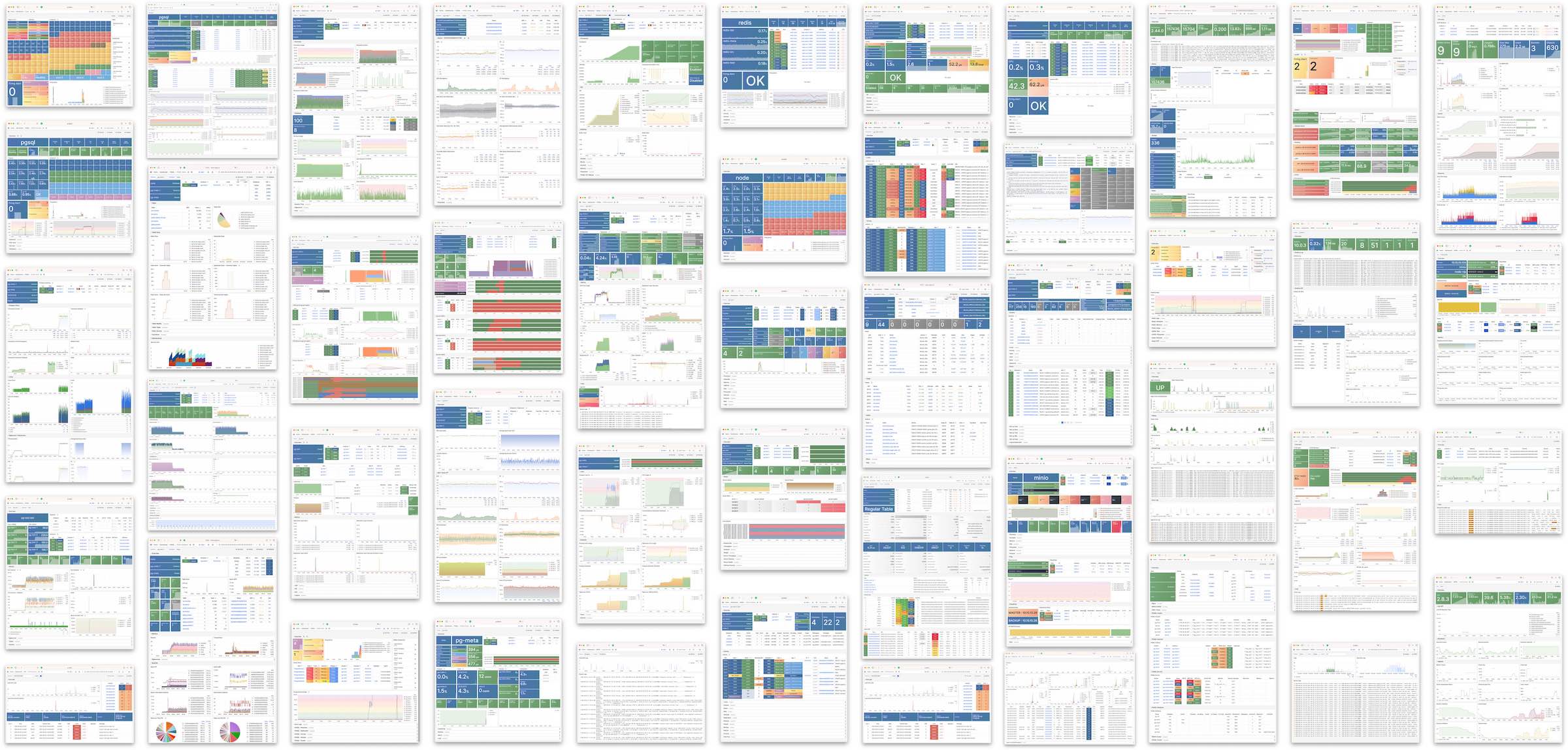
Additionally, Pigsty’s monitoring system module can be used independently — to monitor existing host nodes and database instances, or cloud RDS services. With just one connection string and one command, you can get the ultimate PostgreSQL observability experience.
Visit the Screenshot Gallery and Online Demo for more details.
Battle-Tested Reliability
Out-of-the-box high availability and point-in-time recovery capabilities ensure your database is rock-solid!
For table/database drops caused by software defects or human error, Pigsty provides out-of-the-box PITR point-in-time recovery capability, enabled by default without additional configuration. As long as storage space allows, base backups and WAL archiving based on pgBackRest give you the ability to quickly return to any point in the past. You can use local directories/disks, or dedicated MinIO clusters or S3 object storage services to retain longer recovery windows, according to your budget.
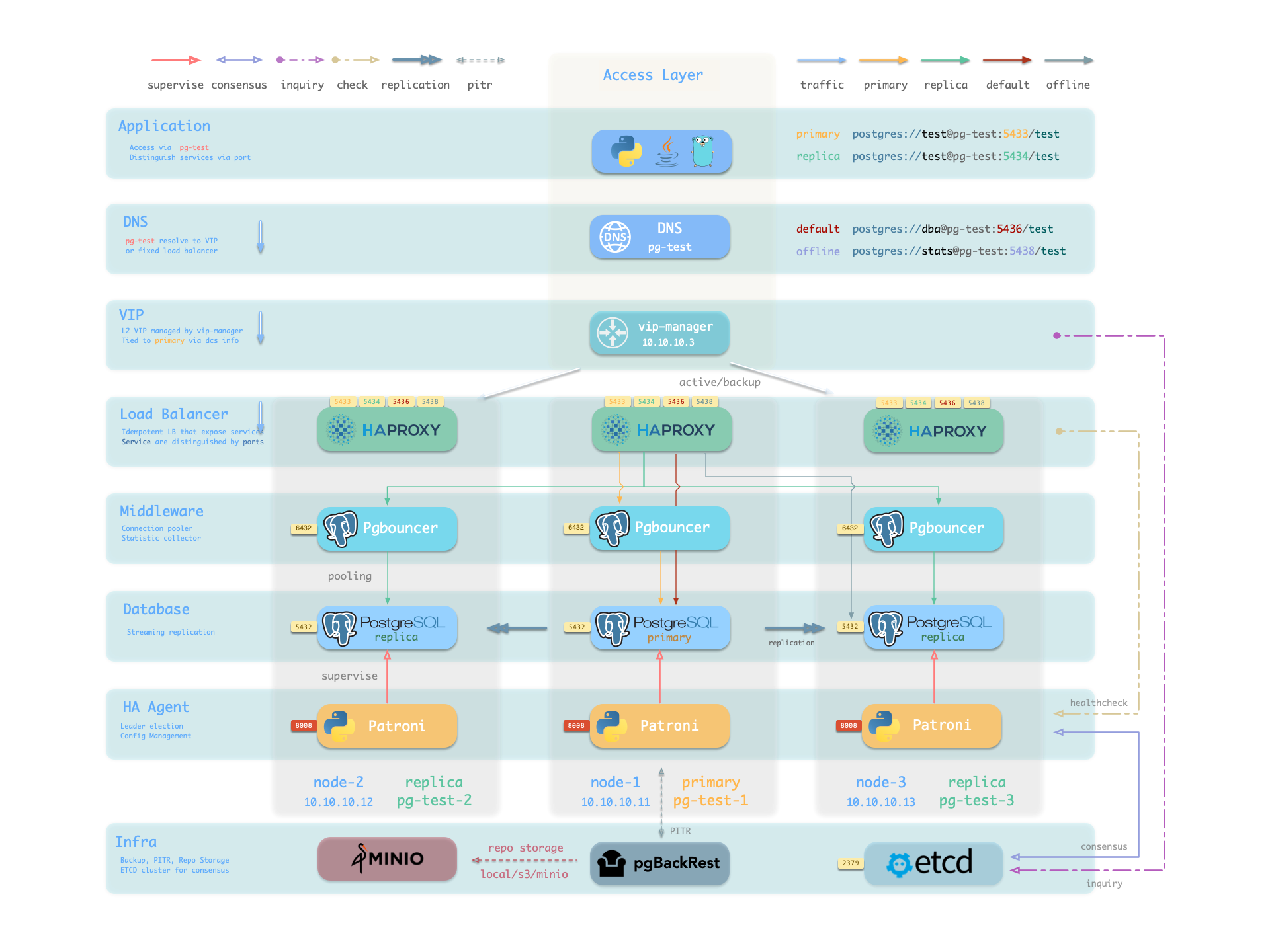
More importantly, Pigsty makes high availability and self-healing the standard for PostgreSQL clusters. The high-availability self-healing architecture based on patroni, etcd, and haproxy lets you handle hardware failures with ease: RTO < 30s for primary failure automatic failover (configurable), with zero data loss RPO = 0 in consistency-first mode. As long as any instance in the cluster survives, the cluster can provide complete service, and clients only need to connect to any node in the cluster to get full service.
Pigsty includes built-in HAProxy load balancers for automatic traffic switching, providing DNS/VIP/LVS and other access methods for clients. Failover and active switchover are almost imperceptible to the business side except for brief interruptions, and applications don’t need to modify connection strings or restart. The minimal maintenance window requirements bring great flexibility and convenience: you can perform rolling maintenance and upgrades on the entire cluster without application coordination. The feature that hardware failures can wait until the next day to handle lets developers, operations, and DBAs sleep well. Many large organizations and core institutions have been using Pigsty in production for extended periods. The largest deployment has 25K CPU cores and 200+ PostgreSQL ultra-large instances; in this deployment case, dozens of hardware failures and various incidents occurred over six to seven years, DBAs changed several times, but still maintained availability higher than 99.999%.
Easy to Use and Maintain
Infra as Code, Database as Code, declarative APIs encapsulate database management complexity.
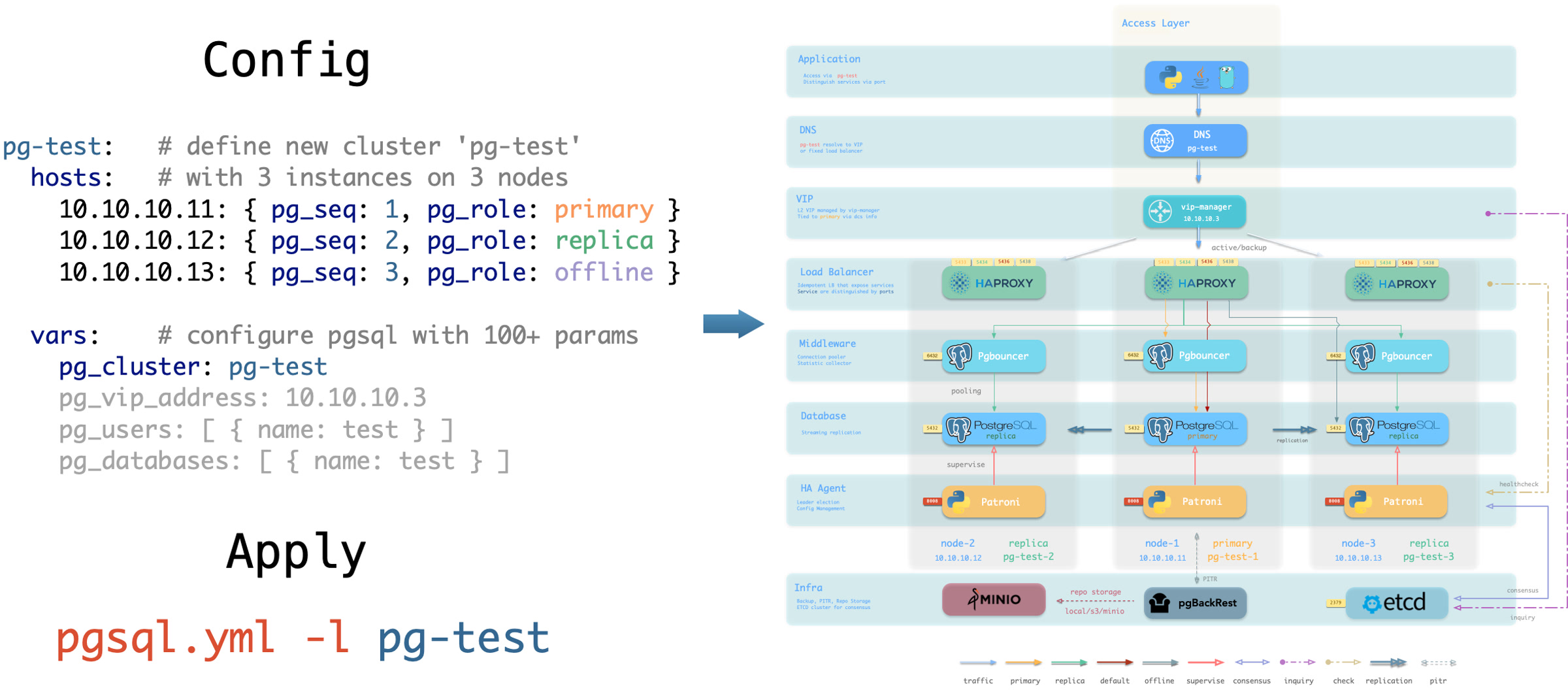
Pigsty provides services through declarative interfaces, elevating system controllability to a new level: users tell Pigsty “what kind of database cluster I want” through configuration inventories, without worrying about how to do it. In effect, this is similar to CRDs and Operators in K8S, but Pigsty can be used for databases and infrastructure on any node: whether containers, virtual machines, or physical machines.
Whether creating/destroying clusters, adding/removing replicas, or creating new databases/users/services/extensions/whitelist rules, you only need to modify the configuration inventory and run the idempotent playbooks provided by Pigsty, and Pigsty adjusts the system to your desired state. Users don’t need to worry about configuration details — Pigsty automatically tunes based on machine hardware configuration. You only need to care about basics like cluster name, how many instances on which machines, what configuration template to use: transaction/analytics/critical/tiny — developers can also self-serve. But if you’re willing to dive into the rabbit hole, Pigsty also provides rich and fine-grained control parameters to meet the demanding customization needs of the most meticulous DBAs.
Beyond that, Pigsty’s own installation and deployment is also one-click foolproof, with all dependencies pre-packaged, requiring no internet access during installation. The machine resources needed for installation can also be automatically obtained through Vagrant or Terraform templates, allowing you to spin up a complete Pigsty deployment from scratch on a local laptop or cloud VM in about ten minutes. The local sandbox environment can run on a 1-core 2GB micro VM, providing the same functional simulation as production environments, usable for development, testing, demos, and learning.
Solid Security Practices
Encryption and backup all included. As long as hardware and keys are secure, you don’t need to worry about database security.
Pigsty is designed for high-standard, demanding enterprise scenarios, adopting industry-leading security best practices to protect your data security (confidentiality/integrity/availability). The default configuration’s security is sufficient to meet compliance requirements for most scenarios.
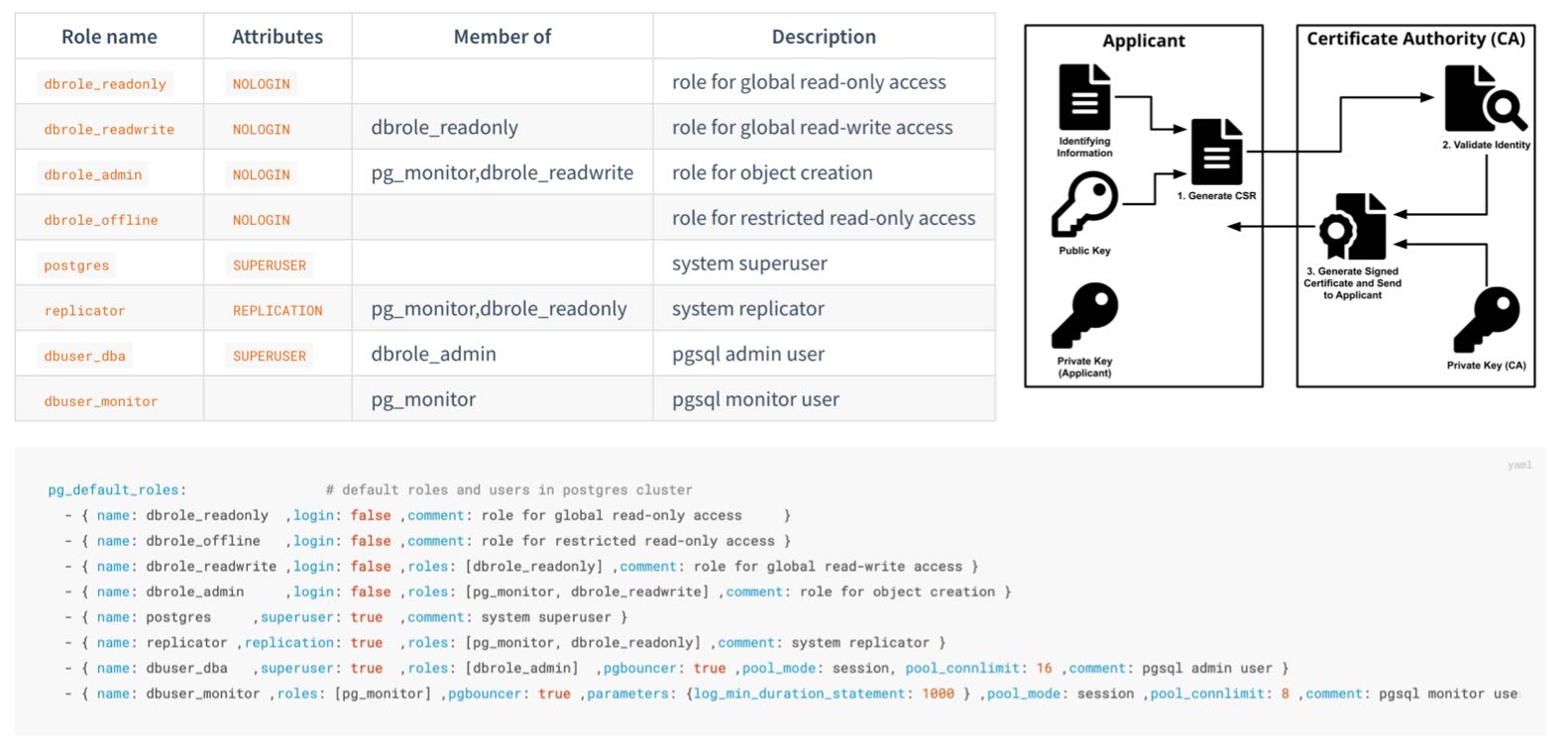
Pigsty creates self-signed CAs (or uses your provided CA) to issue certificates and encrypt network communication. Sensitive management pages and API endpoints that need protection are password-protected. Database backups use AES encryption, database passwords use scram-sha-256 encryption, and plugins are provided to enforce password strength policies. Pigsty provides an out-of-the-box, easy-to-use, easily extensible ACL model, providing read/write/admin/ETL permission distinctions, with HBA rule sets following the principle of least privilege, ensuring system confidentiality through multiple layers of protection.
Pigsty enables database checksums by default to avoid silent data corruption, with replicas providing bad block fallback. Provides CRIT zero-data-loss configuration templates, using watchdog to ensure HA fencing as a fallback. You can audit database operations through the audit plugin, with all system and database logs collected for reference to meet compliance requirements.
Pigsty correctly configures SELinux and firewall settings, and follows the principle of least privilege in designing OS user groups and file permissions, ensuring system security baselines meet compliance requirements. Security is also uncompromised for auxiliary optional components like Etcd and MinIO — both use RBAC models and TLS encrypted communication, ensuring overall system security.
A properly configured system easily passes Level 3 security certification. As long as you follow security best practices, deploy on internal networks with properly configured security groups and firewalls, database security will no longer be your pain point.
Broad Application Scenarios
Use preset Docker templates to spin up massive software using PostgreSQL with one click!
In various data-intensive applications, the database is often the trickiest part. For example, the core difference between GitLab Enterprise and Community Edition is the underlying PostgreSQL database monitoring and high availability. If you already have a good enough local PG RDS, you can refuse to pay for software’s homemade database components.
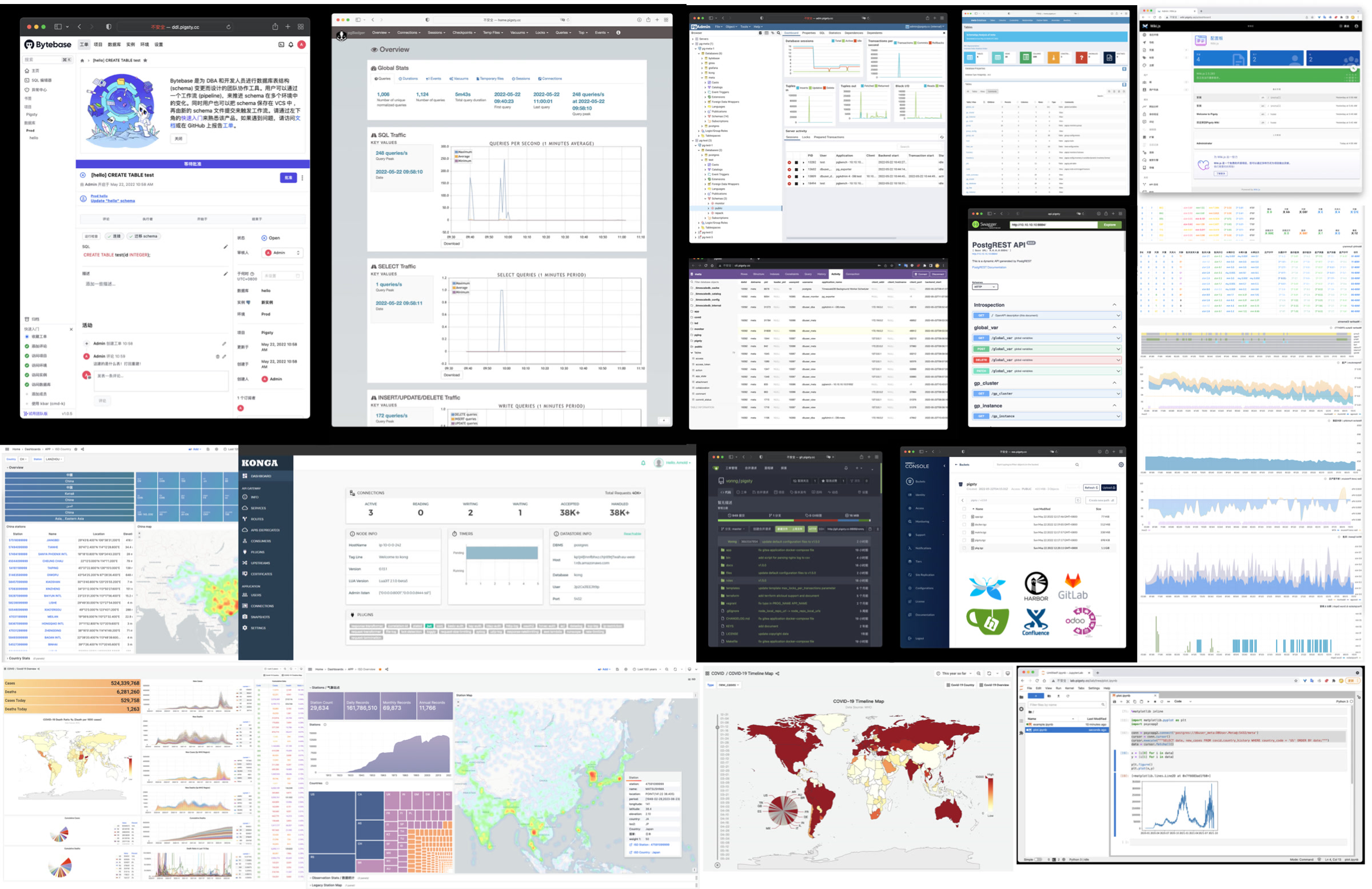
Pigsty provides the Docker module and many out-of-the-box Compose templates. You can use Pigsty-managed high-availability PostgreSQL (as well as Redis and MinIO) as backend storage, spinning up these software in stateless mode with one click: GitLab, Gitea, Wiki.js, NocoDB, Odoo, Jira, Confluence, Harbor, Mastodon, Discourse, KeyCloak, etc. If your application needs a reliable PostgreSQL database, Pigsty is perhaps the simplest way to get one.
Pigsty also provides application development toolsets closely related to PostgreSQL: PGAdmin4, PGWeb, ByteBase, PostgREST, Kong, as well as EdgeDB, FerretDB, Supabase — these “upper-layer databases” using PostgreSQL as storage. More wonderfully, you can build interactive data applications quickly in a low-code manner based on the Grafana and Postgres built into Pigsty, and even use Pigsty’s built-in ECharts panels to create more expressive interactive visualization works.
Pigsty provides a powerful runtime for your AI applications. Your agents can leverage PostgreSQL and the powerful capabilities of the observability world in this environment to quickly build data-driven intelligent agents.
Open-Source Free Software
Pigsty is free software open-sourced under AGPLv3, watered by the passion of PostgreSQL-loving community members
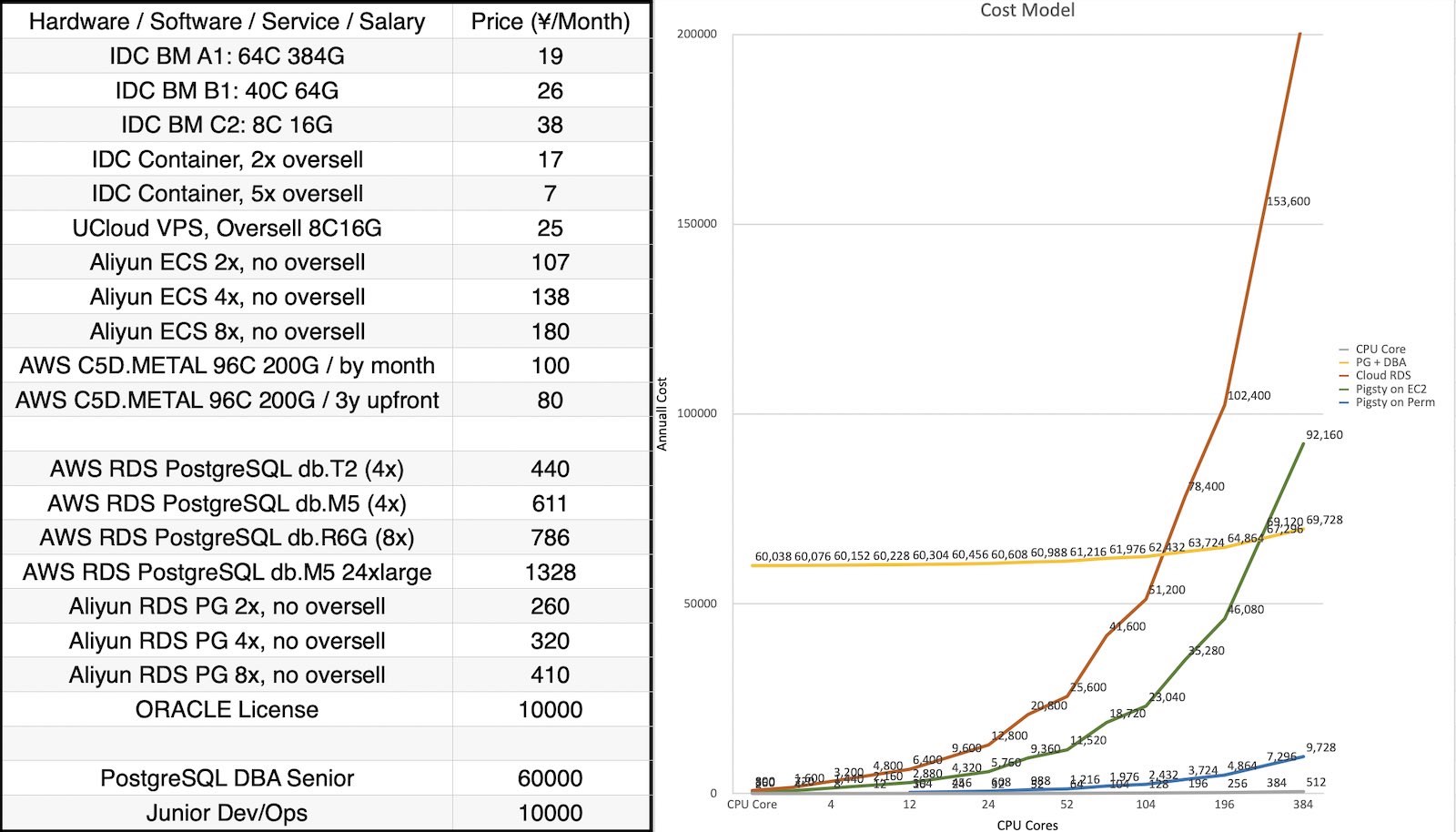
Pigsty is completely open-source and free software, allowing you to run enterprise-grade PostgreSQL database services at nearly pure hardware cost without database experts. For comparison, database vendors’ “enterprise database services” and public cloud vendors’ RDS charge premiums several to over ten times the underlying hardware resources as “service fees.”
Many users choose the cloud precisely because they can’t handle databases themselves; many users use RDS because there’s no other choice. We will break cloud vendors’ monopoly, providing users with a cloud-neutral, better open-source RDS alternative: Pigsty follows PostgreSQL upstream closely, with no vendor lock-in, no annoying “licensing fees,” no node count limits, and no data collection. All your core assets — data — can be “autonomously controlled,” in your own hands.
Pigsty itself aims to replace tedious manual database operations with database autopilot software, but even the best software can’t solve all problems. There will always be some rare, low-frequency edge cases requiring expert intervention. This is why we also provide professional subscription services to provide safety nets for enterprise users who need them. Subscription consulting fees of tens of thousands are less than one-thirtieth of a top DBA’s annual salary, completely eliminating your concerns and putting costs where they really matter. For community users, we also contribute with love, providing free support and daily Q&A.
2 - Roadmap
Release Strategy
Pigsty uses semantic versioning: <major>.<minor>.<patch>. Alpha/Beta/RC versions will have suffixes like -a1, -b1, -c1 appended to the version number.
Major version updates signify incompatible foundational changes and major new features; minor version updates typically indicate regular feature updates and small API changes; patch version updates mean bug fixes and package version updates.
Pigsty plans to release one major version update per year. Minor version updates usually follow PostgreSQL’s minor version update rhythm, catching up within a month at the latest after a new PostgreSQL version is released. Pigsty typically plans 4-6 minor versions per year. For complete release history, please refer to Release Notes.
Pigsty develops using the main trunk branch. Please always use Releases with version numbers.
Unless you know what you’re doing, do not use GitHub’s main branch. Always check out and use a specific version.
Features Under Consideration
- A sufficiently good command-line management tool
- ARM architecture support for infrastructure components
- Add more extensions for PostgreSQL
- More preset scenario-based configuration templates
- Fully migrate software repository and installation download sources to Cloudflare
- Deploy and monitor highly available Kubernetes clusters using SealOS!
- Use VictoriaMetrics to replace Prometheus for time-series data storage
- Monitor and deploy MySQL databases
- Monitor databases in Kubernetes
- Provide richer Docker application templates
- PGLite browser-side support
Here are our Active Issues and Roadmap.
Extensions and Packages
For the extension support roadmap, you can find it here: https://pgext.cloud/e/roadmap
Under Consideration
- walminer
- is_jsonb_valid https://github.com/furstenheim/is_jsonb_valid
- pg_kafka https://github.com/xstevens/pg_kafka
- pg_jieba https://github.com/jaiminpan/pg_jieba
- pg_paxos https://github.com/microsoft/pg_paxos
- OneSparse https://github.com/OneSparse/OneSparse
- PipelineDB https://github.com/pipelinedb/pipelinedb
- SQL Firewall https://github.com/uptimejp/sql_firewall
- zcurve https://github.com/bmuratshin/zcurve
- PG dot net https://github.com/Brick-Abode/pldotnet/releases
- pg_scws: https://github.com/jaiminpan/pg_scws
- themsis: https://github.com/cossacklabs/pg_themis
- pgspeck https://github.com/johto/pgspeck
- lsm3 https://github.com/postgrespro/lsm3
- monq https://github.com/postgrespro/monq
- pg_badplan https://github.com/trustly/pg_badplan
- pg_recall https://github.com/mreithub/pg_recall
- pgfsm https://github.com/michelp/pgfsm
- pg_trgm pro https://github.com/postgrespro/pg_trgm_pro
- pgsql-fio: https://github.com/csimsek/pgsql-fio
Not Considering for Now
- pg_tier: not ready due to incomplete dep parquet_s3_fdw
- parquet_s3_fdw: not ready due to compiler version
- pg_top: not ready due to cmake error
- timestamp9: not ready due to compiler error
- pg_tier obsolete
- pg_timeseries, we already have timescaledb
- pg_quack, we already have a pg_lakehouse
- pg_telemetry, we already have better observability
- pgx_ulid, https://github.com/pksunkara/pgx_ulid, already covered by pg_idkit (MIT, but RUST)
- embedding: obsolete
- FEAT zson https://github.com/postgrespro/zson MIT C (too old)
- GIS pghydro https://github.com/pghydro/pghydro C GPL-2.0 6.6 (no makefile)
- https://github.com/Zeleo/pg_natural_sort_order (too old)
- https://github.com/postgrespro/pg_query_state
- https://github.com/no0p/pgsampler
- pg_lz4 https://github.com/zilder/pg_lz4
- pg_amqp https://github.com/omniti-labs/pg_amqp
- tinyint https://github.com/umitanuki/tinyint-postgresql
- pg_blkchain https://github.com/blkchain/pg_blkchain
- hashtypes https://github.com/pandrewhk/hashtypes
- foreign_table_exposer https://github.com/komamitsu/foreign_table_exposer
- ldap_fdw https://github.com/guedes/ldap_fdw
- pg_backtrace https://github.com/postgrespro/pg_backtrace
- connection_limits https://github.com/tvondra/connection_limits
- fixeddecimal https://github.com/2ndQuadrant/fixeddecimal
3 - History
Historical Origins
The Pigsty project began in 2018-2019, originating from Tantan. Tantan is an internet dating app — China’s Tinder, now acquired by Momo. Tantan was a Nordic-style startup with a Swedish engineering founding team.
Tantan had excellent technical taste, using PostgreSQL and Go as its core technology stack. The entire Tantan system architecture was modeled after Instagram, designed entirely around the PostgreSQL database. Up to several million daily active users, millions of TPS, and hundreds of TB of data, the data component used only PostgreSQL. Almost all business logic was implemented using PG stored procedures — even including 100ms recommendation algorithms!
This atypical development model of deeply using PostgreSQL features placed extremely high demands on the capabilities of engineers and DBAs. And Pigsty is the open-source project we forged in this real-world large-scale, high-standard database cluster scenario — embodying our experience and best practices as top PostgreSQL experts.
Development Process
In the beginning, Pigsty did not have the vision, goals, and scope it has today. It aimed to provide a PostgreSQL monitoring system for our own use. We surveyed all available solutions — open-source, commercial, cloud-based, datadog, pgwatch, etc. — and none could meet our observability needs. So we decided to build one ourselves based on Grafana and Prometheus. This became Pigsty’s predecessor and prototype. Pigsty as a monitoring system was quite impressive, helping us solve countless management problems.
Subsequently, developers wanted such a monitoring system on their local development machines, so we used Ansible to write provisioning playbooks, transforming this system from a one-time construction task into reusable, replicable software. The new functionality allowed users to use Vagrant and Terraform, using Infrastructure as Code to quickly spin up local DevBox development machines or production environment servers, automatically completing PostgreSQL and monitoring system deployment.
Next, we redesigned the production environment PostgreSQL architecture, introducing Patroni and pgBackRest to solve database high availability and point-in-time recovery issues. We developed a zero-downtime migration solution based on logical replication, rolling upgrading two hundred production database clusters to the latest major version through blue-green deployment. And we incorporated these capabilities into Pigsty.
Pigsty is software we made for ourselves. As client users ourselves, we know exactly what we need and won’t slack on our own requirements. The greatest benefit of “eating dog food” is that we are both developers and users — therefore we know exactly what we need and won’t slack on our own requirements.
We solved problem after problem, depositing the solutions into Pigsty. Pigsty’s positioning also gradually evolved from a monitoring system into an out-of-the-box PostgreSQL database distribution. Therefore, at this stage, we decided to open-source Pigsty and began a series of technical sharing and publicity, and external users from various industries began using Pigsty and providing feedback.
Full-Time Entrepreneurship
In 2022, the Pigsty project received seed funding from Miracle Plus, initiated by Dr. Qi Lu, allowing me to work on this full-time.
As an open-source project, Pigsty has developed quite well. In these two years of full-time entrepreneurship, Pigsty’s GitHub stars have multiplied from a few hundred to 3,700; it made the HN front page, and growth began snowballing; In the OSSRank open-source rankings, Pigsty ranks 22nd among PostgreSQL ecosystem projects, the highest among Chinese-led projects.
Previously, Pigsty could only run on CentOS 7, but now it basically covers all mainstream Linux distributions (EL, Debian, Ubuntu). Supported PG major versions cover 13-18, maintaining, collecting, and integrating 440 extension plugins in the PG ecosystem. Among these, I personally maintain over half of the extension plugins, providing out-of-the-box RPM/DEB packages. Including Pigsty itself, “based on open source, giving back to open source,” this is making some contribution to the PG ecosystem.
Pigsty’s positioning has also continuously evolved from a PostgreSQL database distribution to an open-source cloud database alternative. It truly benchmarks against cloud vendors’ entire cloud database brands.
Rebel Against Public Clouds
Public cloud vendors like AWS, Azure, GCP, and Aliyun have provided many conveniences for startups, but they are closed-source and force users to rent infrastructure at exorbitant fees.
We believe that excellent database services, like excellent database kernels, should be accessible to every user, rather than requiring expensive rental from cyber lords.
Cloud computing’s agility and elasticity are great, but it should be free, open-source, inclusive, and local-first — We believe the cloud computing universe needs a solution representing open-source values that returns infrastructure control to users without sacrificing the benefits of the cloud.
Therefore, we are also leading a movement and battle to exit the cloud, as rebels against public clouds, to reshape the industry’s values.
Our Vision
I hope that in the future world, everyone will have the de facto right to freely use excellent services, rather than being confined to a few cyber lord public cloud giants’ territories as cyber tenants or even cyber serfs.
This is exactly what Pigsty aims to do — a better, free and open-source RDS alternative. Allowing users to spin up database services better than cloud RDS anywhere (including cloud servers) with one click.
Pigsty is a complete complement to PostgreSQL, and a spicy mockery of cloud databases. Its original meaning is “pigsty,” but it’s also an acronym for Postgres In Great STYle, meaning “PostgreSQL in its full glory.”
Pigsty itself is completely free and open-source software. We purely rely on providing consulting and services to sustain operations. A well-built system may run for years without encountering problems needing a “safety net,” but database problems, once they occur, are never small issues. Often, expert experience can turn decay into magic with a word, and we provide such services to clients in need — we believe this is a more just, reasonable, and sustainable model.
About the Team
I am Feng Ruohang, the author of Pigsty. The vast majority of Pigsty’s code was developed by me alone, with individual features contributed by the community.
Individual heroism still exists in the software field. Only unique individuals can create unique works — I hope Pigsty can become such a work.
If you’re interested in me, here’s my personal homepage: https://vonng.com/
“Modb Interview with Feng Ruohang” (Chinese)
“Post-90s, Quit to Start Business, Says Will Crush Cloud Databases” (Chinese)
4 - News & Events
Recent News
2025-11-29: Pigsty won the PostgreSQL Magneto Award!
- The 8th Conference of PostgreSQL Ecosystem (Hangzhou, China)
- Topics: “A World-Grade Postgres Meta Distribution”, AI database considerations, PostgreSQL delivery best practices
Pigsty v3.4.1 Released! OpenHalo & OrioleDB support, MySQL compatibility, pgAdmin improvements
- Release Notes: v3.4.1
Pigsty v3.4.0 Released! Better backups, automatic Certbot certificates, Ivory cross-platform, AGE extension, APP improvements
- Release Notes: v3.4.0
Pigsty v3.3.0 Released! 404 extensions, Odoo/Dify/Supabase app templates, DocumentDB support
- Release Notes: v3.3.0
Pigsty 3.2.2 Released!
Pigsty 3.2.1 Released!
Pigsty 3.2.0 Released!
PostgreSQL Package Manager
pigReleased!Pigsty 3.1.0 Released with complete PostgreSQL 17.2 extension support
- Blog Post: “Pigsty v3.1: Self-hosted Supabase, PG17 Default, MinIO Improvements, ARM & Ubuntu24 Support”
- PostgreSQL Official News: “Pigsty v3.1 Release: PG17, Duck Extensions, Self-hosting Supabase, ARM & Ubuntu24”
- Release Notes: v3.1.0
- Postgres Weekly Issue 579: https://postgresweekly.com/issues/579
Pigsty 3.0.4 Released! Extension catalog and repository, PG17 extension compilation, Supabase self-hosting optimization
- Release Notes: v3.0.4
Pigsty 3.0.3 Released! Official PostgreSQL 17 support, Etcd operations and monitoring optimization
- Release Notes: v3.0.3
Pigsty 3.0.2 Released! Slim installation mode, PolarDB 15 support, routine bug fixes (2024-09-07)
- Release Notes: v3.0.2
Pigsty 3.0.1 Released! Oracle compatibility, Patroni 4 support, routine bug fixes (2024-08-31)
- Release Notes: v3.0.1
Pigsty 3.0.0 Released! 333 extensions, replaceable kernels, complete RDS service!
- Release Notes: v3.0.0
- Feature Introduction: Pigsty v3.0.0
News: Pigsty’s supplementary Yum/APT repositories provide 254 additional ready-to-use binary RPM/DEB extensions!
- PostgreSQL Official: Pigsty Supplementary APT/YUM Repository with 254 additional PostgreSQL Extensions!
Pigsty v2.7 Released!
- PostgreSQL Official: Pigsty v2.7 Released, free RDS PG with 255 extensions available
- Postgres Weekly: [https://postgresweekly.com/issues/556)
- Pigsty Blog: Pigsty v2.7: The Great Integration
Pigsty v2.6 Released!
- PostgreSQL Official: Pigsty, Battery-included PostgreSQL Distro & Free RDS Alternative, v2.6 released!
- Postgres Planet (X): https://twitter.com/PostgreSQL/status/1765323952669290515
- Postgres Weekly: https://postgresweekly.com/issues/545
- Pigsty Blog: Pigsty v2.6: PG Challenges OLAP
The name of this project always makes me grin: PIGSTY is actually an acronym, standing for Postgres In Great STYle! It’s a Postgres distribution that includes lots of components and tools out of the box in areas like availability, deployment, and observability. The latest release pushes everything up to Postgres 16.2 standards and introduces new ParadeDB and DuckDB FDW extensions.
Conferences & Talks
| Date | Type | Event | Topic |
|---|---|---|---|
| 2025-11-29 | Award&Talk | The 8th Conf of PG Ecosystem (Hangzhou) | PostgreSQL Magneto Award, A World-Grade Postgres Meta Distribution |
| 2025-05-16 | Lightning | PGConf.Dev 2025, Montreal | Extension Delivery: Make your PGEXT accessible to users |
| 2025-05-12 | Keynote | PGEXT.DAY, PGCon.Dev 2025 | The Missing Package Manager and Extension Repo for PostgreSQL Ecosystem |
| 2025-04-19 | Workshop | PostgreSQL Database Technology Summit | Using Pigsty to Deploy PG Ecosystem Partners: Dify, Odoo, Supabase |
| 2025-04-11 | Live Host | OSCHINA Data Intelligence Talk | Is the Viral MCP Hype or Revolutionary? |
| 2025-01-15 | Live Stream | Open Source Veterans & Newcomers Episode 4 | PostgreSQL Extensions Devouring DB World? PG Package Manager pig & Self-hosted RDS |
| 2025-01-09 | Award | OSCHINA 2024 Outstanding Contribution Expert | Outstanding Contribution Expert Award |
| 2025-01-06 | Panel | China PostgreSQL Database Ecosystem Conference | PostgreSQL Extensions are Devouring the Database World |
| 2024-11-23 | Podcast | Tech Hotpot Podcast | From the Linux Foundation: Why the Recent Focus on ‘Chokepoints’? |
| 2024-08-21 | Interview | Blue Tech Wave | Interview with Feng Ruohang: Simplifying PG Management |
| 2024-08-15 | Tech Summit | GOTC Global Open Source Technology Summit | PostgreSQL AI/ML/RAG Extension Ecosystem and Best Practices |
| 2024-07-12 | Keynote | 13th PG China Technical Conference | The Future of Database World: Extensions, Service, and Postgres |
| 2024-05-31 | Unconference | PGCon.Dev 2024 Global PG Developer Conference | Built-in Prometheus Metrics Exporter |
| 2024-05-28 | Seminar | PGCon.Dev 2024 Extension Summit | Extension in Core & Binary Packing |
| 2024-05-10 | Live Debate | Three-way Talk: Cloud Mudslide Series Episode 3 | Is Public Cloud a Scam? |
| 2024-04-17 | Live Debate | Three-way Talk: Cloud Mudslide Series Episode 2 | Are Cloud Databases a Tax on Intelligence? |
| 2024-04-16 | Panel | Cloudflare Immerse Shenzhen | Cyber Bodhisattva Panel Discussion |
| 2024-04-12 | Tech Summit | 2024 Data Technology Carnival | Pigsty: Solving PostgreSQL Operations Challenges |
| 2024-03-31 | Live Debate | Three-way Talk: Cloud Mudslide Series Episode 1 | Luo Selling Cloud While We’re Moving Off Cloud? |
| 2024-01-24 | Live Host | OSCHINA Open Source Talk Episode 9 | Will DBAs Be Eliminated by Cloud? |
| 2023-12-20 | Live Debate | Open Source Talk Episode 7 | To Cloud or Not: Cost Cutting or Value Creation? |
| 2023-11-24 | Tech Summit | Vector Databases in the LLM Era | Panel: New Future of Vector Databases in the AI Age |
| 2023-09-08 | Interview | Motianlun Feature Interview | Feng Ruohang: A Tech Enthusiast Who Makes Great Open Source Founders |
| 2023-08-16 | Tech Summit | DTCC 2023 | DBA Night: PostgreSQL vs MySQL Open Source License Issues |
| 2023-08-09 | Live Debate | Open Source Talk Episode 1 | MySQL vs PostgreSQL: Which is World’s No.1? |
| 2023-07-01 | Tech Summit | SACC 2023 | Workshop 8: FinOps Practice: Cloud Cost Management & Optimization |
| 2023-05-12 | Meetup | PostgreSQL China Wenzhou Meetup | PG With DB4AI: Vector Database PGVECTOR & AI4DB: Self-Driving Database Pigsty |
| 2023-04-08 | Tech Summit | Database Carnival 2023 | A Better Open Source RDS Alternative: Pigsty |
| 2023-04-01 | Tech Summit | PostgreSQL China Xi’an Meetup | PG High Availability & Disaster Recovery Best Practices |
| 2023-03-23 | Live Stream | Bytebase x Pigsty | Best Practices for Managing PostgreSQL: Bytebase x Pigsty |
| 2023-03-04 | Tech Summit | PostgreSQL China Conference | Challenging RDS, Pigsty v2.0 Release |
| 2023-02-01 | Tech Summit | DTCC 2022 | Open Source RDS Alternative: Battery-Included, Self-Driving Database Distro Pigsty |
| 2022-07-21 | Live Debate | Cloud Swallows Open Source | Can Open Source Strike Back Against Cloud? |
| 2022-07-04 | Interview | Creator’s Story | Post-90s Developer Quits to Start Up, Aiming to Challenge Cloud Databases |
| 2022-06-28 | Live Stream | Bass’s Roundtable | DBA’s Gospel: SQL Audit Best Practices |
| 2022-06-12 | Demo Day | MiraclePlus S22 Demo Day | User-Friendly Cost-Effective Database Distribution Pigsty |
| 2022-06-05 | Live Stream | PG Chinese Community Sharing | Pigsty v1.5 Quick Start, New Features & Production Cluster Setup |
5 - Join the Community
GitHub
Our GitHub repository is: https://github.com/pgsty/pigsty. Please give us a ⭐️ star!
We welcome anyone to submit new Issues or create Pull Requests, propose feature suggestions, and contribute to Pigsty.
Please note that for issues related to Pigsty documentation, please submit Issues in the github.com/pgsty/pigsty.cc repository.
WeChat Groups
Chinese users are mainly active in WeChat groups. Currently, there are seven active groups. Groups 1-4 are full; for other groups, you need to add the assistant’s WeChat to be invited.
To join the WeChat community, search for “Pigsty小助手” (WeChat ID: pigsty-cc), note or send “加群” (join group), and the assistant will invite you to the group.

International Community
Telegram: https://t.me/joinchat/gV9zfZraNPM3YjFh
Discord: https://discord.gg/j5pG8qfKxU
You can also contact me via email: [email protected]
Community Help
When you encounter problems using Pigsty, you can seek help from the community. The more information you provide, the more likely you are to get help from the community.
Please refer to the Community Help Guide and provide as much information as possible so that community members can help you solve the problem. Here is a reference template for asking for help:
What happened? (Required)
Pigsty version and OS version (Required)
$ grep version pigsty.yml

$ cat /etc/os-release

$ uname -a
Some cloud providers have customized standard OS distributions. You can tell us which cloud provider’s OS image you are using. If you have customized and modified the environment after installing the OS, or if there are specific security rules and firewall configurations in your LAN, please also inform us when asking questions.
Pigsty configuration file
Please don’t forget to redact any sensitive information: passwords, internal keys, sensitive configurations, etc.
cat ~/pigsty/pigsty.yml
What did you expect to happen?
Please describe what should happen under normal circumstances, and how the actual situation differs from expectations.
How to reproduce this issue?
Please tell us in as much detail as possible how to reproduce this issue.
Monitoring screenshots
If you are using the monitoring system provided by Pigsty, you can provide relevant screenshots.
Error logs
Please provide logs related to the error as much as possible. Please do not paste content like “Failed to start xxx service” that has no informational value.
You can query logs from Grafana / Loki, or get logs from the following locations:
- Syslog:
/var/log/messages(rhel) or/var/log/syslog(debian) - Postgres:
/pg/log/postgres/* - Patroni:
/pg/log/patroni/* - Pgbouncer:
/pg/log/pgbouncer/* - Pgbackrest:
/pg/log/pgbackrest/*
journalctl -u patroni
journalctl -u <service name>
Have you searched Issues/Website/FAQ?
In the FAQ, we provide answers to many common questions. Please check before asking.
You can also search for related issues from GitHub Issues and Discussions:
Is there any other information we need to know?
The more information and context you provide, the more likely we can help you solve the problem.
6 - Privacy Policy
Pigsty Software
When you install Pigsty software, if you use offline package installation in a network-isolated environment, we will not receive any data about you.
If you choose online installation, when downloading related packages, our servers or cloud provider servers will automatically log the visiting machine’s IP address and/or hostname in the logs, along with the package names you downloaded.
We will not share this information with other organizations unless required by law. (Honestly, we’d have to be really bored to look at this stuff.)
Pigsty’s primary domain is: pigsty.io. For mainland China, please use the registered mirror site pigsty.cc.
Pigsty Website
When you visit our website, our servers will automatically log your IP address and/or hostname in Nginx logs.
We will only store information such as your email address, name, and location when you decide to send us such information by completing a survey or registering as a user on one of our websites.
We collect this information to help us improve website content, customize web page layouts, and contact people for technical and support purposes. We will not share your email address with other organizations unless required by law.
This website uses Google Analytics, a web analytics service provided by Google, Inc. (“Google”). Google Analytics uses “cookies,” which are text files placed on your computer to help the website analyze how users use the site.
The information generated by the cookie about your use of the website (including your IP address) will be transmitted to and stored by Google on servers in the United States. Google will use this information to evaluate your use of the website, compile reports on website activity for website operators, and provide other services related to website activity and internet usage. Google may also transfer this information to third parties if required by law or where such third parties process the information on Google’s behalf. Google will not associate your IP address with any other data held by Google. You may refuse the use of cookies by selecting the appropriate settings on your browser, however, please note that if you do this, you may not be able to use the full functionality of this website. By using this website, you consent to the processing of data about you by Google in the manner and for the purposes set out above.
If you have any questions or comments about this policy, or request deletion of personal data, you can contact us by sending an email to [email protected]
7 - License
Official License: https://github.com/pgsty/pigsty/blob/main/LICENSE
License Summary
Pigsty uses Apache-2.0, AGPLv3 for two optional modules, and CC BY 4.0 for documentation.
Pigsty Core
The Pigsty core is licensed under Apache License 2.0.
Apache-2.0 is a permissive open-source license. You may freely use, modify, and distribute the software for commercial purposes without opening your own source code or adopting the same license.
| What This License Grants | What This License Does NOT Grant | License Conditions |
|---|---|---|
| Commercial use | Trademark use | Include license and copyright notice |
| Modification | Liability & warranty | State changes |
| Distribution | ||
| Patent grant | ||
| Private use |
Pigsty Optional Modules
The INFRA and MINIO modules are licensed under GNU Affero General Public License v3.0 (AGPLv3).
AGPLv3 does not affect regular users: using the software is not “distribution,” so your business code using Pigsty need not be open-sourced.
AGPLv3 obligations apply only when you “distribute” these modules or modifications as part or all of a software/service offering.
| What This License Grants | What This License Does NOT Grant | License Conditions |
|---|---|---|
| Commercial use | Trademark use | Include license and prominent notice |
| Modification | Liability & warranty | Maintain open-source status |
| Distribution | Disclose source code | |
| Patent grant | Network use is distribution | |
| Private use | Use same license |
These modules are optional — avoid them completely to evade AGPLv3 requirements. If used, AGPLv3 compliance is straightforward since Grafana and MinIO already use AGPLv3.
Files and directories under AGPL-3.0:
| Files and Directories | Description |
|---|---|
roles/infra/ | Infrastructure module (Grafana integration) |
roles/minio/ | MinIO object storage module (optional backup repository) |
files/grafana/ | Grafana dashboard definitions |
infra.yml | INFRA module installation playbook |
infra-rm.yml | INFRA module removal playbook |
minio.yml | MinIO module installation playbook |
minio-rm.yml | MinIO module removal playbook |
Pigsty Documentation
Pigsty documentation sites (pigsty.cc, pigsty.io, pgsty.com) use Creative Commons Attribution 4.0 International (CC BY 4.0).
CC BY 4.0 permits free sharing and adaptation with appropriate credit, a license link, and indication of changes.
| What This License Grants | What This License Does NOT Grant | License Conditions |
|---|---|---|
| Commercial use | Trademark use | Attribution |
| Modification | Liability & warranty | Indicate changes |
| Distribution | Patent grant | Provide license link |
| Private use |
SBOM Inventory
Open-source software used or related to the Pigsty project.
For PostgreSQL extension plugin licenses, refer to PostgreSQL Extension License List.
| Module | Software Name | License | Purpose & Description | Necessity |
|---|---|---|---|---|
| PGSQL | PostgreSQL | PostgreSQL License | PostgreSQL kernel | Required |
| PGSQL | patroni | MIT License | PostgreSQL high availability | Required |
| ETCD | etcd | Apache License 2.0 | HA consensus and distributed config storage | Required |
| INFRA | Ansible | GPLv3 | Executes playbooks and management commands | Required |
| INFRA | Nginx | BSD-2 | Exposes Web UI and serves local repo | Recommended |
| PGSQL | pgbackrest | MIT License | PITR backup/recovery management | Recommended |
| PGSQL | pgbouncer | ISC License | PostgreSQL connection pooling | Recommended |
| PGSQL | vip-manager | BSD 2-Clause License | Automatic L2 VIP binding to PG primary | Recommended |
| PGSQL | pg_exporter | Apache License 2.0 | PostgreSQL and PgBouncer monitoring | Recommended |
| NODE | node_exporter | Apache License 2.0 | Host node monitoring metrics | Recommended |
| NODE | haproxy | HAPROXY’s License (GPLv2) | Load balancing and service exposure | Recommended |
| INFRA | Grafana | AGPLv3 | Database visualization platform | Recommended |
| INFRA | Prometheus Stack | Apache License 2.0 | TSDB, metric collection, alerting | Recommended |
| INFRA | Loki | AGPLv3 | Centralized log collection, storage, query | Recommended |
| INFRA | DNSMASQ | GPLv2 / GPLv3 | DNS resolution and cluster name lookup | Recommended |
| MINIO | MinIO | AGPLv3 | S3-compatible object storage service | Optional |
| NODE | keepalived | MIT License | VIP binding on node clusters | Optional |
| REDIS | Redis | Redis License (BSD-3) | Cache service, locked at 7.2.6 | Optional |
| REDIS | Redis Exporter | MIT License | Redis monitoring | Optional |
| MONGO | FerretDB | Apache License 2.0 | MongoDB compatibility over PostgreSQL | Optional |
| DOCKER | docker-ce | Apache License 2.0 | Container management | Optional |
| CLOUD | SealOS | Apache License 2.0 | Fast K8S cluster deployment and packaging | Optional |
| DUCKDB | DuckDB | MIT | High-performance analytics | Optional |
| External | Vagrant | Business Source License 1.1 | Local test environment VMs | Optional |
| External | Terraform | Business Source License 1.1 | One-click cloud resource provisioning | Optional |
| External | Virtualbox | GPLv2 | Virtual machine management software | Optional |
Necessity Levels:
- Required: Essential core capabilities, no option to disable
- Recommended: Enabled by default, can be disabled via configuration
- Optional: Not enabled by default, can be enabled via configuration
Apache-2.0 License Text
                                 Apache License
                           Version 2.0, January 2004
                        http://www.apache.org/licenses/

   TERMS AND CONDITIONS FOR USE, REPRODUCTION, AND DISTRIBUTION

   1. Definitions.

      "License" shall mean the terms and conditions for use, reproduction,
      and distribution as defined by Sections 1 through 9 of this document.

      "Licensor" shall mean the copyright owner or entity authorized by
      the copyright owner that is granting the License.

      "Legal Entity" shall mean the union of the acting entity and all
      other entities that control, are controlled by, or are under common
      control with that entity. For the purposes of this definition,
      "control" means (i) the power, direct or indirect, to cause the
      direction or management of such entity, whether by contract or
      otherwise, or (ii) ownership of fifty percent (50%) or more of the
      outstanding shares, or (iii) beneficial ownership of such entity.

      "You" (or "Your") shall mean an individual or Legal Entity
      exercising permissions granted by this License.

      "Source" form shall mean the preferred form for making modifications,
      including but not limited to software source code, documentation
      source, and configuration files.

      "Object" form shall mean any form resulting from mechanical
      transformation or translation of a Source form, including but
      not limited to compiled object code, generated documentation,
      and conversions to other media types.

      "Work" shall mean the work of authorship, whether in Source or
      Object form, made available under the License, as indicated by a
      copyright notice that is included in or attached to the work
      (an example is provided in the Appendix below).

      "Derivative Works" shall mean any work, whether in Source or Object
      form, that is based on (or derived from) the Work and for which the
      editorial revisions, annotations, elaborations, or other modifications
      represent, as a whole, an original work of authorship. For the purposes
      of this License, Derivative Works shall not include works that remain
      separable from, or merely link (or bind by name) to the interfaces of,
      the Work and Derivative Works thereof.

      "Contribution" shall mean any work of authorship, including
      the original version of the Work and any modifications or additions
      to that Work or Derivative Works thereof, that is intentionally
      submitted to Licensor for inclusion in the Work by the copyright owner
      or by an individual or Legal Entity authorized to submit on behalf of
      the copyright owner. For the purposes of this definition, "submitted"
      means any form of electronic, verbal, or written communication sent
      to the Licensor or its representatives, including but not limited to
      communication on electronic mailing lists, source code control systems,
      and issue tracking systems that are managed by, or on behalf of, the
      Licensor for the purpose of discussing and improving the Work, but
      excluding communication that is conspicuously marked or otherwise
      designated in writing by the copyright owner as "Not a Contribution."

      "Contributor" shall mean Licensor and any individual or Legal Entity
      on behalf of whom a Contribution has been received by Licensor and
      subsequently incorporated within the Work.

   2. Grant of Copyright License. Subject to the terms and conditions of
      this License, each Contributor hereby grants to You a perpetual,
      worldwide, non-exclusive, no-charge, royalty-free, irrevocable
      copyright license to reproduce, prepare Derivative Works of,
      publicly display, publicly perform, sublicense, and distribute the
      Work and such Derivative Works in Source or Object form.

   3. Grant of Patent License. Subject to the terms and conditions of
      this License, each Contributor hereby grants to You a perpetual,
      worldwide, non-exclusive, no-charge, royalty-free, irrevocable
      (except as stated in this section) patent license to make, have made,
      use, offer to sell, sell, import, and otherwise transfer the Work,
      where such license applies only to those patent claims licensable
      by such Contributor that are necessarily infringed by their
      Contribution(s) alone or by combination of their Contribution(s)
      with the Work to which such Contribution(s) was submitted. If You
      institute patent litigation against any entity (including a
      cross-claim or counterclaim in a lawsuit) alleging that the Work
      or a Contribution incorporated within the Work constitutes direct
      or contributory patent infringement, then any patent licenses
      granted to You under this License for that Work shall terminate
      as of the date such litigation is filed.

   4. Redistribution. You may reproduce and distribute copies of the
      Work or Derivative Works thereof in any medium, with or without
      modifications, and in Source or Object form, provided that You
      meet the following conditions:

      (a) You must give any other recipients of the Work or
          Derivative Works a copy of this License; and

      (b) You must cause any modified files to carry prominent notices
          stating that You changed the files; and

      (c) You must retain, in the Source form of any Derivative Works
          that You distribute, all copyright, patent, trademark, and
          attribution notices from the Source form of the Work,
          excluding those notices that do not pertain to any part of
          the Derivative Works; and

      (d) If the Work includes a "NOTICE" text file as part of its
          distribution, then any Derivative Works that You distribute must
          include a readable copy of the attribution notices contained
          within such NOTICE file, excluding those notices that do not
          pertain to any part of the Derivative Works, in at least one
          of the following places: within a NOTICE text file distributed
          as part of the Derivative Works; within the Source form or
          documentation, if provided along with the Derivative Works; or,
          within a display generated by the Derivative Works, if and
          wherever such third-party notices normally appear. The contents
          of the NOTICE file are for informational purposes only and
          do not modify the License. You may add Your own attribution
          notices within Derivative Works that You distribute, alongside
          or as an addendum to the NOTICE text from the Work, provided
          that such additional attribution notices cannot be construed
          as modifying the License.

      You may add Your own copyright statement to Your modifications and
      may provide additional or different license terms and conditions
      for use, reproduction, or distribution of Your modifications, or
      for any such Derivative Works as a whole, provided Your use,
      reproduction, and distribution of the Work otherwise complies with
      the conditions stated in this License.

   5. Submission of Contributions. Unless You explicitly state otherwise,
      any Contribution intentionally submitted for inclusion in the Work
      by You to the Licensor shall be under the terms and conditions of
      this License, without any additional terms or conditions.
      Notwithstanding the above, nothing herein shall supersede or modify
      the terms of any separate license agreement you may have executed
      with Licensor regarding such Contributions.

   6. Trademarks. This License does not grant permission to use the trade
      names, trademarks, service marks, or product names of the Licensor,
      except as required for reasonable and customary use in describing the
      origin of the Work and reproducing the content of the NOTICE file.

   7. Disclaimer of Warranty. Unless required by applicable law or
      agreed to in writing, Licensor provides the Work (and each
      Contributor provides its Contributions) on an "AS IS" BASIS,
      WITHOUT WARRANTIES OR CONDITIONS OF ANY KIND, either express or
      implied, including, without limitation, any warranties or conditions
      of TITLE, NON-INFRINGEMENT, MERCHANTABILITY, or FITNESS FOR A
      PARTICULAR PURPOSE. You are solely responsible for determining the
      appropriateness of using or redistributing the Work and assume any
      risks associated with Your exercise of permissions under this License.

   8. Limitation of Liability. In no event and under no legal theory,
      whether in tort (including negligence), contract, or otherwise,
      unless required by applicable law (such as deliberate and grossly
      negligent acts) or agreed to in writing, shall any Contributor be
      liable to You for damages, including any direct, indirect, special,
      incidental, or consequential damages of any character arising as a
      result of this License or out of the use or inability to use the
      Work (including but not limited to damages for loss of goodwill,
      work stoppage, computer failure or malfunction, or any and all
      other commercial damages or losses), even if such Contributor
      has been advised of the possibility of such damages.

   9. Accepting Warranty or Additional Liability. While redistributing
      the Work or Derivative Works thereof, You may choose to offer,
      and charge a fee for, acceptance of support, warranty, indemnity,
      or other liability obligations and/or rights consistent with this
      License. However, in accepting such obligations, You may act only
      on Your own behalf and on Your sole responsibility, not on behalf
      of any other Contributor, and only if You agree to indemnify,
      defend, and hold each Contributor harmless for any liability
      incurred by, or claims asserted against, such Contributor by reason
      of your accepting any such warranty or additional liability.

   END OF TERMS AND CONDITIONS

   APPENDIX: How to apply the Apache License to your work.

      To apply the Apache License to your work, attach the following
      boilerplate notice, with the fields enclosed by brackets "[]"
      replaced with your own identifying information. (Don't include
      the brackets!)  The text should be enclosed in the appropriate
      comment syntax for the file format. We also recommend that a
      file or class name and description of purpose be included on the
      same "printed page" as the copyright notice for easier
      identification within third-party archives.

   Copyright (C) 2018-2026  Ruohang Feng, @Vonng ([email protected])

   Licensed under the Apache License, Version 2.0 (the "License");
   you may not use this file except in compliance with the License.
   You may obtain a copy of the License at

       http://www.apache.org/licenses/LICENSE-2.0

   Unless required by applicable law or agreed to in writing, software
   distributed under the License is distributed on an "AS IS" BASIS,
   WITHOUT WARRANTIES OR CONDITIONS OF ANY KIND, either express or implied.
   See the License for the specific language governing permissions and
   limitations under the License.
AGPLv3 License Text
                    GNU AFFERO GENERAL PUBLIC LICENSE
                       Version 3, 19 November 2007

 Copyright (C) 2007 Free Software Foundation, Inc. <https://fsf.org/>
 Everyone is permitted to copy and distribute verbatim copies
 of this license document, but changing it is not allowed.

                            Preamble

  The GNU Affero General Public License is a free, copyleft license for
software and other kinds of works, specifically designed to ensure
cooperation with the community in the case of network server software.

  The licenses for most software and other practical works are designed
to take away your freedom to share and change the works.  By contrast,
our General Public Licenses are intended to guarantee your freedom to
share and change all versions of a program--to make sure it remains free
software for all its users.

  When we speak of free software, we are referring to freedom, not
price.  Our General Public Licenses are designed to make sure that you
have the freedom to distribute copies of free software (and charge for
them if you wish), that you receive source code or can get it if you
want it, that you can change the software or use pieces of it in new
free programs, and that you know you can do these things.

  Developers that use our General Public Licenses protect your rights
with two steps: (1) assert copyright on the software, and (2) offer
you this License which gives you legal permission to copy, distribute
and/or modify the software.

  A secondary benefit of defending all users' freedom is that
improvements made in alternate versions of the program, if they
receive widespread use, become available for other developers to
incorporate.  Many developers of free software are heartened and
encouraged by the resulting cooperation.  However, in the case of
software used on network servers, this result may fail to come about.
The GNU General Public License permits making a modified version and
letting the public access it on a server without ever releasing its
source code to the public.

  The GNU Affero General Public License is designed specifically to
ensure that, in such cases, the modified source code becomes available
to the community.  It requires the operator of a network server to
provide the source code of the modified version running there to the
users of that server.  Therefore, public use of a modified version, on
a publicly accessible server, gives the public access to the source
code of the modified version.

  An older license, called the Affero General Public License and
published by Affero, was designed to accomplish similar goals.  This is
a different license, not a version of the Affero GPL, but Affero has
released a new version of the Affero GPL which permits relicensing under
this license.

  The precise terms and conditions for copying, distribution and
modification follow.

                       TERMS AND CONDITIONS

  0. Definitions.

  "This License" refers to version 3 of the GNU Affero General Public License.

  "Copyright" also means copyright-like laws that apply to other kinds of
works, such as semiconductor masks.

  "The Program" refers to any copyrightable work licensed under this
License.  Each licensee is addressed as "you".  "Licensees" and
"recipients" may be individuals or organizations.

  To "modify" a work means to copy from or adapt all or part of the work
in a fashion requiring copyright permission, other than the making of an
exact copy.  The resulting work is called a "modified version" of the
earlier work or a work "based on" the earlier work.

  A "covered work" means either the unmodified Program or a work based
on the Program.

  To "propagate" a work means to do anything with it that, without
permission, would make you directly or secondarily liable for
infringement under applicable copyright law, except executing it on a
computer or modifying a private copy.  Propagation includes copying,
distribution (with or without modification), making available to the
public, and in some countries other activities as well.

  To "convey" a work means any kind of propagation that enables other
parties to make or receive copies.  Mere interaction with a user through
a computer network, with no transfer of a copy, is not conveying.

  An interactive user interface displays "Appropriate Legal Notices"
to the extent that it includes a convenient and prominently visible
feature that (1) displays an appropriate copyright notice, and (2)
tells the user that there is no warranty for the work (except to the
extent that warranties are provided), that licensees may convey the
work under this License, and how to view a copy of this License.  If
the interface presents a list of user commands or options, such as a
menu, a prominent item in the list meets this criterion.

  1. Source Code.

  The "source code" for a work means the preferred form of the work
for making modifications to it.  "Object code" means any non-source
form of a work.

  A "Standard Interface" means an interface that either is an official
standard defined by a recognized standards body, or, in the case of
interfaces specified for a particular programming language, one that
is widely used among developers working in that language.

  The "System Libraries" of an executable work include anything, other
than the work as a whole, that (a) is included in the normal form of
packaging a Major Component, but which is not part of that Major
Component, and (b) serves only to enable use of the work with that
Major Component, or to implement a Standard Interface for which an
implementation is available to the public in source code form.  A
"Major Component", in this context, means a major essential component
(kernel, window system, and so on) of the specific operating system
(if any) on which the executable work runs, or a compiler used to
produce the work, or an object code interpreter used to run it.

  The "Corresponding Source" for a work in object code form means all
the source code needed to generate, install, and (for an executable
work) run the object code and to modify the work, including scripts to
control those activities.  However, it does not include the work's
System Libraries, or general-purpose tools or generally available free
programs which are used unmodified in performing those activities but
which are not part of the work.  For example, Corresponding Source
includes interface definition files associated with source files for
the work, and the source code for shared libraries and dynamically
linked subprograms that the work is specifically designed to require,
such as by intimate data communication or control flow between those
subprograms and other parts of the work.

  The Corresponding Source need not include anything that users
can regenerate automatically from other parts of the Corresponding
Source.

  The Corresponding Source for a work in source code form is that
same work.

  2. Basic Permissions.

  All rights granted under this License are granted for the term of
copyright on the Program, and are irrevocable provided the stated
conditions are met.  This License explicitly affirms your unlimited
permission to run the unmodified Program.  The output from running a
covered work is covered by this License only if the output, given its
content, constitutes a covered work.  This License acknowledges your
rights of fair use or other equivalent, as provided by copyright law.

  You may make, run and propagate covered works that you do not
convey, without conditions so long as your license otherwise remains
in force.  You may convey covered works to others for the sole purpose
of having them make modifications exclusively for you, or provide you
with facilities for running those works, provided that you comply with
the terms of this License in conveying all material for which you do
not control copyright.  Those thus making or running the covered works
for you must do so exclusively on your behalf, under your direction
and control, on terms that prohibit them from making any copies of
your copyrighted material outside their relationship with you.

  Conveying under any other circumstances is permitted solely under
the conditions stated below.  Sublicensing is not allowed; section 10
makes it unnecessary.

  3. Protecting Users' Legal Rights From Anti-Circumvention Law.

  No covered work shall be deemed part of an effective technological
measure under any applicable law fulfilling obligations under article
11 of the WIPO copyright treaty adopted on 20 December 1996, or
similar laws prohibiting or restricting circumvention of such
measures.

  When you convey a covered work, you waive any legal power to forbid
circumvention of technological measures to the extent such circumvention
is effected by exercising rights under this License with respect to
the covered work, and you disclaim any intention to limit operation or
modification of the work as a means of enforcing, against the work's
users, your or third parties' legal rights to forbid circumvention of
technological measures.

  4. Conveying Verbatim Copies.

  You may convey verbatim copies of the Program's source code as you
receive it, in any medium, provided that you conspicuously and
appropriately publish on each copy an appropriate copyright notice;
keep intact all notices stating that this License and any
non-permissive terms added in accord with section 7 apply to the code;
keep intact all notices of the absence of any warranty; and give all
recipients a copy of this License along with the Program.

  You may charge any price or no price for each copy that you convey,
and you may offer support or warranty protection for a fee.

  5. Conveying Modified Source Versions.

  You may convey a work based on the Program, or the modifications to
produce it from the Program, in the form of source code under the
terms of section 4, provided that you also meet all of these conditions:

    a) The work must carry prominent notices stating that you modified
    it, and giving a relevant date.

    b) The work must carry prominent notices stating that it is
    released under this License and any conditions added under section
    7.  This requirement modifies the requirement in section 4 to
    "keep intact all notices".

    c) You must license the entire work, as a whole, under this
    License to anyone who comes into possession of a copy.  This
    License will therefore apply, along with any applicable section 7
    additional terms, to the whole of the work, and all its parts,
    regardless of how they are packaged.  This License gives no
    permission to license the work in any other way, but it does not
    invalidate such permission if you have separately received it.

    d) If the work has interactive user interfaces, each must display
    Appropriate Legal Notices; however, if the Program has interactive
    interfaces that do not display Appropriate Legal Notices, your
    work need not make them do so.

  A compilation of a covered work with other separate and independent
works, which are not by their nature extensions of the covered work,
and which are not combined with it such as to form a larger program,
in or on a volume of a storage or distribution medium, is called an
"aggregate" if the compilation and its resulting copyright are not
used to limit the access or legal rights of the compilation's users
beyond what the individual works permit.  Inclusion of a covered work
in an aggregate does not cause this License to apply to the other
parts of the aggregate.

  6. Conveying Non-Source Forms.

  You may convey a covered work in object code form under the terms
of sections 4 and 5, provided that you also convey the
machine-readable Corresponding Source under the terms of this License,
in one of these ways:

    a) Convey the object code in, or embodied in, a physical product
    (including a physical distribution medium), accompanied by the
    Corresponding Source fixed on a durable physical medium
    customarily used for software interchange.

    b) Convey the object code in, or embodied in, a physical product
    (including a physical distribution medium), accompanied by a
    written offer, valid for at least three years and valid for as
    long as you offer spare parts or customer support for that product
    model, to give anyone who possesses the object code either (1) a
    copy of the Corresponding Source for all the software in the
    product that is covered by this License, on a durable physical
    medium customarily used for software interchange, for a price no
    more than your reasonable cost of physically performing this
    conveying of source, or (2) access to copy the
    Corresponding Source from a network server at no charge.

    c) Convey individual copies of the object code with a copy of the
    written offer to provide the Corresponding Source.  This
    alternative is allowed only occasionally and noncommercially, and
    only if you received the object code with such an offer, in accord
    with subsection 6b.

    d) Convey the object code by offering access from a designated
    place (gratis or for a charge), and offer equivalent access to the
    Corresponding Source in the same way through the same place at no
    further charge.  You need not require recipients to copy the
    Corresponding Source along with the object code.  If the place to
    copy the object code is a network server, the Corresponding Source
    may be on a different server (operated by you or a third party)
    that supports equivalent copying facilities, provided you maintain
    clear directions next to the object code saying where to find the
    Corresponding Source.  Regardless of what server hosts the
    Corresponding Source, you remain obligated to ensure that it is
    available for as long as needed to satisfy these requirements.

    e) Convey the object code using peer-to-peer transmission, provided
    you inform other peers where the object code and Corresponding
    Source of the work are being offered to the general public at no
    charge under subsection 6d.

  A separable portion of the object code, whose source code is excluded
from the Corresponding Source as a System Library, need not be
included in conveying the object code work.

  A "User Product" is either (1) a "consumer product", which means any
tangible personal property which is normally used for personal, family,
or household purposes, or (2) anything designed or sold for incorporation
into a dwelling.  In determining whether a product is a consumer product,
doubtful cases shall be resolved in favor of coverage.  For a particular
product received by a particular user, "normally used" refers to a
typical or common use of that class of product, regardless of the status
of the particular user or of the way in which the particular user
actually uses, or expects or is expected to use, the product.  A product
is a consumer product regardless of whether the product has substantial
commercial, industrial or non-consumer uses, unless such uses represent
the only significant mode of use of the product.

  "Installation Information" for a User Product means any methods,
procedures, authorization keys, or other information required to install
and execute modified versions of a covered work in that User Product from
a modified version of its Corresponding Source.  The information must
suffice to ensure that the continued functioning of the modified object
code is in no case prevented or interfered with solely because
modification has been made.

  If you convey an object code work under this section in, or with, or
specifically for use in, a User Product, and the conveying occurs as
part of a transaction in which the right of possession and use of
User Product is transferred to the recipient in perpetuity or for a
fixed term (regardless of how the transaction is characterized), the
Corresponding Source conveyed under this section must be accompanied
by the Installation Information.  But this requirement does not apply
if neither you nor any third party retains the ability to install
modified object code on the User Product (for example, the work has
been installed in ROM).

  The requirement to provide Installation Information does not include a
requirement to continue to provide support service, warranty, or updates
for a work that has been modified or installed by the recipient, or for
the User Product in which it has been modified or installed.  Access to a
network may be denied when the modification itself materially and
adversely affects the operation of the network or violates the rules and
protocols for communication across the network.

  Corresponding Source conveyed, and Installation Information provided,
in accord with this section must be in a format that is publicly
documented (and with an implementation available to the public in
source code form), and must require no special password or key for
unpacking, reading or copying.

  7. Additional Terms.

  "Additional permissions" are terms that supplement the terms of this
License by making exceptions from one or more of its conditions.
Additional permissions that are applicable to the entire Program shall
be treated as though they were included in this License, to the extent
that they are valid under applicable law.  If additional permissions
apply only to part of the Program, that part may be used separately
under those permissions, but the entire Program remains governed by
this License without regard to the additional permissions.

  When you convey a copy of a covered work, you may at your option
remove any additional permissions from that copy, or from any part of
it.  (Additional permissions may be written to require their own
removal in certain cases when you modify the work.)  You may place
additional permissions on material, added by you to a covered work,
for which you have or can give appropriate copyright permission.

  Notwithstanding any other provision of this License, for material you
add to a covered work, you may (if authorized by the copyright holders of
that material) supplement the terms of this License with terms:

    a) Disclaiming warranty or limiting liability differently from the
    terms of sections 15 and 16 of this License; or

    b) Requiring preservation of specified reasonable legal notices or
    author attributions in that material or in the Appropriate Legal
    Notices displayed by works containing it; or

    c) Prohibiting misrepresentation of the origin of that material, or
    requiring that modified versions of such material be marked in
    reasonable ways as different from the original version; or

    d) Limiting the use for publicity purposes of names of licensors or
    authors of that material; or

    e) Declining to grant rights under trademark law for use of some
    trade names, trademarks, or service marks; or

    f) Requiring indemnification of licensors and authors of that
    material by anyone who conveys the material (or modified versions of
    it) with contractual assumptions of liability to the recipient, for
    any liability that these contractual assumptions directly impose on
    those licensors and authors.

  All other non-permissive additional terms are considered "further
restrictions" within the meaning of section 10.  If the Program as you
received it, or any part of it, contains a notice stating that it is
governed by this License along with a term that is a further
restriction, you may remove that term.  If a license document contains
a further restriction but permits relicensing or conveying under this
License, you may add to a covered work material governed by the terms
of that license document, provided that the further restriction does
not survive such relicensing or conveying.

  If you add terms to a covered work in accord with this section, you
must place, in the relevant source files, a statement of the
additional terms that apply to those files, or a notice indicating
where to find the applicable terms.

  Additional terms, permissive or non-permissive, may be stated in the
form of a separately written license, or stated as exceptions;
the above requirements apply either way.

  8. Termination.

  You may not propagate or modify a covered work except as expressly
provided under this License.  Any attempt otherwise to propagate or
modify it is void, and will automatically terminate your rights under
this License (including any patent licenses granted under the third
paragraph of section 11).

  However, if you cease all violation of this License, then your
license from a particular copyright holder is reinstated (a)
provisionally, unless and until the copyright holder explicitly and
finally terminates your license, and (b) permanently, if the copyright
holder fails to notify you of the violation by some reasonable means
prior to 60 days after the cessation.

  Moreover, your license from a particular copyright holder is
reinstated permanently if the copyright holder notifies you of the
violation by some reasonable means, this is the first time you have
received notice of violation of this License (for any work) from that
copyright holder, and you cure the violation prior to 30 days after
your receipt of the notice.

  Termination of your rights under this section does not terminate the
licenses of parties who have received copies or rights from you under
this License.  If your rights have been terminated and not permanently
reinstated, you do not qualify to receive new licenses for the same
material under section 10.

  9. Acceptance Not Required for Having Copies.

  You are not required to accept this License in order to receive or
run a copy of the Program.  Ancillary propagation of a covered work
occurring solely as a consequence of using peer-to-peer transmission
to receive a copy likewise does not require acceptance.  However,
nothing other than this License grants you permission to propagate or
modify any covered work.  These actions infringe copyright if you do
not accept this License.  Therefore, by modifying or propagating a
covered work, you indicate your acceptance of this License to do so.

  10. Automatic Licensing of Downstream Recipients.

  Each time you convey a covered work, the recipient automatically
receives a license from the original licensors, to run, modify and
propagate that work, subject to this License.  You are not responsible
for enforcing compliance by third parties with this License.

  An "entity transaction" is a transaction transferring control of an
organization, or substantially all assets of one, or subdividing an
organization, or merging organizations.  If propagation of a covered
work results from an entity transaction, each party to that
transaction who receives a copy of the work also receives whatever
licenses to the work the party's predecessor in interest had or could
give under the previous paragraph, plus a right to possession of the
Corresponding Source of the work from the predecessor in interest, if
the predecessor has it or can get it with reasonable efforts.

  You may not impose any further restrictions on the exercise of the
rights granted or affirmed under this License.  For example, you may
not impose a license fee, royalty, or other charge for exercise of
rights granted under this License, and you may not initiate litigation
(including a cross-claim or counterclaim in a lawsuit) alleging that
any patent claim is infringed by making, using, selling, offering for
sale, or importing the Program or any portion of it.

  11. Patents.

  A "contributor" is a copyright holder who authorizes use under this
License of the Program or a work on which the Program is based.  The
work thus licensed is called the contributor's "contributor version".

  A contributor's "essential patent claims" are all patent claims
owned or controlled by the contributor, whether already acquired or
hereafter acquired, that would be infringed by some manner, permitted
by this License, of making, using, or selling its contributor version,
but do not include claims that would be infringed only as a
consequence of further modification of the contributor version.  For
purposes of this definition, "control" includes the right to grant
patent sublicenses in a manner consistent with the requirements of
this License.

  Each contributor grants you a non-exclusive, worldwide, royalty-free
patent license under the contributor's essential patent claims, to
make, use, sell, offer for sale, import and otherwise run, modify and
propagate the contents of its contributor version.

  In the following three paragraphs, a "patent license" is any express
agreement or commitment, however denominated, not to enforce a patent
(such as an express permission to practice a patent or covenant not to
sue for patent infringement).  To "grant" such a patent license to a
party means to make such an agreement or commitment not to enforce a
patent against the party.

  If you convey a covered work, knowingly relying on a patent license,
and the Corresponding Source of the work is not available for anyone
to copy, free of charge and under the terms of this License, through a
publicly available network server or other readily accessible means,
then you must either (1) cause the Corresponding Source to be so
available, or (2) arrange to deprive yourself of the benefit of the
patent license for this particular work, or (3) arrange, in a manner
consistent with the requirements of this License, to extend the patent
license to downstream recipients.  "Knowingly relying" means you have
actual knowledge that, but for the patent license, your conveying the
covered work in a country, or your recipient's use of the covered work
in a country, would infringe one or more identifiable patents in that
country that you have reason to believe are valid.

  If, pursuant to or in connection with a single transaction or
arrangement, you convey, or propagate by procuring conveyance of, a
covered work, and grant a patent license to some of the parties
receiving the covered work authorizing them to use, propagate, modify
or convey a specific copy of the covered work, then the patent license
you grant is automatically extended to all recipients of the covered
work and works based on it.

  A patent license is "discriminatory" if it does not include within
the scope of its coverage, prohibits the exercise of, or is
conditioned on the non-exercise of one or more of the rights that are
specifically granted under this License.  You may not convey a covered
work if you are a party to an arrangement with a third party that is
in the business of distributing software, under which you make payment
to the third party based on the extent of your activity of conveying
the work, and under which the third party grants, to any of the
parties who would receive the covered work from you, a discriminatory
patent license (a) in connection with copies of the covered work
conveyed by you (or copies made from those copies), or (b) primarily
for and in connection with specific products or compilations that
contain the covered work, unless you entered into that arrangement,
or that patent license was granted, prior to 28 March 2007.

  Nothing in this License shall be construed as excluding or limiting
any implied license or other defenses to infringement that may
otherwise be available to you under applicable patent law.

  12. No Surrender of Others' Freedom.

  If conditions are imposed on you (whether by court order, agreement or
otherwise) that contradict the conditions of this License, they do not
excuse you from the conditions of this License.  If you cannot convey a
covered work so as to satisfy simultaneously your obligations under this
License and any other pertinent obligations, then as a consequence you may
not convey it at all.  For example, if you agree to terms that obligate you
to collect a royalty for further conveying from those to whom you convey
the Program, the only way you could satisfy both those terms and this
License would be to refrain entirely from conveying the Program.

  13. Remote Network Interaction; Use with the GNU General Public License.

  Notwithstanding any other provision of this License, if you modify the
Program, your modified version must prominently offer all users
interacting with it remotely through a computer network (if your version
supports such interaction) an opportunity to receive the Corresponding
Source of your version by providing access to the Corresponding Source
from a network server at no charge, through some standard or customary
means of facilitating copying of software.  This Corresponding Source
shall include the Corresponding Source for any work covered by version 3
of the GNU General Public License that is incorporated pursuant to the
following paragraph.

  Notwithstanding any other provision of this License, you have
permission to link or combine any covered work with a work licensed
under version 3 of the GNU General Public License into a single
combined work, and to convey the resulting work.  The terms of this
License will continue to apply to the part which is the covered work,
but the work with which it is combined will remain governed by version
3 of the GNU General Public License.

  14. Revised Versions of this License.

  The Free Software Foundation may publish revised and/or new versions of
the GNU Affero General Public License from time to time.  Such new versions
will be similar in spirit to the present version, but may differ in detail to
address new problems or concerns.

  Each version is given a distinguishing version number.  If the
Program specifies that a certain numbered version of the GNU Affero General
Public License "or any later version" applies to it, you have the
option of following the terms and conditions either of that numbered
version or of any later version published by the Free Software
Foundation.  If the Program does not specify a version number of the
GNU Affero General Public License, you may choose any version ever published
by the Free Software Foundation.

  If the Program specifies that a proxy can decide which future
versions of the GNU Affero General Public License can be used, that proxy's
public statement of acceptance of a version permanently authorizes you
to choose that version for the Program.

  Later license versions may give you additional or different
permissions.  However, no additional obligations are imposed on any
author or copyright holder as a result of your choosing to follow a
later version.

  15. Disclaimer of Warranty.

  THERE IS NO WARRANTY FOR THE PROGRAM, TO THE EXTENT PERMITTED BY
APPLICABLE LAW.  EXCEPT WHEN OTHERWISE STATED IN WRITING THE COPYRIGHT
HOLDERS AND/OR OTHER PARTIES PROVIDE THE PROGRAM "AS IS" WITHOUT WARRANTY
OF ANY KIND, EITHER EXPRESSED OR IMPLIED, INCLUDING, BUT NOT LIMITED TO,
THE IMPLIED WARRANTIES OF MERCHANTABILITY AND FITNESS FOR A PARTICULAR
PURPOSE.  THE ENTIRE RISK AS TO THE QUALITY AND PERFORMANCE OF THE PROGRAM
IS WITH YOU.  SHOULD THE PROGRAM PROVE DEFECTIVE, YOU ASSUME THE COST OF
ALL NECESSARY SERVICING, REPAIR OR CORRECTION.

  16. Limitation of Liability.

  IN NO EVENT UNLESS REQUIRED BY APPLICABLE LAW OR AGREED TO IN WRITING
WILL ANY COPYRIGHT HOLDER, OR ANY OTHER PARTY WHO MODIFIES AND/OR CONVEYS
THE PROGRAM AS PERMITTED ABOVE, BE LIABLE TO YOU FOR DAMAGES, INCLUDING ANY
GENERAL, SPECIAL, INCIDENTAL OR CONSEQUENTIAL DAMAGES ARISING OUT OF THE
USE OR INABILITY TO USE THE PROGRAM (INCLUDING BUT NOT LIMITED TO LOSS OF
DATA OR DATA BEING RENDERED INACCURATE OR LOSSES SUSTAINED BY YOU OR THIRD
PARTIES OR A FAILURE OF THE PROGRAM TO OPERATE WITH ANY OTHER PROGRAMS),
EVEN IF SUCH HOLDER OR OTHER PARTY HAS BEEN ADVISED OF THE POSSIBILITY OF
SUCH DAMAGES.

  17. Interpretation of Sections 15 and 16.

  If the disclaimer of warranty and limitation of liability provided
above cannot be given local legal effect according to their terms,
reviewing courts shall apply local law that most closely approximates
an absolute waiver of all civil liability in connection with the
Program, unless a warranty or assumption of liability accompanies a
copy of the Program in return for a fee.

                     END OF TERMS AND CONDITIONS

            How to Apply These Terms to Your New Programs

  If you develop a new program, and you want it to be of the greatest
possible use to the public, the best way to achieve this is to make it
free software which everyone can redistribute and change under these terms.

  To do so, attach the following notices to the program.  It is safest
to attach them to the start of each source file to most effectively
state the exclusion of warranty; and each file should have at least
the "copyright" line and a pointer to where the full notice is found.

    Copyright (C) 2018-2026  Ruohang Feng, Author of Pigsty

    This program is free software: you can redistribute it and/or modify
    it under the terms of the GNU Affero General Public License as published by
    the Free Software Foundation, either version 3 of the License, or
    (at your option) any later version.

    This program is distributed in the hope that it will be useful,
    but WITHOUT ANY WARRANTY; without even the implied warranty of
    MERCHANTABILITY or FITNESS FOR A PARTICULAR PURPOSE.  See the
    GNU Affero General Public License for more details.

    You should have received a copy of the GNU Affero General Public License
    along with this program.  If not, see <https://www.gnu.org/licenses/>.

Also add information on how to contact you by electronic and paper mail.

  If your software can interact with users remotely through a computer
network, you should also make sure that it provides a way for users to
get its source.  For example, if your program is a web application, its
interface could display a "Source" link that leads users to an archive
of the code.  There are many ways you could offer source, and different
solutions will be better for different programs; see section 13 for the
specific requirements.

  You should also get your employer (if you work as a programmer) or school,
if any, to sign a "copyright disclaimer" for the program, if necessary.
For more information on this, and how to apply and follow the GNU AGPL, see
<https://www.gnu.org/licenses/>.
8 - Sponsor Us
Sponsor Us
Pigsty is a free and open-source software, passionately developed by PostgreSQL community members, aiming to integrate the power of the PostgreSQL ecosystem and promote the widespread adoption of PostgreSQL. If our work has helped you, please consider sponsoring or supporting our project:
- Sponsor us directly with financial support - express your sincere support in the most direct and powerful way!
- Consider purchasing our Technical Support Services. We can provide professional PostgreSQL high-availability cluster deployment and maintenance services, making your budget worthwhile!
- Share your Pigsty use cases and experiences through articles, talks, and videos.
- Allow us to mention your organization in “Users of Pigsty.”
- Recommend/refer our project and services to friends, colleagues, and clients in need.
- Follow our WeChat Official Account and share relevant technical articles to groups and your social media.
Angel Investors
Pigsty is a project invested by Miracle Plus (formerly YC China) S22. We thank Miracle Plus and Dr. Qi Lu for their support of this project!
Sponsors
Special thanks to Vercel for sponsoring pigsty and hosting the Pigsty website.

9 - User Cases
According to Google Analytics PV and download statistics, Pigsty currently has approximately 100,000 users, with half from mainland China and half from other regions globally. They span across multiple industries including internet, cloud computing, finance, autonomous driving, manufacturing, tech innovation, ISV, and defense. If you are using Pigsty and are willing to share your case and Logo with us, please contact us - we offer one free consultation session as a token of appreciation.
Internet
Tantan: 200+ physical machines for PostgreSQL and Redis services
Bilibili: Supporting PostgreSQL innovative business
Cloud Vendors
Bitdeer: Providing PG DBaaS
Oracle OCI: Using Pigsty to deliver PostgreSQL clusters
Finance
AirWallex: Monitoring 200+ GCP PostgreSQL databases
Media & Entertainment
Media Storm: Self-hosted PG RDS / Victoria Metrics
Autonomous Driving
Momenta: Autonomous driving, managing self-hosted PostgreSQL clusters
Manufacturing
Huafon Group: Using Pigsty to deliver PostgreSQL clusters as chemical industry time-series data warehouse
Tech Innovation
Beijing Lingwu Technology: Migrating PostgreSQL from cloud to self-hosted
Motphys: Self-hosted PostgreSQL supporting GitLab
Sailong Biotech: Self-hosted Supabase
Hangzhou Lingma Technology: Self-hosted PostgreSQL
ISV
Inner Mongolia Haode Tianmu Technology Co., Ltd.
Shanghai Yuanfang
DSG
10 - Subscription
Pigsty aims to unite the power of the PostgreSQL ecosystem and help users make the most of the world’s most popular database, PostgreSQL, with self-driving database management software.
While Pigsty itself has already resolved many issues in PostgreSQL usage, achieving truly enterprise-grade service quality requires expert support and comprehensive coverage from the original provider. We deeply understand the importance of professional commercial support for enterprise customers. Therefore, Pigsty Enterprise Edition provides a series of value-added services on top of the open-source version, helping users better utilize PostgreSQL and Pigsty for customers to choose according to their needs.
If you have any of the following needs, please consider Pigsty subscription service:
- Running databases in critical scenarios requiring strict SLA guarantees and comprehensive coverage.
- Need comprehensive support for complex issues related to Pigsty and PostgreSQL.
- Seeking guidance on PostgreSQL/Pigsty production environment best practices.
- Want experts to help interpret monitoring dashboards, analyze and identify performance bottlenecks and fault root causes, and provide recommendations.
- Need to plan database architectures that meet security/disaster recovery/compliance requirements based on existing resources and business needs.
- Need to migrate from other databases to PostgreSQL, or migrate and transform legacy instances.
- Building an observability system, data dashboards, and visualization applications based on the Prometheus/Grafana technology stack.
- Migrating off cloud and seeking open-source alternatives to RDS for PostgreSQL - cloud-neutral, vendor lock-in-free solutions.
- Want professional support for Redis/ETCD/MinIO, as well as extensions like TimescaleDB/Citus.
- Want to avoid AGPL v3 license restrictions that mandate derivative works to use the same open-source license, for secondary development and OEM branding.
- Want to sell Pigsty as SaaS/PaaS/DBaaS, or provide technical services/consulting/cloud services based on this distribution.
Subscription Plans
In addition to the Open Source Edition, Pigsty offers two different subscription service tiers: Professional Edition and Enterprise Edition, which you can choose based on your actual situation and needs.
Free and Open Source
No scale limit, no warranty
License: AGPLv3
PG Support: 18
Architecture Support: x86_64
OS Support: Latest minor versions of three families
- EL 9.4
- Debian 12.7
- Ubuntu 22.04.5
Features: Core Modules
SLA: No SLA commitment
Community support Q&A:
Support: No person-day support option
Repository: Global Cloudflare hosted repository
Starting Price: ¥150,000 / year
Default choice for regular users
License: Commercial License
PG Support: 17, 18
Architecture Support: x86_64, Arm64
OS Support: Five families major/minor versions
- EL 8 / 9 compatible
- Debian 12
- Ubuntu 22 / 24
Features: All Modules (except 信创)
SLA: Response within business hours
Expert consulting services:
- Software bug fixes
- Complex issue analysis
- Expert ticket support
Support: 1 person-day included per year
Delivery: Standard offline software package
Repository: China mainland mirror sites
Starting Price: ¥400,000 / year
Critical scenarios with strict SLA
License: Commercial License
PG Support: 12 - 18+
Architecture Support: x86_64, Arm64
OS Support: Customized on demand
- EL, Debian, Ubuntu
- Cloud Linux operating systems
- Domestic OS and ARM
Features: All Modules
SLA: 7 x 24 (< 1h)
Enterprise-level expert consulting services:
- Software bug fixes
- Complex issue analysis
- Expert Q&A support
- Backup compliance advice
- Upgrade path support
- Performance bottleneck identification
- Annual architecture review
- Extension plugin integration
- DBaaS & OEM use cases
Support: 2 person-days included per year
Repository: China mainland mirror sites
Delivery: Customized offline software package
信创: PolarDB-O support
Pigsty Open Source Edition (OSS)
Pigsty Open Source Edition uses the AGPLv3 license, provides complete core functionality, requires no fees, but does not guarantee any warranty service. If you find defects in Pigsty, we welcome you to submit an Issue on Github.
If you are a regular end user (i.e., users other than public cloud providers and database vendors), we actually enforce the more permissive Apache 2.0 license - even if you perform secondary development on Pigsty, we will not pursue this.
For the open source version, we provide pre-built standard offline software packages for PostgreSQL 18 on the latest minor versions of three specific operating system distributions: EL 9.4, Debian 12.7, Ubuntu 22.04.5 (as support for open source, we also provide Debian 12 Arm64 offline software packages).
Using the Pigsty open source version allows junior development/operations engineers to have 70%+ of the capabilities of professional DBAs. Even without database experts, they can easily set up a highly available, high-performance, easy-to-maintain, secure and reliable PostgreSQL database cluster.
| Code | OS Distribution Version | x86_64 | Arm64 | PG17 | PG16 | PG15 | PG14 | PG13 |
|---|---|---|---|---|---|---|---|---|
| EL9 | RHEL 9 / Rocky9 / Alma9 | el9.x86_64 | ||||||
| U22 | Ubuntu 22.04 (jammy) | u22.x86_64 | ||||||
| D12 | Debian 12 (bookworm) | d12.x86_64 | d12.aarch64 |
= Primary support, = Optional support
Pigsty Professional Edition (PRO)
Pigsty Professional Edition subscription provides complete functional modules and warranty for Pigsty itself. For defects in PostgreSQL itself and extension plugins, we will make our best efforts to provide feedback and fixes through the PostgreSQL global developer community.
Pigsty Professional Edition is built on the open source version, fully compatible with all features of the open source version, and provides additional functional modules and broader database/operating system version compatibility options: we will provide build options for all minor versions of five mainstream operating system distributions.
Pigsty Professional Edition includes support for the latest two PostgreSQL major versions (18, 17), providing all available extension plugins in both major versions, ensuring you can smoothly migrate to the latest PostgreSQL major version through rolling upgrades.
Pigsty Professional Edition subscription allows you to use China mainland mirror site software repositories, accessible without VPN/proxy; we will also customize offline software installation packages for your exact operating system major/minor version, ensuring normal installation and delivery in air-gapped environments, achieving autonomous and controllable deployment.
Pigsty Professional Edition subscription provides standard expert consulting services, including complex issue analysis, DBA Q&A support, backup compliance advice, etc. We commit to responding to your issues within business hours (5x8), and provide 1 person-day support per year, with optional person-day add-on options.
Pigsty Professional Edition uses a commercial license and provides written contractual exemption from AGPLv3 open source obligations. Even if you perform secondary development on Pigsty and violate the AGPLv3 license by not open-sourcing, we will not pursue this.
Pigsty Professional Edition starting price is ¥150,000 / year, equivalent to the annual fee for 9 vCPU AWS high-availability RDS PostgreSQL, or a junior operations engineer with a monthly salary of 10,000 yuan.
| Code | OS Distribution Version | x86_64 | Arm64 | PG17 | PG16 | PG15 | PG14 | PG13 |
|---|---|---|---|---|---|---|---|---|
| EL9 | RHEL 9 / Rocky9 / Alma9 | el9.x86_64 | el9.aarch64 | |||||
| EL8 | RHEL 8 / Rocky8 / Alma8 / Anolis8 | el8.x86_64 | el8.aarch64 | |||||
| U24 | Ubuntu 24.04 (noble) | u24.x86_64 | u24.aarch64 | |||||
| U22 | Ubuntu 22.04 (jammy) | u22.x86_64 | u22.aarch64 | |||||
| D12 | Debian 12 (bookworm) | d12.x86_64 | d12.aarch64 |
Pigsty Enterprise Edition
Pigsty Enterprise Edition subscription includes all service content provided by the Pigsty Professional Edition subscription, plus the following value-added service items:
Pigsty Enterprise Edition subscription provides the broadest range of database/operating system version support, including extended support for EOL operating systems (EL7, U20, D11), domestic operating systems, cloud vendor operating systems, and EOL database major versions (from PG 13 onwards), as well as full support for Arm64 architecture chips.
Pigsty Enterprise Edition subscription provides 信创 (domestic innovation) and localization solutions, allowing you to use PolarDB v2.0 (this kernel license needs to be purchased separately) kernel to replace the native PostgreSQL kernel to meet domestic compliance requirements.
Pigsty Enterprise Edition subscription provides higher-standard enterprise-level consulting services, committing to 7x24 with (< 1h) response time SLA, and can provide more types of consulting support: version upgrades, performance bottleneck identification, annual architecture review, extension plugin integration, etc.
Pigsty Enterprise Edition subscription includes 2 person-days of support per year, with optional person-day add-on options, for resolving more complex and time-consuming issues.
Pigsty Enterprise Edition allows you to use Pigsty for DBaaS purposes, building cloud database services for external sales.
Pigsty Enterprise Edition starting price is ¥400,000 / year, equivalent to the annual fee for 24 vCPU AWS high-availability RDS, or an operations expert with a monthly salary of 30,000 yuan.
| Code | OS Distribution Version | x86_64 | PG17 | PG16 | PG15 | PG14 | PG13 | PG12 | Arm64 | PG17 | PG16 | PG15 | PG14 | PG13 | PG12 |
|---|---|---|---|---|---|---|---|---|---|---|---|---|---|---|---|
| EL9 | RHEL 9 / Rocky9 / Alma9 | el9.x86_64 | el9.arm64 | ||||||||||||
| EL8 | RHEL 8 / Rocky8 / Alma8 / Anolis8 | el8.x86_64 | el8.arm64 | ||||||||||||
| U24 | Ubuntu 24.04 (noble) | u24.x86_64 | u24.arm64 | ||||||||||||
| U22 | Ubuntu 22.04 (jammy) | u22.x86_64 | u22.arm64 | ||||||||||||
| D12 | Debian 12 (bookworm) | d12.x86_64 | d12.arm64 | ||||||||||||
| D11 | Debian 11 (bullseye) | d12.x86_64 | d11.arm64 | ||||||||||||
| U20 | Ubuntu 20.04 (focal) | d12.x86_64 | u20.arm64 | ||||||||||||
| EL7 | RHEL7 / CentOS7 / UOS … | d12.x86_64 | el7.arm64 |
Pigsty Subscription Notes
Feature Differences
Pigsty Professional/Enterprise Edition includes the following additional features compared to the open source version:
- Command Line Management Tool: Unlock the full functionality of the Pigsty command line tool (
pig) - System Customization Capability: Provide pre-built offline installation packages for exact mainstream Linux operating system distribution major/minor versions
- Offline Installation Capability: Complete Pigsty installation in environments without Internet access (air-gapped environments)
- Multi-version PG Kernel: Allow users to freely specify and install PostgreSQL major versions within the lifecycle (13 - 17)
- Kernel Replacement Capability: Allow users to use other PostgreSQL-compatible kernels to replace the native PG kernel, and the ability to install these kernels offline
- Babelfish: Provides Microsoft SQL Server wire protocol-level compatibility
- IvorySQL: Based on PG, provides Oracle syntax/type/stored procedure compatibility
- PolarDB PG: Provides support for open-source PolarDB for PostgreSQL kernel
- PolarDB O: 信创 database, Oracle-compatible kernel that meets domestic compliance requirements (Enterprise Edition subscription only)
- Extension Support Capability: Provides out-of-the-box installation for 440 available PG Extensions for PG 13-18 on mainstream operating systems.
- Complete Functional Modules: Provides all functional modules:
- Supabase: Reliably self-host production-grade open-source Firebase
- MinIO: Enterprise PB-level object storage planning and self-hosting
- DuckDB: Provides comprehensive DuckDB support, and PostgreSQL + DuckDB OLAP extension plugin support
- Kafka: Provides high-availability Kafka cluster deployment and monitoring
- Kubernetes, VictoriaMetrics & VictoriaLogs
- Domestic Operating System Support: Provides domestic 信创 operating system support options (Enterprise Edition subscription only)
- Domestic ARM Architecture Support: Provides domestic ARM64 architecture support options (Enterprise Edition subscription only)
- China Mainland Mirror Repository: Smooth installation without VPN, providing domestic YUM/APT repository mirrors and DockerHub access proxy.
- Chinese Interface Support: Monitoring system Chinese interface support (Beta)
Payment Model
Pigsty subscription uses an annual payment model. After signing the contract, the one-year validity period is calculated from the contract date. If payment is made before the subscription contract expires, it is considered automatic renewal. Consecutive subscriptions have discounts. The first renewal (second year) enjoys a 95% discount, the second and subsequent renewals enjoy a 90% discount on subscription fees, and one-time subscriptions for three years or more enjoy an overall 85% discount.
After the annual subscription contract terminates, you can choose not to renew the subscription service. Pigsty will no longer provide software updates, technical support, and consulting services, but you can continue to use the already installed version of Pigsty Professional Edition software. If you subscribed to Pigsty professional services and choose not to renew, when re-subscribing you do not need to make up for the subscription fees during the interruption period, but all discounts and benefits will be reset.
Pigsty’s pricing strategy ensures value for money - you can immediately get top DBA’s database architecture construction solutions and management best practices, with their consulting support and comprehensive coverage; while the cost is highly competitive compared to hiring database experts full-time or using cloud databases. Here are market references for enterprise-level database professional service pricing:
- AWS RDS for PostgreSQL High Availability Edition: ¥1,160 ~ ¥1,582 / (vCPU·month), equivalent to 14K ~ 19K/year (per vCPU)
- Alibaba Cloud RDS for PostgreSQL High Availability Edition: ¥270 ~ ¥432 / (vCPU·month), equivalent to 3K ~ 5K/year (per vCPU)
- EDB PostgreSQL Cloud Database Enterprise Edition: $183.3 / (vCPU·month), equivalent to 16K/year (per vCPU)
- Fujitsu Enterprise PostgreSQL Kubernetes: $3200 / (Core·year), equivalent to 12K/year (per vCPU)
- Oracle Annual Service Fee: (Enterprise $47,500 + Rac $23,000) * 22% per year, equivalent to 28K/year (per vCPU)
The fair price for decent database professional services is 10,000 ~ 20,000 yuan / year, with the billing unit being vCPU, i.e., one CPU thread (1 Intel core = 2 vCPU threads). Pigsty provides top-tier PostgreSQL expert services in China and adopts a per-node billing model. On commonly seen high-core-count server nodes, it brings users an unparalleled cost reduction and efficiency improvement experience.
Pigsty Expert Services
In addition to Pigsty subscription, Pigsty also provides on-demand Pigsty x PostgreSQL expert services - industry-leading database experts available for consultation.
Within three years, provides 10 complex case handling sessions related to PostgreSQL and Pigsty, and unlimited Q&A.
Industry-leading expert on-site support, available for architecture consultation, fault analysis, problem troubleshooting, database health checks, monitoring interpretation, migration assessment, teaching and training, cloud migration/de-cloud consultation, and other continuous time-consuming scenarios.
Consult on any questions you want to know about Pigsty, PostgreSQL, databases, cloud computing, AI... Database veterans, cloud computing maverick sharing industry-leading insights, cognition, and judgment.
Get a quick diagnostic opinion and response to questions related to PostgreSQL / Pigsty / databases, not exceeding 5 minutes.
Contact Information
Please send an email to [email protected]. Users in mainland China are welcome to add WeChat ID RuohangFeng.
11 - FAQ
What is Pigsty, and what is it not?
Pigsty is a PostgreSQL database distribution, a local-first open-source RDS cloud database solution. Pigsty is not a Database Management System (DBMS), but rather a tool, distribution, solution, and best practice for managing DBMS.
Analogy: The database is the car, then the DBA is the driver, RDS is the taxi service, and Pigsty is the autonomous driving software.
What problem does Pigsty solve?
The ability to use databases well is extremely scarce: either hire database experts at high cost to self-build (hire drivers), or rent RDS from cloud vendors at sky-high prices (hail a taxi), but now you have a new option: Pigsty (autonomous driving). Pigsty helps users use databases well: allowing users to self-build higher-quality and more efficient local cloud database services at less than 1/10 the cost of RDS, without a DBA!
Who are Pigsty’s target users?
Pigsty has two typical target user groups. The foundation is medium to large companies building ultra-large-scale enterprise/production-grade PostgreSQL RDS / DBaaS services. Through extreme customizability, Pigsty can meet the most demanding database management needs and provide enterprise-level support and service guarantees.
At the same time, Pigsty also provides “out-of-the-box” PG RDS self-building solutions for individual developers, small and medium enterprises lacking DBA capabilities, and the open-source community.
Why can Pigsty help you use databases well?
Pigsty embodies the experience and best practices of top experts refined in the most complex and largest-scale client PostgreSQL scenarios, productized into replicable software: Solving extension installation, high availability, connection pooling, monitoring, backup and recovery, parameter optimization, IaC batch management, one-click installation, automated operations, and many other issues at once. Avoiding many pitfalls in advance and preventing repeated mistakes.
Why is Pigsty better than RDS?
Pigsty provides a feature set and infrastructure support far beyond RDS, including 440 extension plugins and 8+ kernel support. Pigsty provides a unique professional-grade monitoring system in the PG ecosystem, along with architectural best practices battle-tested in complex scenarios, simple and easy to use.
Moreover, forged in top-tier client scenarios like Tantan, Apple, and Alibaba, continuously nurtured with passion and love, its depth and maturity are incomparable to RDS’s one-size-fits-all approach.
Why is Pigsty cheaper than RDS?
Pigsty allows you to use 10 ¥/core·month pure hardware resources to run 400¥-1400¥/core·month RDS cloud databases, and save the DBA’s salary. Typically, the total cost of ownership (TCO) of a large-scale Pigsty deployment can be over 90% lower than RDS.
Pigsty can simultaneously reduce software licensing/services/labor costs. Self-building requires no additional staff, allowing you to spend costs where it matters most.
How does Pigsty help developers?
Pigsty integrates the most comprehensive extensions in the PG ecosystem (440), providing an All-in-PG solution: a single component replacing specialized components like Redis, Kafka, MySQL, ES, vector databases, OLAP / big data analytics.
Greatly improving R&D efficiency and agility while reducing complexity costs, and developers can achieve self-service management and autonomous DevOps with Pigsty’s support, without needing a DBA.
How does Pigsty help operations?
Pigsty’s self-healing high-availability architecture ensures hardware failures don’t need immediate handling, letting ops and DBAs sleep well; monitoring aids problem analysis and performance optimization; IaC enables automated management of ultra-large-scale clusters.
Operations can moonlight as DBAs with Pigsty’s support, while DBAs can skip the system building phase, saving significant work hours and focusing on high-value work, or relaxing, learning PG.
Who is the author of Pigsty?
Pigsty is primarily developed by Feng Ruohang alone, an open-source contributor, database expert, and evangelist who has focused on PostgreSQL for 10 years, formerly at Alibaba, Tantan, and Apple, a full-stack expert. Now the founder of a one-person company, providing professional consulting services.
He is also a tech KOL, the founder of the top WeChat database personal account “非法加冯” (Illegally Add Feng), with 60,000+ followers across all platforms.
What is Pigsty’s ecosystem position and influence?
Pigsty is the most influential Chinese open-source project in the global PostgreSQL ecosystem, with about 100,000 users, half from overseas. Pigsty is also one of the most active open-source projects in the PostgreSQL ecosystem, currently dominating in extension distribution and monitoring systems.
PGEXT.Cloud is a PostgreSQL extension repository maintained by Pigsty, with the world’s largest PostgreSQL extension distribution volume. It has become an upstream software supply chain for multiple international PostgreSQL vendors.
Pigsty is currently one of the major distributions in the PostgreSQL ecosystem and a challenger to cloud vendor RDS, now widely used in defense, government, healthcare, internet, finance, manufacturing, and other industries.
What scale of customers is Pigsty suitable for?
Pigsty originated from the need for ultra-large-scale PostgreSQL automated management but has been deeply optimized for ease of use. Individual developers and small-medium enterprises lacking professional DBA capabilities can also easily get started.
The largest deployment is 25K vCPU, 4.5 million QPS, 6+ years; the smallest deployment can run completely on a 1c1g VM for Demo / Devbox use.
What capabilities does Pigsty provide?
Pigsty focuses on integrating the PostgreSQL ecosystem and providing PostgreSQL best practices, but also supports a series of open-source software that works well with PostgreSQL. For example:
- Etcd, Redis, MinIO, DuckDB, Prometheus
- FerretDB, Babelfish, IvorySQL, PolarDB, OrioleDB
- OpenHalo, Supabase, Greenplum, Dify, Odoo, …
What scenarios is Pigsty suitable for?
- Running large-scale PostgreSQL clusters for business
- Self-building RDS, object storage, cache, data warehouse, Supabase, …
- Self-building enterprise applications like Odoo, Dify, Wiki, GitLab
- Running monitoring infrastructure, monitoring existing databases and hosts
- Using multiple PG extensions in combination
- Dashboard development and interactive data application demos, data visualization, web building
Is Pigsty open source and free?
Pigsty is 100% open-source software + free software. Under the premise of complying with the open-source license, you can use it freely and for various commercial purposes.
We value software freedom. For non-DBaaS / OEM use cases, we enforce a more relaxed equivalent Apache 2.0 license. Please see the license for more details.
Does Pigsty provide commercial support?
Pigsty software itself is open-source and free, and provides commercial subscriptions for all budgets, providing quality assurance for Pigsty & PostgreSQL. Subscriptions provide broader OS/PG/chip architecture support ranges, as well as expert consulting and support. Pigsty commercial subscriptions deliver industry-leading management/technical experience/solutions, helping you save valuable time, shouldering risks for you, and providing a safety net for difficult problems.
Does Pigsty support domestic innovation (信创)?
Pigsty software itself is not a database and is not subject to domestic innovation catalog restrictions, and already has multiple military use cases. However, the Pigsty open-source edition does not provide any form of domestic innovation support. Commercial subscription provides domestic innovation solutions in cooperation with Alibaba Cloud, supporting the use of PolarDB-O with domestic innovation qualifications (requires separate purchase) as the RDS kernel, capable of running on domestic innovation OS/chip environments.
Can Pigsty run as a multi-tenant DBaaS?
If you use the Pigsty Infra module and distribute or operate it as part of a public cloud database service (DBaaS), you may use it for this purpose under the premise of complying with the AGPLv3 license — open-sourcing derivative works under the same license.
We reserve the right to hold public cloud/database vendors accountable for violating the AGPLv3 license. If you do not wish to open-source derivative works, we recommend purchasing the Pigsty Enterprise Edition subscription plan, which provides clear authorization for this use case and exemption from Pigsty’s AGPLv3 open-source obligations.
Can Pigsty’s Logo be rebranded as your own product?
When redistributing Pigsty, you must retain copyright notices, patent notices, trademark notices, and attribution notices from the original work, and attach prominent change descriptions in modified files while preserving the content of the LICENSE file. Under these premises, you can replace PIGSTY’s Logo and trademark, but you must not promote it as “your own original work.” We provide commercial licensing support for OEM and rebranding in the enterprise edition.
Pigsty’s Business Entity
Pigsty is a project invested by Miracle Plus S22. The original entity Panji Cloud Data (Beijing) Technology Co., Ltd. has been liquidated and divested of the Pigsty business.
Pigsty is currently independently operated and maintained by author Feng Ruohang. The business entities are:
- Hainan Zhuxia Cloud Data Co., Ltd. / 91460000MAE6L87B94
- Haikou Longhua Piji Data Center / 92460000MAG0XJ569B
- Haikou Longhua Yuehang Technology Center / 92460000MACCYGBQ1N
PIGSTY® and PGSTY® are registered trademarks of Haikou Longhua Yuehang Technology Center.
12 - Release Note
The current stable version is v3.7.0, and the latest beta is v4.0.0-b3.
| Version | Release Date | Summary | Release Page |
|---|---|---|---|
| v4.0.0 | 2026-01-31 | Infra overhaul, security hardening, agent capabilities, fork & clone | v4.0.0-c1 |
| v3.7.0 | 2025-12-02 | PG18 default, 437 extensions, EL10 & Debian 13 support, PGEXT.CLOUD | v3.7.0 |
| v3.6.1 | 2025-08-15 | Routine PG minor updates, PGDG China mirror, EL10/D13 stubs | v3.6.1 |
| v3.6.0 | 2025-07-30 | pgactive, MinIO/ETCD improvements, simplified install, config cleanup | v3.6.0 |
| v3.5.0 | 2025-06-16 | PG18 beta, 421 extensions, monitoring upgrade, code refactor | v3.5.0 |
| v3.4.1 | 2025-04-05 | OpenHalo & OrioleDB, MySQL compatibility, pgAdmin improvements | v3.4.1 |
| v3.4.0 | 2025-03-30 | Backup improvements, auto certs, AGE, IvorySQL all platforms | v3.4.0 |
| v3.3.0 | 2025-02-24 | 404 extensions, extension directory, App playbook, Nginx customization | v3.3.0 |
| v3.2.2 | 2025-01-23 | 390 extensions, Omnigres, Mooncake, Citus 13 & PG17 support | v3.2.2 |
| v3.2.1 | 2025-01-12 | 350 extensions, Ivory4, Citus enhancements, Odoo template | v3.2.1 |
| v3.2.0 | 2024-12-24 | Extension CLI, Grafana enhancements, ARM64 extension completion | v3.2.0 |
| v3.1.0 | 2024-11-24 | PG17 default, config simplification, Ubuntu24 & ARM support | v3.1.0 |
| v3.0.4 | 2024-10-30 | PG17 extensions, OLAP suite, pg_duckdb | v3.0.4 |
| v3.0.3 | 2024-09-27 | PostgreSQL 17, Etcd improvements, IvorySQL 3.4, PostGIS 3.5 | v3.0.3 |
| v3.0.2 | 2024-09-07 | Mini install mode, PolarDB 15 support, monitoring view updates | v3.0.2 |
| v3.0.1 | 2024-08-31 | Routine bug fixes, Patroni 4 support, Oracle compatibility improvements | v3.0.1 |
| v3.0.0 | 2024-08-25 | 333 extensions, pluggable kernels, MSSQL/Oracle/PolarDB compatibility | v3.0.0 |
| v2.7.0 | 2024-05-20 | Extension explosion, 20+ new powerful extensions, Docker apps | v2.7.0 |
| v2.6.0 | 2024-02-28 | PG16 as default, ParadeDB & DuckDB extensions introduced | v2.6.0 |
| v2.5.1 | 2023-12-01 | Routine minor update, PG16 key extension support | v2.5.1 |
| v2.5.0 | 2023-09-24 | Ubuntu/Debian support: bullseye, bookworm, jammy, focal | v2.5.0 |
| v2.4.1 | 2023-09-24 | Supabase/PostgresML support with graphql, jwt, pg_net, vault | v2.4.1 |
| v2.4.0 | 2023-09-14 | PG16, RDS monitoring, new extensions: FTS/graph/HTTP/embedding | v2.4.0 |
| v2.3.1 | 2023-09-01 | PGVector with HNSW, PG16 RC1, doc refresh, Chinese docs, bug fixes | v2.3.1 |
| v2.3.0 | 2023-08-20 | Node VIP, FerretDB, NocoDB, MySQL stub, CVE fixes | v2.3.0 |
| v2.2.0 | 2023-08-04 | Dashboard & provisioning overhaul, UOS compatibility | v2.2.0 |
| v2.1.0 | 2023-06-10 | PostgreSQL 12-16beta support | v2.1.0 |
| v2.0.2 | 2023-03-31 | Added pgvector support, fixed MinIO CVE | v2.0.2 |
| v2.0.1 | 2023-03-21 | v2 bug fixes, security enhancements, Grafana upgrade | v2.0.1 |
| v2.0.0 | 2023-02-28 | Major architecture upgrade, compatibility/security/maintainability | v2.0.0 |
| v1.5.1 | 2022-06-18 | Grafana security hotfix | v1.5.1 |
| v1.5.0 | 2022-05-31 | Docker application support | v1.5.0 |
| v1.4.1 | 2022-04-20 | Bug fixes & full English documentation translation | v1.4.1 |
| v1.4.0 | 2022-03-31 | MatrixDB support, separated INFRA/NODES/PGSQL/REDIS modules | v1.4.0 |
| v1.3.0 | 2021-11-30 | PGCAT overhaul & PGSQL enhancement & Redis beta support | v1.3.0 |
| v1.2.0 | 2021-11-03 | Default PGSQL version upgraded to 14 | v1.2.0 |
| v1.1.0 | 2021-10-12 | Homepage, JupyterLab, PGWEB, Pev2 & pgbadger | v1.1.0 |
| v1.0.0 | 2021-07-26 | v1 GA, Monitoring System Overhaul | v1.0.0 |
| v0.9.0 | 2021-04-04 | Pigsty GUI, CLI, Logging Integration | v0.9.0 |
| v0.8.0 | 2021-03-28 | Service Provision | v0.8.0 |
| v0.7.0 | 2021-03-01 | Monitor only deployment | v0.7.0 |
| v0.6.0 | 2021-02-19 | Architecture Enhancement | v0.6.0 |
| v0.5.0 | 2021-01-07 | Database Customize Template | v0.5.0 |
| v0.4.0 | 2020-12-14 | PostgreSQL 13 Support, Official Documentation | v0.4.0 |
| v0.3.0 | 2020-10-22 | Provisioning Solution GA | v0.3.0 |
| v0.2.0 | 2020-07-10 | PGSQL Monitoring v6 GA | v0.2.0 |
| v0.1.0 | 2020-06-20 | Validation on Testing Environment | v0.1.0 |
| v0.0.5 | 2020-08-19 | Offline Installation Mode | v0.0.5 |
| v0.0.4 | 2020-07-27 | Refactor playbooks into Ansible roles | v0.0.4 |
| v0.0.3 | 2020-06-22 | Interface enhancement | v0.0.3 |
| v0.0.2 | 2020-04-30 | First Commit | v0.0.2 |
| v0.0.1 | 2019-05-15 | POC | v0.0.1 |
v4.0.0-c1
curl https://pigsty.cc/get | bash -s v4.0.0
Highlights
- Observability Revolution: Prometheus → VictoriaMetrics (10x perf), Loki+Promtail → VictoriaLogs+Vector
- Security Hardening: Auto-generated passwords, etcd RBAC, firewall/SELinux modes, permission tightening
- Database Management:
pg_databasesstate (create/absent/recreate), instant clone withstrategy - PITR & Fork:
/pg/bin/pg-forkfor instant CoW cloning, enhancedpg-pitrwith pre-backup - Multi-Cloud Terraform: AWS, Azure, GCP, Hetzner, DigitalOcean, Linode, Vultr, TencentCloud templates
- AI Agent: Add support for claude code, opencode and uv
- License: AGPL-3.0 → Apache-2.0
244 commits, 554 files changed, +94,508 / -41,374 lines
Infra Software Versions
| Package | Version | Package | Version |
|---|---|---|---|
| grafana | 12.3.1 | victoria-metrics | 1.132.0 |
| victoria-logs | 1.43.1 | vector | 0.52.0 |
| alertmanager | 0.30.0 | blackbox_exporter | 0.28.0 |
| etcd | 3.6.7 | duckdb | 1.4.3 |
| pg_exporter | 1.1.1 | pgbackrest_exporter | 0.22.0 |
| minio | 20251203 | pig | 0.9.0 |
| uv | 0.9.18 (new) | opencode | 1.0.223 (new) |
PostgreSQL Extensions
New: pg_textsearch 0.1.0, pg_clickhouse 0.1.0, pg_ai_query 0.1.1
Updated: IvorySQL 5.1, timescaledb 2.24.0, pg_search 0.20.4, pg_duckdb 1.1.1, pg_biscuit 2.0.1, pg_anon 2.5.1, pg_enigma 0.5.0, pg_session_jwt 0.4.0, pg_vectorize 0.26.0, vchord_bm25 0.3.0, wrappers 0.5.7
PG18 Deb Fixes: pg_vectorize, pg_tiktoken, pg_tzf, pglite_fusion, pgsmcrypto, pgx_ulid, plprql, pg_summarize, supautils
Breaking Changes
Observability Stack
| Before | After |
|---|---|
| Prometheus | VictoriaMetrics |
| Loki | VictoriaLogs |
| Promtail | Vector |
Parameters
| Removed | Replacement |
|---|---|
node_disable_firewall | node_firewall_mode (off/none/zone) |
node_disable_selinux | node_selinux_mode (disabled/permissive/enforcing) |
pg_pwd_enc | removed |
infra_pip | infra_uv |
Defaults Changed
| Parameter | Before → After |
|---|---|
grafana_clean | true → false |
effective_io_concurrency | 1000 → 200 |
install.yml | renamed to deploy.yml (symlink kept) |
Observability
- Using the new VictoriaMetrics to replace Prometheus — achieving several times the performance with a fraction of the resources.
- Using the new log collection solution: VictoriaLogs + Vector, replacing Promtail + Loki.
- Unified log format adjustments for all components, PG logs use UTC timestamp (log_timezone)
- Adjusted PostgreSQL log rotation method, using weekly truncated log rotation mode
- Recording temporary file allocations over 1MB in PG logs, enabling PG 17/18 log new parameters in specific templates
- Added Nginx Access & Error / Syslog / PG CSV / Pgbackrest vector log parsing configurations
- Datasource registration now runs on all Infra nodes, Victoria datasources automatically registered in Grafana
- Added
grafana_pgurlparameter allowing Grafana to use PG as backend metadata storage - Added
grafana_view_pgpassparameter to specify password used by Grafana Meta datasource pgbackrest_exporterdefault options now set a 120s internal cache interval (originally 600s)grafana_cleanparameter default now changed fromtruetofalse, i.e., not cleaned by default.- Added new metric collector
pg_timeline, collecting more real-time timeline metricspg_timeline_id pg_exporterupdated to 1.1.1, fixing numerous historical issues.
Interface Improvements
install.ymlplaybook now renamed todeploy.ymlfor better semantics.pg_databasesdatabase provisioning improvements:- Added database removal capability: use
statefield to specifycreate,absent,recreatestates. - Added clone capability: use
strategyparameter in database definition to specify clone method - Support newer version locale config parameters:
locale_provider,icu_locale,icu_rules,builtin_locale - Support
is_templateparameter to mark database as template database - Added more type checks, avoiding character parameter injection
- Allow specifying
state: absentin extension to remove extensions
- Added database removal capability: use
pg_usersuser provisioning improvements: addedadminparameter, similar toroles, but withADMIN OPTIONpermission for re-granting.
Parameter Optimization
pg_io_methodparameter, auto, sync, worker, io_uring four options available, default workeridle_replication_slot_timeout, default 7d, crit template 3dlog_lock_failures, oltp, crit templates enabledtrack_cost_delay_timing, olap, crit templates enabledlog_connections, oltp/olap enables authentication logs, crit enables all logs.maintenance_io_concurrencyset to 100 if using SSDeffective_io_concurrencyreduced from 1000 to 200file_copy_methodparameter set toclonefor PG18, providing instant database cloning capability- For PG17+, if
pg_checksumsswitch is off, explicitly disable checksums during patroni cluster initialization - Fixed issue where
duckdb.allow_community_extensionsalways took effect - Allow specifying HBA trusted “intranet segments” via
node_firewall_intranet - pg_hba and pgbouncer_hba now support IPv6 localhost access
Architecture Improvements
- On Infra nodes, set fixed
/infrasymlink pointing to Infra data directory/data/infra. - Infra data now defaults to
/data/infradirectory, making container usage more convenient. - Local software repo now placed at /data/nginx/pigsty, /www now a symlink to /data/nginx for compatibility.
- DNS resolution records now placed under
/infra/hostsdirectory, solving Ansible SELinux race condition issues - pg_remove/pg_pitr etcd metadata removal tasks now run on etcd cluster instead of depending on admin_ip management node
- Simplify the 36-node simu template into the 20-node version.
- Adapted to upstream changes, removed PGDG sysupdate repo, removed all llvmjit related packages on EL systems
- Using full OS version numbers (
major.minor) for EPEL 10 / PGDG 9/10 repos - Allow specifying
metaparameter in repo definitions to override yum repo definition metadata - Added
/pg/bin/pg-forkscript for quickly creating CoW replica database instances - Adjusted
/pg/bin/pg-pitrscript, now usable for instance-level PITR recovery - Ensure vagrant libvirt templates default to 128GB disk, mounted at
/datawith xfs. - Ensure pgbouncer no longer modifies
0.0.0.0listen address to*. - Multi-cloud Terraform templates: AWS, Azure, GCP, Hetzner, DigitalOcean, Linode, Vultr, TencentCloud
Security Improvements
configurenow auto-generates random strong passwords, avoiding security risks from default passwords.- Removed
node_disable_firewall, addednode_firewall_modesupporting off, none, zone three modes. - Removed
node_disable_selinux, addednode_selinux_modesupporting disabled, permissive, enforcing three modes. - Added nginx basic auth support, allowing optional HTTP Basic Auth for Nginx Servers.
- Fixed ownca certificate validity issues, ensuring Chrome can recognize self-signed certificates.
- Changed MinIO module default password to avoid conflict with well-known default passwords
- Enabled etcd RBAC, each cluster can now only manage its own PostgreSQL database cluster.
- etcd root password now placed in
/etc/etcd/etcd.passfile, readable only by administrators - Configured correct SELinux contexts for HAProxy, Nginx, DNSMasq, Redis and other components
- Revoked executable script ownership permissions from all non-root users
- Added admin_ip to Patroni API allowed access IP whitelist
- Always create admin system user group, patronictl config restricted to admin group users only
- Added
node_admin_sudoparameter allowing specification/adjustment of database administrator sudo permission mode (all/nopass) - Fixed several
ansible copy contentfield empty error issues. - Fixed some legacy issues in
pg_pitr, ensuring no race conditions during patroni cluster recovery.
Bug Fixes
- Fixed ownca certificate validity for Chrome compatibility
- Fixed Vector 0.52 syslog_raw parsing issue
- Fixed pg_pitr multiple replica clonefrom timing issues
- Fixed Ansible SELinux race condition in dnsmasq
- Fixed EL9 aarch64 patroni & llvmjit issues
- Fixed Debian groupadd path issue
- Fixed empty sudoers file generation
- Fixed pgbouncer pid path (
/run/postgresql) - Fixed
duckdb.allow_community_extensionsalways active - Hidden pg_partman for EL8 due to upstream break
Checksums
4c38ca59e756f239448e7eb45d2236f0  pigsty-pkg-v4.0.0.d12.aarch64.tgz
020b0ded1af009d0e758de8a33393239  pigsty-pkg-v4.0.0.d12.x86_64.tgz
513c98a3ba911eebf10a1364fd70ce90  pigsty-pkg-v4.0.0.d13.aarch64.tgz
524ca6f1e8ef6ff821eff1f618f8683e  pigsty-pkg-v4.0.0.d13.x86_64.tgz
b5ad7a6b6dee0515e7a0dd33611b7aba  pigsty-pkg-v4.0.0.el10.aarch64.tgz
bb20de1730c9cce75f476f3dc444eab5  pigsty-pkg-v4.0.0.el10.x86_64.tgz
fe2f27406d218216beba9b92d7da3080  pigsty-pkg-v4.0.0.el8.aarch64.tgz
f2e12f9db85b280df5e4e6504bbf69af  pigsty-pkg-v4.0.0.el8.x86_64.tgz
73d79ef99e5030cb0daf5ec1bd8afe2f  pigsty-pkg-v4.0.0.el9.aarch64.tgz
27b59e5b4994dd0bb17d1b4f50eff96a  pigsty-pkg-v4.0.0.el9.x86_64.tgz
9838065e0c43c67a3ff2274c9b48f354  pigsty-pkg-v4.0.0.u22.aarch64.tgz
fec238e811b0f838770602ed1c93a5a1  pigsty-pkg-v4.0.0.u22.x86_64.tgz
0dc4140abd907c872c29db7b77aeb54a  pigsty-pkg-v4.0.0.u24.aarch64.tgz
3aa158fb40555f34e45422a4177850b7  pigsty-pkg-v4.0.0.u24.x86_64.tgz
8eeb5d05edf865543aafcc7fcb935825  pigsty-v4.0.0.tgz
v3.7.0
Highlights
- PostgreSQL 18 Deep Support: Now the default major PG version, with full extension readiness!
- Expanded OS Support: Added EL10 and Debian 13, bringing the total supported operating systems to 14.
- Extension Growth: The PostgreSQL extension library now includes 437 entries.
- Ansible 2.19 Compatibility: Full support for Ansible 2.19 following its breaking changes.
- Kernel Updates: Latest versions for Supabase, PolarDB, IvorySQL, and Percona kernels.
- Optimized Tuning: Refined logic for default PG parameters to maximize resource utilization.
- PGEXT.CLOUD: Dedicated extension website open-sourced under Apache-2.0 license
Version Updates
- PostgreSQL 18.1, 17.7, 16.11, 15.15, 14.20, 13.23
- Patroni 4.1.0
- Pgbouncer 1.25.0
- pg_exporter 1.0.3
- pgbackrest 2.57.0
- Supabase 2025-11
- PolarDB 15.15.5.0
- FerretDB 2.7.0
- DuckDB 1.4.2
- Etcd 3.6.6
- pig 0.7.4
For detailed version changes, please refer to:
API Changes
- Implemented a refined optimization strategy for parallel execution parameters. See Tuning Guide.
- The
citusextension is no longer installed by default inrichandfulltemplates (PG 18 support pending). - Added
duckdbextension stubs to PostgreSQL parameter templates. - Capped
min_wal_size,max_wal_size, andmax_slot_wal_keep_sizeat 200 GB, 2000 GB, and 3000 GB, respectively. - Capped
temp_file_limitat 200 GB (2 TB for OLAP workloads). - Increased the default connection count for the connection pool.
- Added
prometheus_port(default:9058) to avoid conflicts with the EL10 RHEL Web Console port. - Changed
alertmanager_portdefault to9059to avoid potential conflicts with Kafka SSL ports. - Added a
pg_presubtask topg_pkg: removes conflicting LLVM packages (bpftool,python3-perf) on EL9+ prior to PG installation. - Added the
llvmmodule to the default repository definition for Debian/Ubuntu. - Fixed package removal logic in
infra-rm.yml.
Compatibility Fixes
- Ubuntu/Debian CA Trust: Fixed incorrect warning return codes when trusting Certificate Authorities.
- Ansible 2.19 Support: Resolved numerous compatibility issues introduced by Ansible 2.19 to ensure stability across versions:
- Added explicit
inttype casting for sequence variables. - Migrated
with_itemssyntax toloop. - Nested key exchange variables in lists to prevent character iteration on strings in newer versions.
- Explicitly cast
rangeusage tolist. - Renamed reserved variables such as
nameandport. - Replaced
play_hostswithansible_play_hosts. - Added string casting for specific variables to prevent runtime errors.
- Added explicit
- EL10 Adaptation:
- Fixed missing
ansible-collection-community-cryptopreventing key generation. - Fixed missing
ansiblelogic packages. - Removed
modulemd_tools,flamegraph, andtimescaledb-tool. - Replaced
java-17-openjdkwithjava-21-openjdk. - Resolved aarch64 YUM repository naming issues.
- Fixed missing
- Debian 13 Adaptation:
- Replaced
dnsutilswithbind9-dnsutils.
- Replaced
- Ubuntu 24 Fixes:
- Temporarily removed
tcpdumpdue to upstream dependency crashes.
- Temporarily removed
Checksums
e00d0c2ac45e9eff1cc77927f9cd09df  pigsty-v3.7.0.tgz
987529769d85a3a01776caefefa93ecb  pigsty-pkg-v3.7.0.d12.aarch64.tgz
2d8272493784ae35abeac84568950623  pigsty-pkg-v3.7.0.d12.x86_64.tgz
090cc2531dcc25db3302f35cb3076dfa  pigsty-pkg-v3.7.0.d13.x86_64.tgz
ddc54a9c4a585da323c60736b8560f55  pigsty-pkg-v3.7.0.el10.aarch64.tgz
d376e75c490e8f326ea0f0fbb4a8fd9b  pigsty-pkg-v3.7.0.el10.x86_64.tgz
8c2deeba1e1d09ef3d46d77a99494e71  pigsty-pkg-v3.7.0.el8.aarch64.tgz
9795e059bd884b9d1b2208011abe43cd  pigsty-pkg-v3.7.0.el8.x86_64.tgz
08b860155d6764ae817ed25f2fcf9e5b  pigsty-pkg-v3.7.0.el9.aarch64.tgz
1ac430768e488a449d350ce245975baa  pigsty-pkg-v3.7.0.el9.x86_64.tgz
e033aaf23690755848db255904ab3bcd  pigsty-pkg-v3.7.0.u22.aarch64.tgz
cc022ea89181d89d271a9aaabca04165  pigsty-pkg-v3.7.0.u22.x86_64.tgz
0e978598796db3ce96caebd76c76e960  pigsty-pkg-v3.7.0.u24.aarch64.tgz
48223898ace8812cc4ea79cf3178476a  pigsty-pkg-v3.7.0.u24.x86_64.tgz
v3.6.1
curl https://repo.pigsty.cc/get | bash -s v3.6.1
Highlights
- PostgreSQL 17.6, 16.10, 15.14, 14.19, 13.22, and 18 Beta 3 Released!
- PGDG APT/YUM mirror for Mainland China Users
- New home website https://pgsty.com
- Add el10, debian 13 stub, add el10 terraform images
Infra Package Updates
- Grafana 12.1.0
- pg_exporter 1.0.2
- pig 0.6.1
- vector 0.49.0
- redis_exporter 1.75.0
- mongo_exporter 0.47.0
- victoriametrics 1.123.0
- victorialogs: 1.28.0
- grafana-victoriametrics-ds 0.18.3
- grafana-victorialogs-ds 0.19.3
- grafana-infinity-ds 3.4.1
- etcd 3.6.4
- ferretdb 2.5.0
- tigerbeetle 0.16.54
- genai-toolbox 0.12.0
Extension Package Updates
- pg_search 0.17.3
API Changes
- remove
br_filterfrom defaultnode_kernel_modules - do not use OS minor version dir for pgdg yum repos
Checksums
045977aff647acbfa77f0df32d863739  pigsty-pkg-v3.6.1.d12.aarch64.tgz
636b15c2d87830f2353680732e1af9d2  pigsty-pkg-v3.6.1.d12.x86_64.tgz
700a9f6d0db9c686d371bf1c05b54221  pigsty-pkg-v3.6.1.el8.aarch64.tgz
2aff03f911dd7be363ba38a392b71a16  pigsty-pkg-v3.6.1.el8.x86_64.tgz
ce07261b02b02b36a307dab83e460437  pigsty-pkg-v3.6.1.el9.aarch64.tgz
d598d62a47bbba2e811059a53fe3b2b5  pigsty-pkg-v3.6.1.el9.x86_64.tgz
13fd68752e59f5fd2a9217e5bcad0acd  pigsty-pkg-v3.6.1.u22.aarch64.tgz
c25ccfb98840c01eb7a6e18803de55bb  pigsty-pkg-v3.6.1.u22.x86_64.tgz
0d71e58feebe5299df75610607bf428c  pigsty-pkg-v3.6.1.u24.aarch64.tgz
4fbbab1f8465166f494110c5ec448937  pigsty-pkg-v3.6.1.u24.x86_64.tgz
083d8680fa48e9fec3c3fcf481d25d2f  pigsty-v3.6.1.tgz
v3.6.0
curl https://repo.pigsty.cc/get | bash -s v3.6.0
Highlights
- Brand-new documentation site: https://doc.pgsty.com
- Added
pgsql-pitrplaybook and backup/restore tutorial, improved PITR experience - Added kernel support: Percona PG TDE (PG17)
- Optimized self-hosted Supabase experience, updated to the latest version, and fixed issues with the official template
- Simplified installation steps, online install by default, bootstrap now part of install script
Improvements
- Refactored
ETCDmodule with dedicated remove playbook and bin utils - Refactored
MinIOmodule with plain HTTP mode, better bucket provisioning options. - Reorganized and streamlined all configuration templates for easier use
- Faster Docker Registry mirror for users in mainland China
- Optimized tuned OS parameter templates for modern hardware and NVMe disks
- Added extension
pgactivefor multi-master replication and sub-second failover - Adjusted default values for
pg_fs_main/pg_fs_backup, simplified file directory structure design
Bug Fixes
- Fixed pgbouncer configuration file error by @housei-zzy
- Fixed OrioleDB issues on Debian platform
- Fixed tuned shm configuration parameter issue
- Offline packages now use the PGDG source directly, avoiding out-of-sync mirror sites
- Fix ivorysql libxcrypt dependencies issues
- Fix Replace the slow and broken epel mirror
- Fix
haproxy_enabledflag not working
Infra Package Updates
Added Victoria Metrics / Victoria Logs related packages
- genai-toolbox 0.9.0 (new)
- victoriametrics 1.120.0 -> 1.121.0 (refactor)
- vmutils 1.121.0 (rename from victoria-metrics-utils)
- grafana-victoriametrics-ds 0.15.1 -> 0.17.0
- victorialogs 1.24.0 -> 1.25.1 (refactor)
- vslogcli 1.24.0 -> 1.25.1
- vlagent 1.25.1 (new)
- grafana-victorialogs-ds 0.16.3 -> 0.18.1
- prometheus 3.4.1 -> 3.5.0
- grafana 12.0.0 -> 12.0.2
- vector 0.47.0 -> 0.48.0
- grafana-infinity-ds 3.2.1 -> 3.3.0
- keepalived_exporter 1.7.0
- blackbox_exporter 0.26.0 -> 0.27.0
- redis_exporter 1.72.1 -> 1.77.0
- rclone 1.69.3 -> 1.70.3
Database Package Updates
- PostgreSQL 18 Beta2 update
- pg_exporter 1.0.1, updated to latest dependencies and provides Docker image
- pig 0.6.0, updated extension and repository list, with
pig installsubcommand - vip-manager 3.0.0 -> 4.0.0
- ferretdb 2.2.0 -> 2.3.1
- dblab 0.32.0 -> 0.33.0
- duckdb 1.3.1 -> 1.3.2
- etcd 3.6.1 -> 3.6.3
- ferretdb 2.2.0 -> 2.4.0
- juicefs 1.2.3 -> 1.3.0
- tigerbeetle 0.16.41 -> 0.16.50
- pev2 1.15.0 -> 1.16.0
Extension Package Updates
- OrioleDB 1.5 beta12
- OriolePG 17.11
- plv8 3.2.3 -> 3.2.4
- postgresql_anonymizer 2.1.1 -> 2.3.0
- pgvectorscale 0.7.1 -> 0.8.0
- wrappers 0.5.0 -> 0.5.3
- supautils 2.9.1 -> 2.10.0
- citus 13.0.3 -> 13.1.0
- timescaledb 2.20.0 -> 2.21.1
- vchord 0.3.0 -> 0.4.3
- pgactive 2.1.5 (new)
- documentdb 0.103.0 -> 0.105.0
- pg_search 0.17.0
API Changes
pg_fs_backup: Renamed topg_fs_backup, default value/data/backups.pg_rm_bkup: Renamed topg_rm_backup, default valuetrue.pg_fs_main: Default value adjusted to/data/postgres.nginx_cert_validity: New parameter to control Nginx self-signed certificate validity, default397d.minio_buckets: Default value adjusted to create three buckets namedpgsql,meta,data.minio_users: Removeddbauser, addeds3user_metaands3user_datausers formetaanddatabuckets respectively.minio_https: New parameter to allow MinIO to use HTTP mode.minio_provision: New parameter to allow skipping MinIO provisioning stage (skip bucket and user creation)minio_safeguard: New parameter, abortminio-rm.ymlwhen enabledminio_rm_data: New parameter, whether to remove minio data directory duringminio-rm.ymlminio_rm_pkg: New parameter, whether to uninstall minio package duringminio-rm.ymletcd_learner: New parameter to control whether to init etcd instance as learneretcd_rm_data: New parameter, whether to remove etcd data directory duringetcd-rm.ymletcd_rm_pkg: New parameter, whether to uninstall etcd package duringetcd-rm.yml
Checksums
ab91bc05c54b88c455bf66533c1d8d43  pigsty-v3.6.0.tgz
cea861e2b4ec7ff5318e1b3c30b470cb  pigsty-pkg-v3.6.0.d12.aarch64.tgz
2f253af87e19550057c0e7fca876d37c  pigsty-pkg-v3.6.0.d12.x86_64.tgz
0158145b9bbf0e4a120b8bfa8b44f857  pigsty-pkg-v3.6.0.el8.aarch64.tgz
07330d687d04d26e7d569c8755426c5a  pigsty-pkg-v3.6.0.el8.x86_64.tgz
311df5a342b39e3288ebb8d14d81e0d1  pigsty-pkg-v3.6.0.el9.aarch64.tgz
92aad54cc1822b06d3e04a870ae14e29  pigsty-pkg-v3.6.0.el9.x86_64.tgz
c4fadf1645c8bbe3e83d5a01497fa9ca  pigsty-pkg-v3.6.0.u22.aarch64.tgz
5477ed6be96f156a43acd740df8a9b9b  pigsty-pkg-v3.6.0.u22.x86_64.tgz
196169afc1be02f93fcc599d42d005ca  pigsty-pkg-v3.6.0.u24.aarch64.tgz
dbe5c1e8a242a62fe6f6e1f6e6b6c281  pigsty-pkg-v3.6.0.u24.x86_64.tgz
v3.5.0
Highlights
- New website: https://pgsty.com
- PostgreSQL 18 (Beta) support: monitoring via
pg_exporter 1.0.0, installer alias viapig 0.4.2, and apg18template - 421 bundled extensions, now including OrioleDB and OpenHalo kernels on all platforms
pig doCLI replaces legacybin/scripts- Hardening for self-hosted Supabase (replication lag, key distribution, etc.)
- Code & architecture refactor — slimmer tasks, cleaner defaults for Postgres & PgBouncer
- Monitoring stack refresh — Grafana 12,
pg_exporter 1.0, new panels & plugins - Run vagrant on Apple Silicon
curl https://repo.pigsty.io/get | bash -s v3.5.0
Module Changes
- Add PostgreSQL 18 support
- PG18 metrics support with pg_exporter 1.0.0+
- PG18 install support with pig 0.4.1+
- New config template
pg18.yml - Refactored
pgsqlmodule - Split monitoring into a new
pg_monitorrole; removedcleanlogic - Pruned duplicate tasks, dropped
dir/utilsblock, renamed templates (no.j2) - All extensions install in
extensionsschema (Supabase best-practice) - Added
SET search_path=''to every monitoring function - Tuned PgBouncer defaults (larger pool, cleanup query); new
pgbouncer_ignore_param - New
pg_keytask to generatepgsodiummaster keys - Enabled
sync_replication_slotsby default on PG 17 - Retagged subtasks for clearer structure
- Refactored
pg_removemodule - New flags
pg_rm_data,pg_rm_bkup,pg_rm_pkgcontrol what gets wiped - Clearer role layout & tagging
- Added new
pg_monitormodule - pgbouncer_exporter no longer shares configuration files with
pg_exporter - Added monitoring metrics for TimescaleDB and Citus
- Using
pg_exporter0.9.0 with updated replication slot metrics for PG16/17 - Using more compact, newly designed collector configuration files
- Supabase Enhancement (thanks @lawso017 for the contribution)
- update supabase containers and schemas to the latest version
- Support
pgsodiumserver key loading - fix logflare lag issue with
supa-kickcrontab - add
set search_pathclause for monitor functions - Added new
pig docommand to CLI, allowing command-line tool to replace Shell scripts inbin/
Infra Package Updates
- pig 0.4.2
- duckdb 1.3.0
- etcd 3.6.0
- vector 0.47.0
- minio 20250422221226
- mcli 20250416181326
- pev 1.5.0
- rclone 1.69.3
- mtail 3.0.8 (new)
Observability Package Updates
- grafana 12.0.0
- grafana-victorialogs-ds 0.16.3
- grafana-victoriametrics-ds 0.15.1
- grafana-infinity-ds 3.2.1
- grafana_plugins 12.0.0
- prometheus 3.4.0
- pushgateway 1.11.1
- nginx_exporter 1.4.2
- pg_exporter 1.0.0
- pgbackrest_exporter 0.20.0
- redis_exporter 1.72.1
- keepalived_exporter 1.6.2
- victoriametrics 1.117.1
- victoria_logs 1.22.2
Database Package Updates
- PostgreSQL 17.5, 16.9, 15.13, 14.18, 13.21
- PostgreSQL 18beta1 support
- pgbouncer 1.24.1
- pgbackrest 2.55
- pgbadger 13.1
Extension Package Updates
- spat 0.1.0a4 new extension
- pgsentinel 1.1.0 new extension
- pgdd 0.6.0 (pgrx 0.14.1) new extension add back
- convert 0.0.4 (pgrx 0.14.1) new extension
- pg_tokenizer.rs 0.1.0 (pgrx 0.13.1)
- pg_render 0.1.2 (pgrx 0.12.8)
- pgx_ulid 0.2.0 (pgrx 0.12.7)
- pg_idkit 0.3.0 (pgrx 0.14.1)
- pg_ivm 1.11.0
- orioledb 1.4.0 beta11 rpm & add debian/ubuntu support
- openhalo 14.10 add debian/ubuntu support
- omnigres 20250507 (miss on d12/u22)
- citus 12.0.3
- timescaledb 2.20.0 (DROP PG14 support)
- supautils 2.9.2
- pg_envvar 1.0.1
- pgcollection 1.0.0
- aggs_for_vecs 1.4.0
- pg_tracing 0.1.3
- pgmq 1.5.1
- tzf-pg 0.2.0 (pgrx 0.14.1)
- pg_search 0.15.18 (pgrx 0.14.1)
- anon 2.1.1 (pgrx 0.14.1)
- pg_parquet 0.4.0 (0.14.1)
- pg_cardano 1.0.5 (pgrx 0.12) -> 0.14.1
- pglite_fusion 0.0.5 (pgrx 0.12.8) -> 14.1
- vchord_bm25 0.2.1 (pgrx 0.13.1)
- vchord 0.3.0 (pgrx 0.13.1)
- pg_vectorize 0.22.1 (pgrx 0.13.1)
- wrappers 0.4.6 (pgrx 0.12.9)
- timescaledb-toolkit 1.21.0 (pgrx 0.12.9)
- pgvectorscale 0.7.1 (pgrx 0.12.9)
- pg_session_jwt 0.3.1 (pgrx 0.12.6) -> 0.12.9
- pg_timetable 5.13.0
- ferretdb 2.2.0
- documentdb 0.103.0 (+aarch64 support)
- pgml 2.10.0 (pgrx 0.12.9)
- sqlite_fdw 2.5.0 (fix pg17 deb)
- tzf 0.2.2 0.14.1 (rename src)
- pg_vectorize 0.22.2 (pgrx 0.13.1)
- wrappers 0.5.0 (pgrx 0.12.9)
Checksums
c7e5ce252ddf848e5f034173e0f29345  pigsty-v3.5.0.tgz
ba31f311a16d615c1ee1083dc5a53566  pigsty-pkg-v3.5.0.d12.aarch64.tgz
3aa5c56c8f0de53303c7100f2b3934f4  pigsty-pkg-v3.5.0.d12.x86_64.tgz
a098cb33822633357e6880eee51affd6  pigsty-pkg-v3.5.0.el8.x86_64.tgz
63723b0aeb4d6c02fff0da2c78e4de31  pigsty-pkg-v3.5.0.el9.aarch64.tgz
eb91c8921d7b8a135d8330c77468bfe7  pigsty-pkg-v3.5.0.el9.x86_64.tgz
87ff25e14dfb9001fe02f1dfbe70ae9e  pigsty-pkg-v3.5.0.u22.x86_64.tgz
18be503856f6b39a59efbd1d0a8556b6  pigsty-pkg-v3.5.0.u24.aarch64.tgz
2bbef6a18cfa99af9cd175ef0adf873c  pigsty-pkg-v3.5.0.u24.x86_64.tgz
v3.4.1
GitHub Release Page: v3.4.1
- Added support for MySQL wire-compatible PostgreSQL kernel on EL systems: openHalo
- Added support for OLTP-enhanced PostgreSQL kernel on EL systems: orioledb
- Optimized pgAdmin 9.2 application template with automatic server list updates and pgpass password population
- Increased PG default max connections to 250, 500, 1000
- Removed the
mysql_fdwextension with dependency errors from EL8
Infra Updates
- pig 0.3.4
- etcd 3.5.21
- restic 0.18.0
- ferretdb 2.1.0
- tigerbeetle 0.16.34
- pg_exporter 0.8.1
- node_exporter 1.9.1
- grafana 11.6.0
- zfs_exporter 3.8.1
- mongodb_exporter 0.44.0
- victoriametrics 1.114.0
- minio 20250403145628
- mcli 20250403170756
Extension Update
- Bump pg_search to 0.15.13
- Bump citus to 13.0.3
- Bump timescaledb to 2.19.1
- Bump pgcollection RPM to 1.0.0
- Bump pg_vectorize RPM to 0.22.1
- Bump pglite_fusion RPM to 0.0.4
- Bump aggs_for_vecs RPM to 1.4.0
- Bump pg_tracing RPM to 0.1.3
- Bump pgmq RPM to 1.5.1
Checksums
471c82e5f050510bd3cc04d61f098560  pigsty-v3.4.1.tgz
4ce17cc1b549cf8bd22686646b1c33d2  pigsty-pkg-v3.4.1.d12.aarch64.tgz
c80391c6f93c9f4cad8079698e910972  pigsty-pkg-v3.4.1.d12.x86_64.tgz
811bf89d1087512a4f8801242ca8bed5  pigsty-pkg-v3.4.1.el9.x86_64.tgz
9fe2e6482b14a3e60863eeae64a78945  pigsty-pkg-v3.4.1.u22.x86_64.tgz
v3.4.0
GitHub Release Page: v3.4.0
Introduction Blog: Pigsty v3.4 MySQL Compatibility and Overall Enhancements
New Features
- Added new pgBackRest backup monitoring metrics and dashboards
- Enhanced Nginx server configuration options, with support for automated Certbot issuance
- Now prioritizing PostgreSQL’s built-in
C/C.UTF-8locale settings - IvorySQL 4.4 is now fully supported across all platforms (RPM/DEB on x86/ARM)
- Added new software packages: Juicefs, Restic, TimescaleDB EventStreamer
- The Apache AGE graph database extension now fully supports PostgreSQL 13–17 on EL
- Improved the
app.ymlplaybook: launch standard Docker app without extra config - Bump Supabase, Dify, and Odoo app templates, bump to their latest versions
- Add electric app template, local-first PostgreSQL Sync Engine
Infra Packages
- +restic 0.17.3
- +juicefs 1.2.3
- +timescaledb-event-streamer 0.12.0
- Prometheus 3.2.1
- AlertManager 0.28.1
- blackbox_exporter 0.26.0
- node_exporter 1.9.0
- mysqld_exporter 0.17.2
- kafka_exporter 1.9.0
- redis_exporter 1.69.0
- pgbackrest_exporter 0.19.0-2
- DuckDB 1.2.1
- etcd 3.5.20
- FerretDB 2.0.0
- tigerbeetle 0.16.31
- vector 0.45.0
- VictoriaMetrics 1.113.0
- VictoriaLogs 1.17.0
- rclone 1.69.1
- pev2 1.14.0
- grafana-victorialogs-ds 0.16.0
- grafana-victoriametrics-ds 0.14.0
- grafana-infinity-ds 3.0.0
PostgreSQL Related
- Patroni 4.0.5
- PolarDB 15.12.3.0-e1e6d85b
- IvorySQL 4.4
- pgbackrest 2.54.2
- pev2 1.14
- WiltonDB 13.17
PostgreSQL Extensions
- pgspider_ext 1.3.0 (new extension)
- apache age 13–17 el rpm (1.5.0)
- timescaledb 2.18.2 → 2.19.0
- citus 13.0.1 → 13.0.2
- documentdb 1.101-0 → 1.102-0
- pg_analytics 0.3.4 → 0.3.7
- pg_search 0.15.2 → 0.15.8
- pg_ivm 1.9 → 1.10
- emaj 4.4.0 → 4.6.0
- pgsql_tweaks 0.10.0 → 0.11.0
- pgvectorscale 0.4.0 → 0.6.0 (pgrx 0.12.5)
- pg_session_jwt 0.1.2 → 0.2.0 (pgrx 0.12.6)
- wrappers 0.4.4 → 0.4.5 (pgrx 0.12.9)
- pg_parquet 0.2.0 → 0.3.1 (pgrx 0.13.1)
- vchord 0.2.1 → 0.2.2 (pgrx 0.13.1)
- pg_tle 1.2.0 → 1.5.0
- supautils 2.5.0 → 2.6.0
- sslutils 1.3 → 1.4
- pg_profile 4.7 → 4.8
- pg_snakeoil 1.3 → 1.4
- pg_jsonschema 0.3.2 → 0.3.3
- pg_incremental 1.1.1 → 1.2.0
- pg_stat_monitor 2.1.0 → 2.1.1
- ddl_historization 0.7 → 0.0.7 (bug fix)
- pg_sqlog 3.1.7 → 1.6 (bug fix)
- pg_random removed development suffix (bug fix)
- asn1oid 1.5 → 1.6
- table_log 0.6.1 → 0.6.4
Interface Changes
- Added new Docker parameters:
docker_dataanddocker_storage_driver(#521 by @waitingsong) - Added new Infra parameter:
alertmanager_port, which lets you specify the AlertManager port - Added new Infra parameter:
certbot_sign, apply for cert during nginx init? (false by default) - Added new Infra parameter:
certbot_email, specifying the email used when requesting certificates via Certbot - Added new Infra parameter:
certbot_options, specifying additional parameters for Certbot - Updated IvorySQL to place its default binary under
/usr/ivory-4starting in IvorySQL 4.4 - Changed the default for
pg_lc_ctypeand other locale-related parameters fromen_US.UTF-8toC - For PostgreSQL 17, if using
UTF8encoding withCorC.UTF-8locales, PostgreSQL’s built-in localization rules now take priority configureautomatically detects whetherC.utf8is supported by both the PG version and the environment, and adjusts locale-related options accordingly- Set the default IvorySQL binary path to
/usr/ivory-4 - Updated the default value of
pg_packagestopgsql-main patroni pgbouncer pgbackrest pg_exporter pgbadger vip-manager - Updated the default value of
repo_packagesto[node-bootstrap, infra-package, infra-addons, node-package1, node-package2, pgsql-utility, extra-modules] - Removed
LANGandLC_ALLenvironment variable settings from/etc/profile.d/node.sh - Now using
bento/rockylinux-8andbento/rockylinux-9as the Vagrant box images for EL - Added a new alias,
extra_modules, which includes additional optional modules - Updated PostgreSQL aliases:
postgresql,pgsql-main,pgsql-core,pgsql-full - GitLab repositories are now included among available modules
- The Docker module has been merged into the Infra module
- The
node.ymlplaybook now includes anode_piptask to configure a pip mirror on each node - The
pgsql.ymlplaybook now includes apgbackrest_exportertask for collecting backup metrics - The
Makefilenow allows the use ofMETA/PKGenvironment variables - Added
/pg/spooldirectory as temporary storage for pgBackRest - Disabled pgBackRest’s
link-alloption by default - Enabled block-level incremental backups for MinIO repositories by default
Bug Fixes
- Fixed the exit status code in
pg-backup(#532 by @waitingsong) - In
pg-tune-hugepage, restricted PostgreSQL to use only large pages (#527 by @waitingsong) - Fixed logic errors in the
pg-roletask - Corrected type conversion for hugepage configuration parameters
- Fixed default value issues for
node_repo_modulesin theslimtemplate
Checksums
768bea3bfc5d492f4c033cb019a81d3a  pigsty-v3.4.0.tgz
7c3d47ef488a9c7961ca6579dc9543d6  pigsty-pkg-v3.4.0.d12.aarch64.tgz
b5d76aefb1e1caa7890b3a37f6a14ea5  pigsty-pkg-v3.4.0.d12.x86_64.tgz
42dacf2f544ca9a02148aeea91f3153a  pigsty-pkg-v3.4.0.el8.aarch64.tgz
d0a694f6cd6a7f2111b0971a60c49ad0  pigsty-pkg-v3.4.0.el8.x86_64.tgz
7caa82254c1b0750e89f78a54bf065f8  pigsty-pkg-v3.4.0.el9.aarch64.tgz
8f817e5fad708b20ee217eb2e12b99cb  pigsty-pkg-v3.4.0.el9.x86_64.tgz
8b2fcaa6ef6fd8d2726f6eafbb488aaf  pigsty-pkg-v3.4.0.u22.aarch64.tgz
83291db7871557566ab6524beb792636  pigsty-pkg-v3.4.0.u22.x86_64.tgz
c927238f0343cde82a4a9ab230ecd2ac  pigsty-pkg-v3.4.0.u24.aarch64.tgz
14cbcb90693ed5de8116648a1f2c3e34  pigsty-pkg-v3.4.0.u24.x86_64.tgz
v3.3.0
- Total available extensions increased to 404!
- PostgreSQL February Minor Updates: 17.4, 16.8, 15.12, 14.17, 13.20
- New Feature:
app.ymlscript for auto-installing apps like Odoo, Supabase, Dify. - New Feature: Further Nginx configuration customization in
infra_portal. - New Feature: Added Certbot support for quick free HTTPS certificate requests.
- New Feature: Pure-text extension list now supported in
pg_default_extensions. - New Feature: Default repositories now include mongo, redis, groonga, haproxy, etc.
- New Parameter:
node_aliasesto add command aliases for Nodes. - Fix: Resolved default EPEL repo address issue in Bootstrap script.
- Improvement: Added Aliyun mirror for Debian Security repository.
- Improvement: pgBackRest backup support for IvorySQL kernel.
- Improvement: ARM64 and Debian/Ubuntu support for PolarDB.
- pg_exporter 0.8.0 now supports new metrics in pgbouncer 1.24.
- New Feature: Auto-completion for common commands like
git,docker,systemctl#506 #507 by @waitingsong. - Improvement: Refined
ignore_startup_parametersinpgbouncerconfig template #488 by @waitingsong. - New homepage design: Pigsty’s website now features a fresh new look.
- Extension Directory: Detailed information and download links for RPM/DEB binary packages.
- Extension Build:
pigCLI now auto-sets PostgreSQL extension build environment.
New Extensions
12 new PostgreSQL extensions added, bringing the total to 404 available extensions.
- documentdb 0.101-0
- VectorChord-bm25 (vchord_bm25) 0.1.0
- pg_tracing 0.1.2
- pg_curl 2.4
- pgxicor 0.1.0
- pgsparql 1.0
- pgjq 0.1.0
- hashtypes 0.1.5
- db_migrator 1.0.0
- pg_cooldown 0.1
- pgcollection 0.9.1
- pg_bzip 1.0.0
Bump Extension
- citus 13.0.0 -> 13.0.1
- pg_duckdb 0.2.0 -> 0.3.1
- pg_mooncake 0.1.0 -> 0.1.2
- timescaledb 2.17.2 -> 2.18.2
- supautils 2.5.0 -> 2.6.0
- supabase_vault 0.3.1 (become C)
- VectorChord 0.1.0 -> 0.2.1
- pg_bulkload 3.1.22 (+pg17)
- pg_store_plan 1.8 (+pg17)
- pg_search 0.14 -> 0.15.2
- pg_analytics 0.3.0 -> 0.3.4
- pgroonga 3.2.5 -> 4.0.0
- zhparser 2.2 -> 2.3
- pg_vectorize 0.20.0 -> 0.21.1
- pg_net 0.14.0
- pg_curl 2.4.2
- table_version 1.10.3 -> 1.11.0
- pg_duration 1.0.2
- pg_graphql 1.5.9 -> 1.5.11
- vchord 0.1.1 -> 0.2.1 ((+13))
- vchord_bm25 0.1.0 -> 0.1.1
- pg_mooncake 0.1.1 -> 0.1.2
- pgddl 0.29
- pgsql_tweaks 0.11.0
Infra Updates
- pig 0.1.3 -> 0.3.0
- pushgateway 1.10.0 -> 1.11.0
- alertmanager 0.27.0 -> 0.28.0
- nginx_exporter 1.4.0 -> 1.4.1
- pgbackrest_exporter 0.18.0 -> 0.19.0
- redis_exporter 1.66.0 -> 1.67.0
- mongodb_exporter 0.43.0 -> 0.43.1
- VictoriaMetrics 1.107.0 -> 1.111.0
- VictoriaLogs v1.3.2 -> 1.9.1
- DuckDB 1.1.3 -> 1.2.0
- Etcd 3.5.17 -> 3.5.18
- pg_timetable 5.10.0 -> 5.11.0
- FerretDB 1.24.0 -> 2.0.0-rc
- tigerbeetle 0.16.13 -> 0.16.27
- grafana 11.4.0 -> 11.5.2
- vector 0.43.1 -> 0.44.0
- minio 20241218131544 -> 20250218162555
- mcli 20241121172154 -> 20250215103616
- rclone 1.68.2 -> 1.69.0
- vray 5.23 -> 5.28
v3.2.2
- New Extension(s):
Omnigres33 extensions, postgres as platform - New Extension:
pg_mooncake: duckdb in postgres - New Extensions:
pg_xxhash - New Extension:
timescaledb_toolkit - New Extension:
pg_xenophile - New Extension:
pg_drop_events - New Extension:
pg_incremental - Bump
citusto 13.0.0 with PostgreSQL 17 support. - Bump
pgmlto 2.10.0 - Bump
pg_extra_timeto 2.0.0 - Bump
pg_vectorizeto 0.20.0
What’s Changed
- Bump IvorySQL to 4.2 (PostgreSQL 17.2)
- Add Arm64 and Debian support for PolarDB kernel
- Add certbot and certbot-nginx to default
infra_packages - Increase pgbouncer max_prepared_statements to 256
- remove
pgxxx-cituspackage alias - hide
pgxxx-olapcategory inpg_extensionsby default
v3.2.1
Highlights
- 351 PostgreSQL Extensions, including the powerful postgresql-anonymizer 2.0
- IvorySQL 4.0 support for EL 8/9
- Now use the Pigsty compiled Citus, TimescaleDB and pgroonga on all distros
- Add self-hosting Odoo template and support
Bump software versions
- pig CLI 0.1.2 self-updating capability
- prometheus 3.1.0
Add New Extension
- add pg_anon 2.0.0
- add omnisketch 1.0.2
- add ddsketch 1.0.1
- add pg_duration 1.0.1
- add ddl_historization 0.0.7
- add data_historization 1.1.0
- add schedoc 0.0.1
- add floatfile 1.3.1
- add pg_upless 0.0.3
- add pg_task 1.0.0
- add pg_readme 0.7.0
- add vasco 0.1.0
- add pg_xxhash 0.0.1
Update Extension
- lower_quantile 1.0.3
- quantile 1.1.8
- sequential_uuids 1.0.3
- pgmq 1.5.0 (subdir)
- floatvec 1.1.1
- pg_parquet 0.2.0
- wrappers 0.4.4
- pg_later 0.3.0
- topn fix for deb.arm64
- add age 17 on debian
- powa + pg17, 5.0.1
- h3 + pg17
- ogr_fdw + pg17
- age + pg17 1.5 on debian
- pgtap + pg17 1.3.3
- repmgr
- topn + pg17
- pg_partman 5.2.4
- credcheck 3.0
- ogr_fdw 1.1.5
- ddlx 0.29
- postgis 3.5.1
- tdigest 1.4.3
- pg_repack 1.5.2
v3.2.0
Highlights
- New CLI: Introducing the
pigcommand-line tool for managing extension plugins. - ARM64 Support: 390 extensions are now available for ARM64 across five major distributions.
- Supabase Update: Latest Supabase Release Week updates are now supported for self-hosting on all distributions.
- Grafana v11.4: Upgraded Grafana to version 11.4, featuring a new Infinity datasource.
Package Changes
- New Extensions
- Added
timescaledb,timescaledb-loader,timescaledb-toolkit, andtimescaledb-toolto the PIGSTY repository. - Added a custom-compiled pg_timescaledb for EL.
- Added pgroonga, custom-compiled for all EL variants.
- Added vchord 0.1.0.
- Added pg_bestmatch.rs 0.0.1.
- Added pglite_fusion 0.0.3.
- Added pgpdf 0.1.0.
- Updated Extensions
- pgvectorscale: 0.4.0 → 0.5.1
- pg_parquet: 0.1.0 → 0.1.1
- pg_polyline: 0.0.1
- pg_cardano: 1.0.2 → 1.0.3
- pg_vectorize: 0.20.0
- pg_duckdb: 0.1.0 → 0.2.0
- pg_search: 0.13.0 → 0.13.1
- aggs_for_vecs: 1.3.1 → 1.3.2
- Infrastructure
- Added promscale 0.17.0
- Added grafana-plugins 11.4
- Added grafana-infinity-plugins
- Added grafana-victoriametrics-ds
- Added grafana-victorialogs-ds
- vip-manager: 2.8.0 → 3.0.0
- vector: 0.42.0 → 0.43.0
- grafana: 11.3 → 11.4
- prometheus: 3.0.0 → 3.0.1 (package name changed from
prometheus2toprometheus) - nginx_exporter: 1.3.0 → 1.4.0
- mongodb_exporter: 0.41.2 → 0.43.0
- VictoriaMetrics: 1.106.1 → 1.107.0
- VictoriaLogs: 1.0.0 → 1.3.2
- pg_timetable: 5.9.0 → 5.10.0
- tigerbeetle: 0.16.13 → 0.16.17
- pg_export: 0.7.0 → 0.7.1
- New Docker App
- Add mattermost the open-source Slack alternative self-hosting template
- Bug Fixes
- Added
python3-cdiffforel8.aarch64to fix missing Patroni dependency. - Added
timescaledb-toolsforel9.aarch64to fix missing package in official repo. - Added
pg_filedumpforel9.aarch64to fix missing package in official repo. - Removed Extensions
- pg_mooncake: Removed due to conflicts with
pg_duckdb. - pg_top: Removed because of repeated version issues and quality concerns.
- hunspell_pt_pt: Removed because of conflict with official PG dictionary files.
- pgml: Disabled by default (no longer downloaded or installed).
API Changes
repo_url_packagesnow defaults to an empty array; packages are installed via OS package managers.grafana_plugin_cacheis deprecated; Grafana plugins are now installed via OS package managers.grafana_plugin_listis deprecated for the same reason.- The 36-node “production” template has been renamed to
simu. - Auto-generated code under
node_id/varsnow includesaarch64support. infra_packagesnow includes thepigCLI tool.- The
configurecommand now updates the version numbers ofpgsql-xxxaliases in auto-generated config files. - Update terraform templates with Makefile shortcuts and better provision experience
Bug Fix
- Fix pgbouncer dashboard selector issue #474
- Add
--arg valuesupport forpg-pitrby @waitingsong - Fix redis log message typo by @waitingsong
Checksums
c42da231067f25104b71a065b4a50e68  pigsty-pkg-v3.2.0.d12.aarch64.tgz
ebb818f98f058f932b57d093d310f5c2  pigsty-pkg-v3.2.0.d12.x86_64.tgz
d2b85676235c9b9f2f8a0ad96c5b15fd  pigsty-pkg-v3.2.0.el9.aarch64.tgz
649f79e1d94ec1845931c73f663ae545  pigsty-pkg-v3.2.0.el9.x86_64.tgz
24c0be1d8436f3c64627c12f82665a17  pigsty-pkg-v3.2.0.u22.aarch64.tgz
0b9be0e137661e440cd4f171226d321d  pigsty-pkg-v3.2.0.u22.x86_64.tgz
8fdc6a60820909b0a2464b0e2b90a3a6  pigsty-v3.2.0.tgz
v3.1.0
2024-11-24 : ARM64 & Ubuntu24, PG17 by Default, Better Supabase & MinIO
https://github.com/pgsty/pigsty/releases/tag/v3.1.0
v3.0.4
2024-10-28 : PostgreSQL 17 Extensions, Better self-hosting Supabase
https://github.com/pgsty/pigsty/releases/tag/v3.0.4
v3.0.3
2024-09-27 : PostgreSQL 17, Etcd Enhancement, IvorySQL 3.4, PostGIS 3.5
https://github.com/pgsty/pigsty/releases/tag/v3.0.3
v3.0.2
2024-09-07 : Mini Install, PolarDB 15, Bloat View Update
https://github.com/pgsty/pigsty/releases/tag/v3.0.2
v3.0.1
2024-08-31 : Oracle Compatibility, Patroni 4.0, Routine Bug Fix
https://github.com/pgsty/pigsty/releases/tag/v3.0.1
v3.0.0
2024-08-30 : Extension Exploding & Pluggable Kernels (MSSQL, Oracle)
https://github.com/pgsty/pigsty/releases/tag/v3.0.0
v2.7.0
2024-05-16 : Extension Overwhelming, new docker apps
https://github.com/pgsty/pigsty/releases/tag/v2.7.0
v2.6.0
2024-02-29 : PG 16 as default version, ParadeDB & DuckDB
https://github.com/pgsty/pigsty/releases/tag/v2.6.0
v2.5.1
2023-12-01 : Routine update, pg16 major extensions
https://github.com/pgsty/pigsty/releases/tag/v2.5.1
v2.5.0
2023-10-24 : Ubuntu/Debian Support: bullseye, bookworm, jammy, focal
https://github.com/pgsty/pigsty/releases/tag/v2.5.0
v2.4.1
2023-09-24 : Supabase/PostgresML support, graphql, jwt, pg_net, vault
https://github.com/pgsty/pigsty/releases/tag/v2.4.1
v2.4.0
2023-09-14 : PG16, RDS Monitor, New Extensions
https://github.com/pgsty/pigsty/releases/tag/v2.4.0
v2.3.1
2023-09-01 : PGVector with HNSW, PG16 RC1, Chinese Docs, Bug Fix
https://github.com/pgsty/pigsty/releases/tag/v2.3.1
v2.3.0
2023-08-20 : PGSQL/REDIS Update, NODE VIP, Mongo/FerretDB, MYSQL Stub
https://github.com/pgsty/pigsty/releases/tag/v2.3.0
v2.2.0
2023-08-04 : Dashboard & Provision overhaul, UOS compatibility
https://github.com/pgsty/pigsty/releases/tag/v2.2.0
v2.1.0
2023-06-10 : PostgreSQL 12 ~ 16beta support
https://github.com/pgsty/pigsty/releases/tag/v2.1.0
v2.0.2
2023-03-31 : Add pgvector support and fix MinIO CVE
https://github.com/pgsty/pigsty/releases/tag/v2.0.2
v2.0.1
2023-03-21 : v2 Bug Fix, security enhance and bump grafana version
https://github.com/pgsty/pigsty/releases/tag/v2.0.1
v2.0.0
2023-02-28 : Compatibility Security Maintainability Enhancement
https://github.com/pgsty/pigsty/releases/tag/v2.0.0
v1.5.1
2022-06-18 : Grafana Security Hotfix
https://github.com/pgsty/pigsty/releases/tag/v1.5.1
v1.5.0
2022-05-31 : Docker Applications
https://github.com/pgsty/pigsty/releases/tag/v1.5.0
v1.4.1
2022-04-20 : Bug fix & Full translation of English documents.
https://github.com/pgsty/pigsty/releases/tag/v1.4.1
v1.4.0
2022-03-31 : MatrixDB Support, Separated INFRA, NODES, PGSQL, REDIS
https://github.com/pgsty/pigsty/releases/tag/v1.4.0
v1.3.0
2021-11-30 : PGCAT Overhaul & PGSQL Enhancement & Redis Support Beta
https://github.com/pgsty/pigsty/releases/tag/v1.3.0
v1.2.0
2021-11-03 : Upgrade default Postgres to 14, monitoring existing pg
https://github.com/pgsty/pigsty/releases/tag/v1.2.0
v1.1.0
2021-10-12 : HomePage, JupyterLab, PGWEB, Pev2 & Pgbadger
https://github.com/pgsty/pigsty/releases/tag/v1.1.0
v1.0.0
2021-07-26 : v1 GA, Monitoring System Overhaul
https://github.com/pgsty/pigsty/releases/tag/v1.0.0
v0.9.0
2021-04-04 : Pigsty GUI, CLI, Logging Integration
https://github.com/pgsty/pigsty/releases/tag/v0.9.0
v0.8.0
2021-03-28 : Service Provision
https://github.com/pgsty/pigsty/releases/tag/v0.8.0
v0.7.0
2021-03-01 : Monitor only deployment
https://github.com/pgsty/pigsty/releases/tag/v0.7.0
v0.6.0
2021-02-19 : Architecture Enhancement
https://github.com/pgsty/pigsty/releases/tag/v0.6.0
v0.5.0
2021-01-07 : Database Customize Template
https://github.com/pgsty/pigsty/releases/tag/v0.5.0
v0.4.0
2020-12-14 : PostgreSQL 13 Support, Official Documentation
https://github.com/pgsty/pigsty/releases/tag/v0.4.0
v0.3.0
2020-10-22 : Provisioning Solution GA
https://github.com/pgsty/pigsty/releases/tag/v0.3.0
v0.2.0
2020-07-10 : PGSQL Monitoring v6 GA
https://github.com/pgsty/pigsty/commit/385e33a62a19817e8ba19997260e6b77d99fe2ba
v0.1.0
2020-06-20 : Validation on Testing Environment
https://github.com/pgsty/pigsty/commit/1cf2ea5ee91db071de00ec805032928ff582453b
v0.0.5
2020-08-19 : Offline Installation Mode
https://github.com/pgsty/pigsty/commit/0fe9e829b298fe5e56307de3f78c95071de28245
v0.0.4
2020-07-27 : Refactor playbooks into ansible roles
https://github.com/pgsty/pigsty/commit/90b44259818d2c71e37df5250fe8ed1078a883d0
v0.0.3
2020-06-22 : Interface enhancement
https://github.com/pgsty/pigsty/commit/4c5c68ccd57bc32a9e9c98aa3f264aa19f45c7ee
v0.0.2
2020-04-30 : First Commit
https://github.com/pgsty/pigsty/commit/dd646775624ddb33aef7884f4f030682bdc371f8
v0.0.1
2019-05-15 : POC
https://github.com/Vonng/pg/commit/fa2ade31f8e81093eeba9d966c20120054f0646b
13 - Comparison
Comparison with RDS
Pigsty is a local-first RDS alternative released under AGPLv3, deployable on your own physical/virtual machines or cloud servers.
We’ve chosen Amazon AWS RDS for PostgreSQL (the global market leader) and Alibaba Cloud RDS for PostgreSQL (China’s market leader) as benchmarks for comparison.
Both Aliyun RDS and AWS RDS are closed-source cloud database services, available only through rental models on public clouds. The following comparison is based on the latest PostgreSQL 16 as of February 2024.
Feature Comparison
| Feature | Pigsty | Aliyun RDS | AWS RDS |
|---|---|---|---|
| Major Version Support | 13 - 18 | 13 - 18 | 13 - 18 |
| Read Replicas | Supports unlimited read replicas | Standby instances not exposed to users | Standby instances not exposed to users |
| Read/Write Splitting | Port-based traffic separation | Separate paid component | Separate paid component |
| Fast/Slow Separation | Supports offline ETL instances | Not available | Not available |
| Cross-Region DR | Supports standby clusters | Multi-AZ deployment supported | Multi-AZ deployment supported |
| Delayed Replicas | Supports delayed instances | Not available | Not available |
| Load Balancing | HAProxy / LVS | Separate paid component | Separate paid component |
| Connection Pool | Pgbouncer | Separate paid component: RDS | Separate paid component: RDS Proxy |
| High Availability | Patroni / etcd | Requires HA edition | Requires HA edition |
| Point-in-Time Recovery | pgBackRest / MinIO | Backup supported | Backup supported |
| Metrics Monitoring | Prometheus / Exporter | Free basic / Paid advanced | Free basic / Paid advanced |
| Log Collection | Loki / Promtail | Basic support | Basic support |
| Visualization | Grafana / Echarts | Basic monitoring | Basic monitoring |
| Alert Aggregation | AlertManager | Basic support | Basic support |
Key Extensions
Here are some important extensions compared based on PostgreSQL 16, as of 2024-02-28
| Extension | Pigsty RDS / PGDG Official Repo | Aliyun RDS | AWS RDS |
|---|---|---|---|
| Install Extensions | Free to install | Not allowed | Not allowed |
| Geospatial | PostGIS 3.4.2 | PostGIS 3.3.4 / Ganos 6.1 | PostGIS 3.4.1 |
| Point Cloud | PG PointCloud 1.2.5 | Ganos PointCloud 6.1 | |
| Vector Embedding | PGVector 0.6.1 / Svector 0.5.6 | pase 0.0.1 | PGVector 0.6 |
| Machine Learning | PostgresML 2.8.1 | ||
| Time Series | TimescaleDB 2.14.2 | ||
| Horizontal Scaling | Citus 12.1 | ||
| Columnar Storage | Hydra 1.1.1 | ||
| Full Text Search | pg_bm25 0.5.6 | ||
| Graph Database | Apache AGE 1.5.0 | ||
| GraphQL | PG GraphQL 1.5.0 | ||
| OLAP | pg_analytics 0.5.6 | ||
| Message Queue | pgq 3.5.0 | ||
| DuckDB | duckdb_fdw 1.1 | ||
| Fuzzy Tokenization | zhparser 1.1 / pg_bigm 1.2 | zhparser 1.0 / pg_jieba | pg_bigm 1.2 |
| CDC Extraction | wal2json 2.5.3 | wal2json 2.5 | |
| Bloat Management | pg_repack 1.5.0 | pg_repack 1.4.8 | pg_repack 1.5.0 |
AWS RDS PG Available Extensions
AWS RDS for PostgreSQL 16 available extensions (excluding PG built-in extensions)
| name | pg16 | pg15 | pg14 | pg13 | pg12 | pg11 | pg10 |
|---|---|---|---|---|---|---|---|
| amcheck | 1.3 | 1.3 | 1.3 | 1.2 | 1.2 | yes | 1 |
| auto_explain | yes | yes | yes | yes | yes | yes | yes |
| autoinc | 1 | 1 | 1 | 1 | null | null | null |
| bloom | 1 | 1 | 1 | 1 | 1 | 1 | 1 |
| bool_plperl | 1 | 1 | 1 | 1 | null | null | null |
| btree_gin | 1.3 | 1.3 | 1.3 | 1.3 | 1.3 | 1.3 | 1.2 |
| btree_gist | 1.7 | 1.7 | 1.6 | 1.5 | 1.5 | 1.5 | 1.5 |
| citext | 1.6 | 1.6 | 1.6 | 1.6 | 1.6 | 1.5 | 1.4 |
| cube | 1.5 | 1.5 | 1.5 | 1.4 | 1.4 | 1.4 | 1.2 |
| dblink | 1.2 | 1.2 | 1.2 | 1.2 | 1.2 | 1.2 | 1.2 |
| dict_int | 1 | 1 | 1 | 1 | 1 | 1 | 1 |
| dict_xsyn | 1 | 1 | 1 | 1 | 1 | 1 | 1 |
| earthdistance | 1.1 | 1.1 | 1.1 | 1.1 | 1.1 | 1.1 | 1.1 |
| fuzzystrmatch | 1.2 | 1.1 | 1.1 | 1.1 | 1.1 | 1.1 | 1.1 |
| hstore | 1.8 | 1.8 | 1.8 | 1.7 | 1.6 | 1.5 | 1.4 |
| hstore_plperl | 1 | 1 | 1 | 1 | 1 | 1 | 1 |
| insert_username | 1 | 1 | 1 | 1 | null | null | null |
| intagg | 1.1 | 1.1 | 1.1 | 1.1 | 1.1 | 1.1 | 1.1 |
| intarray | 1.5 | 1.5 | 1.5 | 1.3 | 1.2 | 1.2 | 1.2 |
| isn | 1.2 | 1.2 | 1.2 | 1.2 | 1.2 | 1.2 | 1.1 |
| jsonb_plperl | 1 | 1 | 1 | 1 | 1 | null | null |
| lo | 1.1 | 1.1 | 1.1 | 1.1 | 1.1 | 1.1 | 1.1 |
| ltree | 1.2 | 1.2 | 1.2 | 1.2 | 1.1 | 1.1 | 1.1 |
| moddatetime | 1 | 1 | 1 | 1 | null | null | null |
| old_snapshot | 1 | 1 | 1 | null | null | null | null |
| pageinspect | 1.12 | 1.11 | 1.9 | 1.8 | 1.7 | 1.7 | 1.6 |
| pg_buffercache | 1.4 | 1.3 | 1.3 | 1.3 | 1.3 | 1.3 | 1.3 |
| pg_freespacemap | 1.2 | 1.2 | 1.2 | 1.2 | 1.2 | 1.2 | 1.2 |
| pg_prewarm | 1.2 | 1.2 | 1.2 | 1.2 | 1.2 | 1.2 | 1.1 |
| pg_stat_statements | 1.1 | 1.1 | 1.9 | 1.8 | 1.7 | 1.6 | 1.6 |
| pg_trgm | 1.6 | 1.6 | 1.6 | 1.5 | 1.4 | 1.4 | 1.3 |
| pg_visibility | 1.2 | 1.2 | 1.2 | 1.2 | 1.2 | 1.2 | 1.2 |
| pg_walinspect | 1.1 | 1 | null | null | null | null | null |
| pgcrypto | 1.3 | 1.3 | 1.3 | 1.3 | 1.3 | 1.3 | 1.3 |
| pgrowlocks | 1.2 | 1.2 | 1.2 | 1.2 | 1.2 | 1.2 | 1.2 |
| pgstattuple | 1.5 | 1.5 | 1.5 | 1.5 | 1.5 | 1.5 | 1.5 |
| plperl | 1 | 1 | 1 | 1 | 1 | 1 | 1 |
| plpgsql | 1 | 1 | 1 | 1 | 1 | 1 | 1 |
| pltcl | 1 | 1 | 1 | 1 | 1 | 1 | 1 |
| postgres_fdw | 1.1 | 1.1 | 1.1 | 1 | 1 | 1 | 1 |
| refint | 1 | 1 | 1 | 1 | null | null | null |
| seg | 1.4 | 1.4 | 1.4 | 1.3 | 1.3 | 1.3 | 1.1 |
| sslinfo | 1.2 | 1.2 | 1.2 | 1.2 | 1.2 | 1.2 | 1.2 |
| tablefunc | 1 | 1 | 1 | 1 | 1 | 1 | 1 |
| tcn | 1 | 1 | 1 | 1 | 1 | 1 | 1 |
| tsm_system_rows | 1 | 1 | 1 | 1 | 1 | 1 | 1.1 |
| tsm_system_time | 1 | 1 | 1 | 1 | 1 | 1 | 1.1 |
| unaccent | 1.1 | 1.1 | 1.1 | 1.1 | 1.1 | 1.1 | 1.1 |
| uuid-ossp | 1.1 | 1.1 | 1.1 | 1.1 | 1.1 | 1.1 | 1.1 |
Aliyun RDS PG Available Extensions
Aliyun RDS for PostgreSQL 16 available extensions (excluding PG built-in extensions)
| name | pg16 | pg15 | pg14 | pg13 | pg12 | pg11 | pg10 | description |
|---|---|---|---|---|---|---|---|---|
| bloom | 1 | 1 | 1 | 1 | 1 | 1 | 1 | Provides a bloom filter-based index access method. |
| btree_gin | 1.3 | 1.3 | 1.3 | 1.3 | 1.3 | 1.3 | 1.2 | Provides GIN operator class examples that implement B-tree equivalent behavior for multiple data types and all enum types. |
| btree_gist | 1.7 | 1.7 | 1.6 | 1.5 | 1.5 | 1.5 | 1.5 | Provides GiST operator class examples that implement B-tree equivalent behavior for multiple data types and all enum types. |
| citext | 1.6 | 1.6 | 1.6 | 1.6 | 1.6 | 1.5 | 1.4 | Provides a case-insensitive string type. |
| cube | 1.5 | 1.5 | 1.5 | 1.4 | 1.4 | 1.4 | 1.2 | Provides a data type for representing multi-dimensional cubes. |
| dblink | 1.2 | 1.2 | 1.2 | 1.2 | 1.2 | 1.2 | 1.2 | Cross-database table operations. |
| dict_int | 1 | 1 | 1 | 1 | 1 | 1 | 1 | Additional full-text search dictionary template example. |
| earthdistance | 1.1 | 1.1 | 1.1 | 1.1 | 1.1 | 1.1 | 1.1 | Provides two different methods to calculate great circle distances on the Earth’s surface. |
| fuzzystrmatch | 1.2 | 1.1 | 1.1 | 1.1 | 1.1 | 1.1 | 1.1 | Determines similarities and distances between strings. |
| hstore | 1.8 | 1.8 | 1.8 | 1.7 | 1.6 | 1.5 | 1.4 | Stores key-value pairs in a single PostgreSQL value. |
| intagg | 1.1 | 1.1 | 1.1 | 1.1 | 1.1 | 1.1 | 1.1 | Provides an integer aggregator and an enumerator. |
| intarray | 1.5 | 1.5 | 1.5 | 1.3 | 1.2 | 1.2 | 1.2 | Provides some useful functions and operators for manipulating null-free integer arrays. |
| isn | 1.2 | 1.2 | 1.2 | 1.2 | 1.2 | 1.2 | 1.1 | Validates input according to a hard-coded prefix list, also used for concatenating numbers during output. |
| ltree | 1.2 | 1.2 | 1.2 | 1.2 | 1.1 | 1.1 | 1.1 | For representing labels of data stored in a hierarchical tree structure. |
| pg_buffercache | 1.4 | 1.3 | 1.3 | 1.3 | 1.3 | 1.3 | 1.3 | Provides a way to examine the shared buffer cache in real time. |
| pg_freespacemap | 1.2 | 1.2 | 1.2 | 1.2 | 1.2 | 1.2 | 1.2 | Examines the free space map (FSM). |
| pg_prewarm | 1.2 | 1.2 | 1.2 | 1.2 | 1.2 | 1.2 | 1.1 | Provides a convenient way to load data into the OS buffer or PostgreSQL buffer. |
| pg_stat_statements | 1.1 | 1.1 | 1.9 | 1.8 | 1.7 | 1.6 | 1.6 | Provides a means of tracking execution statistics of all SQL statements executed by a server. |
| pg_trgm | 1.6 | 1.6 | 1.6 | 1.5 | 1.4 | 1.4 | 1.3 | Provides functions and operators for alphanumeric text similarity, and index operator classes that support fast searching of similar strings. |
| pgcrypto | 1.3 | 1.3 | 1.3 | 1.3 | 1.3 | 1.3 | 1.3 | Provides cryptographic functions for PostgreSQL. |
| pgrowlocks | 1.2 | 1.2 | 1.2 | 1.2 | 1.2 | 1.2 | 1.2 | Provides a function to show row locking information for a specified table. |
| pgstattuple | 1.5 | 1.5 | 1.5 | 1.5 | 1.5 | 1.5 | 1.5 | Provides multiple functions to obtain tuple-level statistics. |
| plperl | 1 | 1 | 1 | 1 | 1 | 1 | 1 | Provides Perl procedural language. |
| plpgsql | 1 | 1 | 1 | 1 | 1 | 1 | 1 | Provides SQL procedural language. |
| pltcl | 1 | 1 | 1 | 1 | 1 | 1 | 1 | Provides Tcl procedural language. |
| postgres_fdw | 1.1 | 1.1 | 1.1 | 1 | 1 | 1 | 1 | Cross-database table operations. |
| sslinfo | 1.2 | 1.2 | 1.2 | 1.2 | 1.2 | 1.2 | 1.2 | Provides information about the SSL certificate provided by the current client. |
| tablefunc | 1 | 1 | 1 | 1 | 1 | 1 | 1 | Contains multiple table-returning functions. |
| tsm_system_rows | 1 | 1 | 1 | 1 | 1 | 1 | 1 | Provides the table sampling method SYSTEM_ROWS. |
| tsm_system_time | 1 | 1 | 1 | 1 | 1 | 1 | 1 | Provides the table sampling method SYSTEM_TIME. |
| unaccent | 1.1 | 1.1 | 1.1 | 1.1 | 1.1 | 1.1 | 1.1 | A text search dictionary that can remove accents (diacritics) from lexemes. |
| uuid-ossp | 1.1 | 1.1 | 1.1 | 1.1 | 1.1 | 1.1 | 1.1 | Provides functions to generate universally unique identifiers (UUIDs) using several standard algorithms. |
| xml2 | 1.1 | 1.1 | 1.1 | 1.1 | 1.1 | 1.1 | 1.1 | Provides XPath queries and XSLT functionality. |
Performance Comparison
| Metric | Pigsty | Aliyun RDS | AWS RDS |
|---|---|---|---|
| Peak Performance | PGTPC on NVME SSD Benchmark sysbench oltp_rw | RDS PG Performance Whitepaper sysbench oltp scenario QPS 4000 ~ 8000 per core | |
| Storage Spec: Max Capacity | 32TB / NVME SSD | 32 TB / ESSD PL3 | 64 TB / io2 EBS Block Express |
| Storage Spec: Max IOPS | 4K Random Read: Max 3M, Random Write 2000~350K | 4K Random Read: Max 1M | 16K Random IOPS: 256K |
| Storage Spec: Max Latency | 4K Random Read: 75µs, Random Write: 15µs | 4K Random Read: 200µs | 500µs / Inferred as 16K random IO |
| Storage Spec: Max Reliability | UBER < 1e-18, equivalent to 18 nines MTBF: 2M hours 5DWPD, 3 years continuous | Reliability 9 nines, equivalent to UBER 1e-9 Storage and Data Reliability | Durability: 99.999%, 5 nines (0.001% annual failure rate) io2 specification |
| Storage Spec: Max Cost | ¥31.5/TB·month (5-year warranty amortized / 3.2T / Enterprise-grade / MLC) | ¥3200/TB·month (original ¥6400, monthly ¥4000) 50% off with 3-year prepaid | ¥1900/TB·month using max spec 65536GB / 256K IOPS best discount |
Observability
Pigsty provides nearly 3000 monitoring metrics and 50+ monitoring dashboards, covering database monitoring, host monitoring, connection pool monitoring, load balancer monitoring, and more, providing users with an unparalleled observability experience.
Pigsty provides 638 PostgreSQL-related monitoring metrics, while AWS RDS only has 99, and Aliyun RDS has only single-digit metrics:
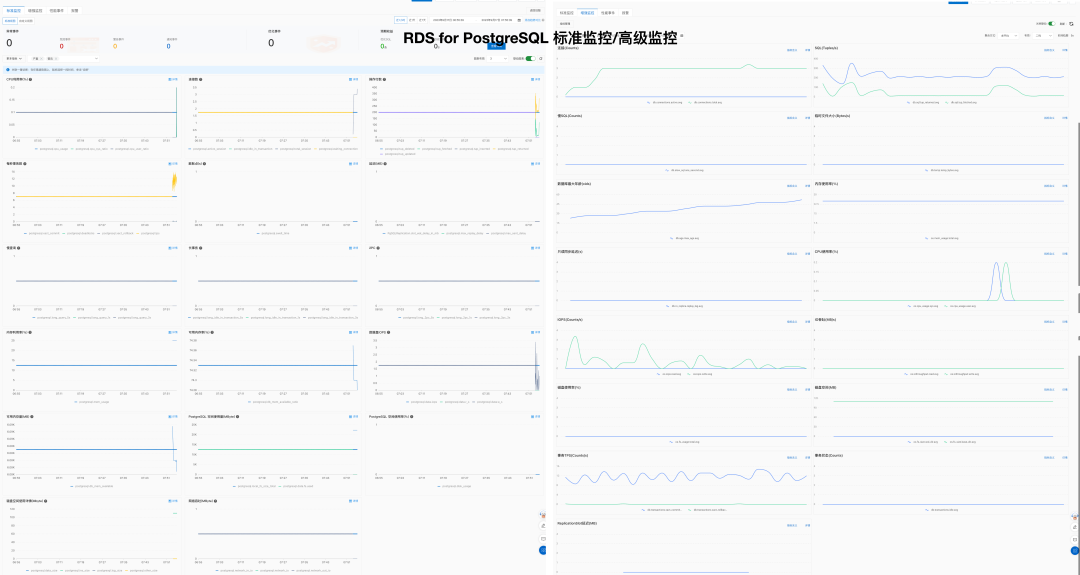
Additionally, some projects provide PostgreSQL monitoring capabilities, but are relatively simple:
- pgwatch: 123 metric types
- pgmonitor: 156 metric types
- datadog: 69 metric types
- pgDash
- ClusterControl
- pganalyze
- Aliyun RDS: 8 metric types
- AWS RDS: 99 metric types
- Azure RDS
Maintainability
| Metric | Pigsty | Aliyun RDS | AWS RDS |
|---|---|---|---|
| System Usability | Simple | Simple | Simple |
| Configuration Management | Config files / CMDB based on Ansible Inventory | Can use Terraform | Can use Terraform |
| Change Method | Idempotent Playbooks based on Ansible Playbook | Console click operations | Console click operations |
| Parameter Tuning | Auto-adapts to node specs, Four preset templates: OLTP, OLAP, TINY, CRIT | ||
| Infra as Code | Natively supported | Can use Terraform | Can use Terraform |
| Customizable Parameters | Pigsty Parameters 283 parameters | ||
| Service & Support | Commercial subscription support available | After-sales ticket support | After-sales ticket support |
| Air-gapped Deployment | Offline installation supported | N/A | N/A |
| Database Migration | Playbooks for zero-downtime migration from existing v10+ PG instances to Pigsty managed instances via logical replication | Cloud migration assistance Aliyun RDS Data Sync |
Cost
Based on experience, RDS unit cost is 5-15 times that of self-hosted for software and hardware resources, with a rent-to-own ratio typically around one month. For details, see Cost Analysis.
| Factor | Metric | Pigsty | Aliyun RDS | AWS RDS |
|---|---|---|---|---|
| Cost | Software License/Service Fee | Free, hardware ~¥20-40/core·month | ¥200-400/core·month | ¥400-1300/core·month |
| Support Service Fee | Service ~¥100/core·month | Included in RDS cost |
Other On-Premises Database Management Software
Some software and vendors providing PostgreSQL management capabilities:
- Aiven: Closed-source commercial cloud-hosted solution
- Percona: Commercial consulting, simple PG distribution
- ClusterControl: Commercial database management software
Other Kubernetes Operators
Pigsty refuses to use Kubernetes for managing databases in production, so there are ecological differences with these solutions.
- PGO
- StackGres
- CloudNativePG
- TemboOperator
- PostgresOperator
- PerconaOperator
- Kubegres
- KubeDB
- KubeBlocks
For more information, see:
13.1 - Cost Reference
Overview
| EC2 | Core·Month | RDS | Core·Month |
|---|---|---|---|
| DHH Self-Hosted Core-Month Price (192C 384G) | 25.32 | Junior Open Source DB DBA Reference Salary | ¥15K/person·month |
| IDC Self-Hosted (Dedicated Physical: 64C384G) | 19.53 | Mid-Level Open Source DB DBA Reference Salary | ¥30K/person·month |
| IDC Self-Hosted (Container, 500% Oversold) | 7 | Senior Open Source DB DBA Reference Salary | ¥60K/person·month |
| UCloud Elastic VM (8C16G, Oversold) | 25 | ORACLE Database License | 10000 |
| Aliyun ECS 2x Memory (Dedicated, No Oversold) | 107 | Aliyun RDS PG 2x Memory (Dedicated) | 260 |
| Aliyun ECS 4x Memory (Dedicated, No Oversold) | 138 | Aliyun RDS PG 4x Memory (Dedicated) | 320 |
| Aliyun ECS 8x Memory (Dedicated, No Oversold) | 180 | Aliyun RDS PG 8x Memory (Dedicated) | 410 |
| AWS C5D.METAL 96C 200G (Monthly No Prepaid) | 100 | AWS RDS PostgreSQL db.T2 (2x) | 440 |
| AWS C5D.METAL 96C 200G (3-Year Prepaid) | 80 | AWS RDS PostgreSQL db.M5 (4x) | 611 |
| AWS C7A.METAL 192C 384G (3-Year Prepaid) | 104.8 | AWS RDS PostgreSQL db.R6G (8x) | 786 |
RDS Cost Reference
| Payment Model | Price | Annualized (¥10K) |
|---|---|---|
| IDC Self-Hosted (Single Physical Machine) | ¥75K / 5 years | 1.5 |
| IDC Self-Hosted (2-3 Machines for HA) | ¥150K / 5 years | 3.0 ~ 4.5 |
| Aliyun RDS On-Demand | ¥87.36/hour | 76.5 |
| Aliyun RDS Monthly (Baseline) | ¥42K / month | 50 |
| Aliyun RDS Annual (85% off) | ¥425,095 / year | 42.5 |
| Aliyun RDS 3-Year Prepaid (50% off) | ¥750,168 / 3 years | 25 |
| AWS On-Demand | $25,817 / month | 217 |
| AWS 1-Year No Prepaid | $22,827 / month | 191.7 |
| AWS 3-Year Full Prepaid | $120K + $17.5K/month | 175 |
| AWS China/Ningxia On-Demand | ¥197,489 / month | 237 |
| AWS China/Ningxia 1-Year No Prepaid | ¥143,176 / month | 171 |
| AWS China/Ningxia 3-Year Full Prepaid | ¥647K + ¥116K/month | 160.6 |
Here’s a comparison of self-hosted vs cloud database costs:
| Method | Annualized (¥10K) |
|---|---|
| IDC Hosted Server 64C / 384G / 3.2TB NVME SSD 660K IOPS (2-3 Machines) | 3.0 ~ 4.5 |
| Aliyun RDS PG HA Edition pg.x4m.8xlarge.2c, 64C / 256GB / 3.2TB ESSD PL3 | 25 ~ 50 |
| AWS RDS PG HA Edition db.m5.16xlarge, 64C / 256GB / 3.2TB io1 x 80k IOPS | 160 ~ 217 |
ECS Cost Reference
Pure Compute Price Comparison (Excluding NVMe SSD / ESSD PL3)
Using Aliyun as an example, the monthly pure compute price is 5-7x the self-hosted baseline, while 5-year prepaid is 2x self-hosted
| Payment Model | Unit Price (¥/Core·Month) | Relative to Standard | Self-Hosted Premium Multiple |
|---|---|---|---|
| On-Demand (1.5x) | ¥ 202 | 160 % | 9.2 ~ 11.2 |
| Monthly (Standard) | ¥ 126 | 100 % | 5.7 ~ 7.0 |
| 1-Year Prepaid (65% off) | ¥ 83.7 | 66 % | 3.8 ~ 4.7 |
| 2-Year Prepaid (55% off) | ¥ 70.6 | 56 % | 3.2 ~ 3.9 |
| 3-Year Prepaid (44% off) | ¥ 55.1 | 44 % | 2.5 ~ 3.1 |
| 4-Year Prepaid (35% off) | ¥ 45 | 35 % | 2.0 ~ 2.5 |
| 5-Year Prepaid (30% off) | ¥ 38.5 | 30 % | 1.8 ~ 2.1 |
| DHH @ 2023 | ¥ 22.0 | ||
| Tantan IDC Self-Hosted | ¥ 18.0 |
Equivalent Price Comparison Including NVMe SSD / ESSD PL3
Including common NVMe SSD specs, the monthly pure compute price is 11-14x the self-hosted baseline, while 5-year prepaid is about 9x.
| Payment Model | Unit Price (¥/Core·Month) | + 40GB ESSD PL3 | Self-Hosted Premium Multiple |
|---|---|---|---|
| On-Demand (1.5x) | ¥ 202 | ¥ 362 | 14.3 ~ 18.6 |
| Monthly (Standard) | ¥ 126 | ¥ 286 | 11.3 ~ 14.7 |
| 1-Year Prepaid (65% off) | ¥ 83.7 | ¥ 244 | 9.6 ~ 12.5 |
| 2-Year Prepaid (55% off) | ¥ 70.6 | ¥ 230 | 9.1 ~ 11.8 |
| 3-Year Prepaid (44% off) | ¥ 55.1 | ¥ 215 | 8.5 ~ 11.0 |
| 4-Year Prepaid (35% off) | ¥ 45 | ¥ 205 | 8.1 ~ 10.5 |
| 5-Year Prepaid (30% off) | ¥ 38.5 | ¥ 199 | 7.9 ~ 10.2 |
| DHH @ 2023 | ¥ 25.3 | ||
| Tantan IDC Self-Hosted | ¥ 19.5 |
DHH Case: 192 cores with 12.8TB Gen4 SSD (1c:66); Tantan Case: 64 cores with 3.2T Gen3 MLC SSD (1c:50).
Cloud prices calculated at 40GB ESSD PL3 per core (1 core:4x RAM:40x disk).
EBS Cost Reference
| Evaluation Factor | Local PCI-E NVME SSD | Aliyun ESSD PL3 | AWS io2 Block Express |
|---|---|---|---|
| Capacity | 32TB | 32 TB | 64 TB |
| IOPS | 4K Random Read: 600K ~ 1.1M, 4K Random Write: 200K ~ 350K | 4K Random Read: Max 1M | 16K Random IOPS: 256K |
| Latency | 4K Random Read: 75µs, 4K Random Write: 15µs | 4K Random Read: 200µs | Random IO: ~500µs (contextually inferred as 16K) |
| Reliability | UBER < 1e-18, equivalent to 18 nines, MTBF: 2M hours, 5DWPD for 3 years | Data Reliability 9 nines Storage and Data Reliability | Durability: 99.999%, 5 nines (0.001% annual failure rate) io2 Specification |
| Cost | ¥16/TB·month (5-year amortized / 3.2T MLC), 5-year warranty, ¥3000 retail | ¥3200/TB·month (original ¥6400, monthly ¥4000), 50% off with 3-year full prepaid | ¥1900/TB·month using max spec 65536GB 256K IOPS best discount |
| SLA | 5-year warranty, replacement on failure | Aliyun RDS SLA Availability 99.99%: 15% monthly fee, 99%: 30% monthly fee, 95%: 100% monthly fee | Amazon RDS SLA Availability 99.95%: 15% monthly fee, 99%: 25% monthly fee, 95%: 100% monthly fee |
S3 Cost Reference
| Date | $/GB·Month | ¥/TB·5Years | HDD ¥/TB | SSD ¥/TB |
|---|---|---|---|---|
| 2006.03 | 0.150 | 63000 | 2800 | |
| 2010.11 | 0.140 | 58800 | 1680 | |
| 2012.12 | 0.095 | 39900 | 420 | 15400 |
| 2014.04 | 0.030 | 12600 | 371 | 9051 |
| 2016.12 | 0.023 | 9660 | 245 | 3766 |
| 2023.12 | 0.023 | 9660 | 105 | 280 |
| Other References | High-Perf Storage | Top-Tier Discounted | vs Purchased NVMe SSD | Price Ref |
| S3 Express | 0.160 | 67200 | DHH 12T | 1400 |
| EBS io2 | 0.125 + IOPS | 114000 | Shannon 3.2T | 900 |
Cloud Exit Collection
There was a time when “moving to the cloud” was almost politically correct in tech circles, and an entire generation of app developers had their vision obscured by the cloud. Let’s use real data analysis and firsthand experience to explain the value and pitfalls of the public cloud rental model — for your reference in this era of cost reduction and efficiency improvement — please see “Cloud Computing Mudslide: Collection”
Cloud Infrastructure Basics
Exposing Object Storage: From Cost Reduction to Price Gouging
Garbage Tencent Cloud CDN: From Getting Started to Giving Up
Cloud Business Model
Cloud Exit Odyssey
Cloud Failure Post-Mortems
RDS Failures
Cloud Vendor Profiles