How PITR Works
PITR mechanism: base backup, WAL archive, recovery window, and transaction boundaries
When you accidentally delete data, tables, or even the entire database, PITR lets you return to any point in time and avoid data loss from software defects and human error.
— This “magic” once reserved for senior DBAs is now available out of the box to everyone.
Pigsty’s PostgreSQL clusters come with auto-configured Point-in-Time Recovery (PITR) capability, powered by the backup component pgBackRest and optional object storage repository MinIO.
High availability solutions can address hardware failures but are powerless against data deletion/overwriting/database drops caused by software defects and human errors. For such situations, Pigsty provides out-of-the-box Point-in-Time Recovery (PITR) capability, enabled by default without additional configuration.
Pigsty provides default configurations for base backups and WAL archiving. You can use local directories and disks, or dedicated MinIO clusters or S3 object storage services to store backups and achieve geo-redundant disaster recovery. When using local disks, the default capability to recover to any point within the past day is retained. When using MinIO or S3, the default capability to recover to any point within the past week is retained. As long as storage space permits, you can retain any arbitrarily long recoverable time window, as your budget allows.
| Standalone Configuration Strategy | Event | RTO | RPO |
|---|---|---|---|
| Nothing | Crash | Permanently lost | All lost |
| Base Backup | Crash | Depends on backup size and bandwidth (hours) | Lose data since last backup (hours to days) |
| Base Backup + WAL Archive | Crash | Depends on backup size and bandwidth (hours) | Lose unarchived data (tens of MB) |
If only PITR is used for failure recovery, RTO and RPO metrics are inferior compared to high availability solutions, and typically both should be used together.
Besides PITR, you can also use delayed clusters in Pigsty to address data deletion/modification caused by human errors or software defects.
Point-in-time recovery allows you to restore and roll back your cluster to “any point” in the past, avoiding data loss caused by software defects and human errors. To achieve this, two preparations are needed: Base Backup and WAL Archiving. Having a base backup allows users to restore the database to its state at backup time, while having WAL archives starting from a base backup allows users to restore the database to any point after the base backup time.
For detailed mechanisms, see Base Backup and Point-in-Time Recovery; for specific operations, refer to PGSQL Admin: Backup and Recovery.
Pigsty uses pgBackRest to manage PostgreSQL backups. pgBackRest initializes empty repositories on all cluster instances but only actually uses the repository on the cluster primary.
pgBackRest supports three backup modes: full backup, incremental backup, and differential backup, with the first two being most commonly used. Full backup takes a complete physical snapshot of the database cluster at the current moment; incremental backup records the differences between the current database cluster and the previous full backup.
Pigsty provides a wrapper command for backups: /pg/bin/pg-backup [full|incr]. You can schedule regular base backups as needed through Crontab or any other task scheduling system.
Pigsty enables WAL archiving on the cluster primary by default and uses the pgbackrest command-line tool to continuously push WAL segment files to the backup repository.
pgBackRest automatically manages required WAL files and timely cleans up expired backups and their corresponding WAL archive files based on the backup retention policy.
If you don’t need PITR functionality, you can disable WAL archiving by configuring the cluster: archive_mode: off and remove node_crontab to stop scheduled backup tasks.
By default, Pigsty provides two preset backup strategies: The default uses local filesystem backup repository, performing one full backup daily to ensure users can roll back to any point within the past day. The alternative strategy uses dedicated MinIO clusters or S3 storage for backups, with weekly full backups, daily incremental backups, and two weeks of backup and WAL archive retention by default.
Pigsty uses pgBackRest to manage backups, receive WAL archives, and perform PITR. Backup repositories can be flexibly configured (pgbackrest_repo): defaults to primary’s local filesystem (local), but can also use other disk paths, or the included optional MinIO service (minio) and cloud S3 services.
pgbackrest_enabled: true          # enable pgBackRest on pgsql host?
pgbackrest_clean: true            # remove pg backup data during init?
pgbackrest_log_dir: /pg/log/pgbackrest # pgbackrest log dir, `/pg/log/pgbackrest` by default
pgbackrest_method: local          # pgbackrest repo method: local, minio, [user-defined...]
pgbackrest_repo:                  # pgbackrest repo: https://pgbackrest.org/configuration.html#section-repository
  local:                          # default pgbackrest repo with local posix fs
    path: /pg/backup              # local backup directory, `/pg/backup` by default
    retention_full_type: count    # retention full backup by count
    retention_full: 2             # keep at most 3 full backup, at least 2, when using local fs repo
  minio:                          # optional minio repo for pgbackrest
    type: s3                      # minio is s3-compatible, so use s3
    s3_endpoint: sss.pigsty       # minio endpoint domain name, `sss.pigsty` by default
    s3_region: us-east-1          # minio region, us-east-1 by default, not used for minio
    s3_bucket: pgsql              # minio bucket name, `pgsql` by default
    s3_key: pgbackrest            # minio user access key for pgbackrest
    s3_key_secret: S3User.Backup  # minio user secret key for pgbackrest
    s3_uri_style: path            # use path style uri for minio rather than host style
    path: /pgbackrest             # minio backup path, `/pgbackrest` by default
    storage_port: 9000            # minio port, 9000 by default
    storage_ca_file: /etc/pki/ca.crt  # minio ca file path, `/etc/pki/ca.crt` by default
    bundle: y                     # bundle small files into a single file
    cipher_type: aes-256-cbc      # enable AES encryption for remote backup repo
    cipher_pass: pgBackRest       # AES encryption password, default is 'pgBackRest'
    retention_full_type: time     # retention full backup by time on minio repo
    retention_full: 14            # keep full backup for last 14 days
  # You can also add other optional backup repos, such as S3, for geo-redundant disaster recovery
Pigsty parameter pgbackrest_repo target repositories are converted to repository definitions in the /etc/pgbackrest/pgbackrest.conf configuration file.
For example, if you define a US West S3 repository for storing cold backups, you can use the following reference configuration.
s3:    # ------> /etc/pgbackrest/pgbackrest.conf
  repo1-type: s3                                   # ----> repo1-type=s3
  repo1-s3-region: us-west-1                       # ----> repo1-s3-region=us-west-1
  repo1-s3-endpoint: s3-us-west-1.amazonaws.com    # ----> repo1-s3-endpoint=s3-us-west-1.amazonaws.com
  repo1-s3-key: '<your_access_key>'                # ----> repo1-s3-key=<your_access_key>
  repo1-s3-key-secret: '<your_secret_key>'         # ----> repo1-s3-key-secret=<your_secret_key>
  repo1-s3-bucket: pgsql                           # ----> repo1-s3-bucket=pgsql
  repo1-s3-uri-style: host                         # ----> repo1-s3-uri-style=host
  repo1-path: /pgbackrest                          # ----> repo1-path=/pgbackrest
  repo1-bundle: y                                  # ----> repo1-bundle=y
  repo1-cipher-type: aes-256-cbc                   # ----> repo1-cipher-type=aes-256-cbc
  repo1-cipher-pass: pgBackRest                    # ----> repo1-cipher-pass=pgBackRest
  repo1-retention-full-type: time                  # ----> repo1-retention-full-type=time
  repo1-retention-full: 90                         # ----> repo1-retention-full=90
You can directly use the following wrapper commands for PostgreSQL database cluster point-in-time recovery.
Pigsty uses incremental differential parallel recovery by default, allowing you to recover to a specified point in time at maximum speed.
pg-pitr                                 # Restore to the end of WAL archive stream (e.g., for entire datacenter failure)
pg-pitr -i                              # Restore to the most recent backup completion time (rarely used)
pg-pitr --time="2022-12-30 14:44:44+08" # Restore to a specified point in time (for database or table drops)
pg-pitr --name="my-restore-point"       # Restore to a named restore point created with pg_create_restore_point
pg-pitr --lsn="0/7C82CB8" -X            # Restore to immediately before the LSN
pg-pitr --xid="1234567" -X -P           # Restore to immediately before the specified transaction ID, then promote cluster to primary
pg-pitr --backup=latest                 # Restore to the latest backup set
pg-pitr --backup=20221108-105325        # Restore to a specific backup set, backup sets can be listed with pgbackrest info

pg-pitr                                 # pgbackrest --stanza=pg-meta restore
pg-pitr -i                              # pgbackrest --stanza=pg-meta --type=immediate restore
pg-pitr -t "2022-12-30 14:44:44+08"     # pgbackrest --stanza=pg-meta --type=time --target="2022-12-30 14:44:44+08" restore
pg-pitr -n "my-restore-point"           # pgbackrest --stanza=pg-meta --type=name --target=my-restore-point restore
pg-pitr -b 20221108-105325F             # pgbackrest --stanza=pg-meta --type=name --set=20221230-120101F restore
pg-pitr -l "0/7C82CB8" -X               # pgbackrest --stanza=pg-meta --type=lsn --target="0/7C82CB8" --target-exclusive restore
pg-pitr -x 1234567 -X -P                # pgbackrest --stanza=pg-meta --type=xid --target="0/7C82CB8" --target-exclusive --target-action=promote restore
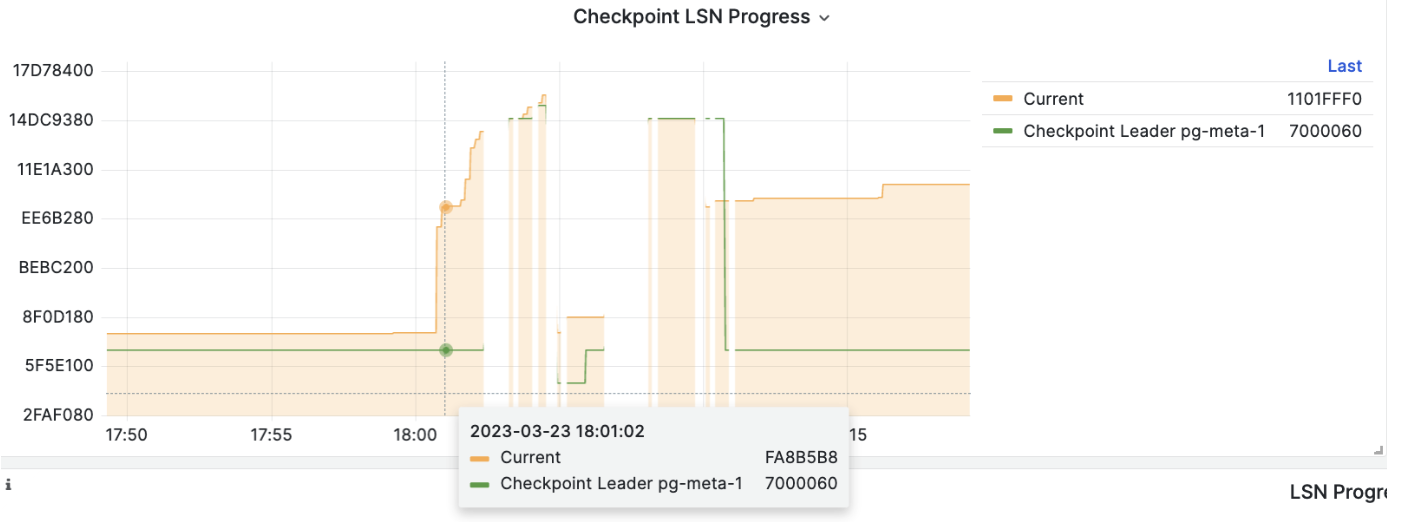
When performing PITR, you can use Pigsty’s monitoring system to observe the cluster LSN position status and determine whether recovery to the specified point in time, transaction point, LSN position, or other point was successful.
PITR mechanism: base backup, WAL archive, recovery window, and transaction boundaries
Pigsty PITR architecture: pgBackRest, repositories, and execution flow
PITR strategy tradeoffs: repository choice, space planning, and recommendations
Typical PITR scenarios: data deletion, DDL drops, batch errors, branch restore, and site disasters
Was this page helpful?
Thanks for the feedback! Please let us know how we can improve.
Sorry to hear that. Please let us know how we can improve.